
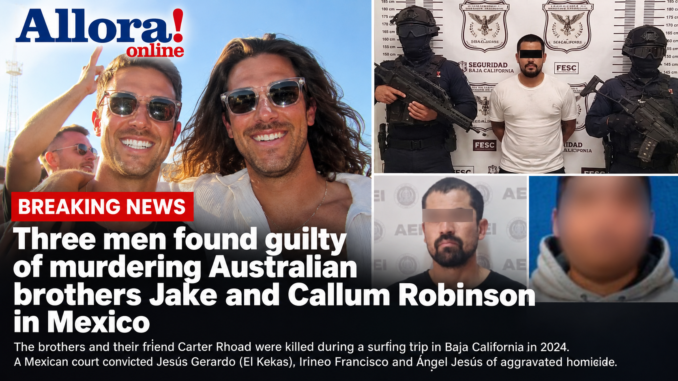
A Mexican court has found three men guilty of the murders of Australian brothers Jake and Callum Robinson and their American friend Carter Rhoad during a surfing holiday in Baja California in 2024. The verdict follows weeks of testimony and an emotional appeal from the brothers’ parents, who travelled from Western Australia to attend the trial. The family is now awaiting sentencing.
By the Allora! Online Editorial Team
Three men have been found guilty of murdering Australian brothers Jake and Callum Robinson and their American friend Carter Rhoad during a surfing and camping trip in Mexico, bringing a significant development in a case that shocked Australia and attracted international attention.
A Mexican judge convicted Jesús Gerardo, known as “El Kekas”, Irineo Francisco and Ángel Jesús of aggravated homicide and several related offences.
The defendants’ full names have been withheld for legal reasons.
The verdict was delivered in a court in Ensenada, Baja California, where the three men had been standing trial over the killings in April 2024.
Prosecutors argued that the victims were murdered during a robbery that turned violent. Defence lawyers had challenged the prosecution’s evidence, maintaining that it was insufficient to establish guilt.
The court ultimately ruled against the defendants.
A surfing holiday that ended in tragedy
Jake Robinson, 31, a doctor from Perth, and his older brother Callum, 32, had travelled to Mexico with their American friend Carter Rhoad to enjoy the Pacific coast’s renowned surfing destinations.
The three men disappeared while camping near Punta San José, approximately 80 kilometres south of Ensenada.
Their bodies were subsequently discovered in a remote well, triggering an extensive criminal investigation involving Mexican authorities.
The killings prompted an outpouring of grief in Australia and renewed concerns about the safety of international travellers visiting parts of Mexico.
Parents travelled from Australia for justice
The brothers’ parents, Debra and Martin Robinson, travelled from Western Australia to attend the trial and were present when the verdict was delivered.
Their appearance in court followed more than two years of grief and a determined effort to understand what happened to their sons.
During a victim impact statement, Debra Robinson urged the judge to impose the maximum available prison sentences.
“No sentence can bring Callum and Jake back; nothing can undo what has happened, but accountability matters,” she told the court.
The family’s determination to attend the proceedings reflected their desire to hear the evidence firsthand and ensure that their sons’ lives were remembered beyond the circumstances of their deaths.
In earlier statements, the Robinsons had emphasised that their pursuit of justice was not motivated by revenge, but by love, truth and accountability.
Prosecutors presented evidence of a violent robbery
During the trial, prosecutors outlined their case that the three travellers had been confronted while camping on the Baja California coast.
The prosecution argued that the defendants attempted to rob the men and that the confrontation ended in their deaths.
The court heard evidence from investigators and witnesses as prosecutors sought to establish the defendants’ involvement.
The defence questioned aspects of the investigation and challenged the reliability and sufficiency of the evidence.
After considering the case, the judge found all three defendants guilty of aggravated homicide and associated offences.
Sentencing is the next stage
The verdict represents a major step in the judicial process, but the final prison sentences have not yet been announced in the initial reports.
The Robinson family has requested the maximum penalties available under Mexican law.
Further court proceedings will determine the punishment imposed on each convicted man.
For the families of Jake and Callum Robinson and Carter Rhoad, the convictions provide a measure of legal accountability after more than two years of uncertainty and loss.
The guilty verdict cannot reverse the tragedy, but it marks an important moment in the families’ long pursuit of justice.
The case has left a lasting impact on the Australian community, particularly among those who knew the brothers through sport, surfing and their professional lives.
As the sentencing phase approaches, attention will remain focused on the Mexican court and the final outcome of a case that has resonated far beyond the country’s borders.
This is a developing story. Further details, including sentencing information, will be reported as they become available.