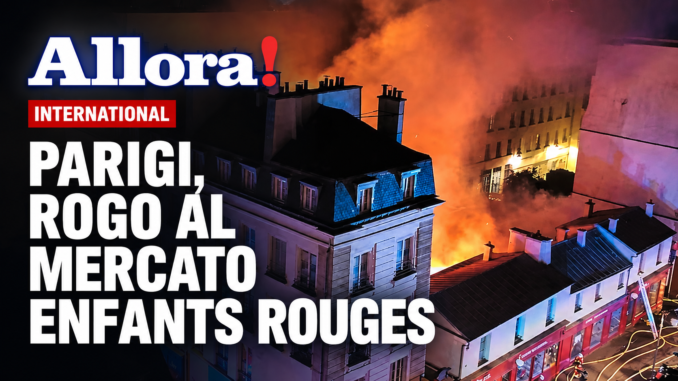
A violent overnight fire has destroyed the Marché des Enfants Rouges, Paris’s oldest covered food market and one of the French capital’s most celebrated culinary landmarks. Dating back to 1615, the historic market in the Marais district was engulfed in flames, causing part of its metal structure to collapse. Firefighters prevented the blaze from spreading to surrounding buildings, while city authorities have pledged to help affected traders resume their businesses.
By the Allora! Online Editorial Team
One of Paris’s most treasured culinary landmarks has been devastated by a major fire, leaving behind the remains of a historic market that had served generations of Parisians for more than four centuries.
The Marché des Enfants Rouges, located in the heart of the fashionable Marais district, was destroyed after flames swept through the covered market in the early hours of Monday morning.
The fire broke out shortly after 3am, rapidly spreading through the approximately 1,000-square-metre site.
Firefighters battled the intense blaze, deploying extensive equipment to prevent the flames from reaching nearby residential and commercial buildings.
Ariel Weil, mayor of central Paris, confirmed the destruction and described the incident as a violent fire.
Although the market suffered catastrophic damage, emergency crews successfully prevented the flames from spreading to neighbouring properties.
A 400-year-old landmark reduced to ruins
The destruction represents a significant cultural and architectural loss for the French capital.
Established in 1615 during the reign of King Louis XIII, the Marché des Enfants Rouges was widely recognised as Paris’s oldest surviving covered food market.
Its unusual name, meaning Market of the Red Children, originated from a nearby orphanage whose children traditionally wore red uniforms.
Over the centuries, the market became an important meeting place for local residents, merchants and visitors.
Originally associated with the sale of fresh agricultural produce, it gradually evolved into a celebrated destination for traditional French food and international cuisine.
The building was officially listed as a historic monument in 1982, recognising its architectural and cultural importance.
Firefighters battle flames and collapsing structures
Lieutenant Colonel Pierre de Bouvier of the Paris Fire Brigade confirmed that the market’s covered structure had been destroyed, with parts of its metal framework collapsing during the blaze.
More than 150 firefighters were involved in the emergency response, supported by approximately 50 fire vehicles.
Nine firefighting hoses, including two high-powered lines, were deployed to contain the flames.
The intensity of the fire made it particularly difficult to protect the historic structure.
Despite the extensive destruction, firefighters managed to stop the blaze from spreading through the densely built surrounding neighbourhood.
Investigators have begun examining the circumstances of the fire.
The cause remains unknown, and authorities have not announced any official findings.
One of the world’s most celebrated street-food destinations
Beyond its architectural significance, the Marché des Enfants Rouges had become one of Paris’s most popular gastronomic attractions.
Its narrow aisles and bustling food stalls offered visitors an extraordinary variety of flavours, bringing together traditional French cooking and international culinary traditions.
Shoppers could find fresh vegetables, cheese, meat and seafood alongside freshly prepared Moroccan, Lebanese, Japanese and other dishes.
The market attracted residents, tourists and food enthusiasts seeking an authentic alternative to conventional restaurants.
Its reputation extended far beyond France.
Food & Wine magazine ranked the market fifth among the world’s leading street-food destinations in 2026, placing it alongside celebrated culinary locations in London, Bangkok, Lyon and Mexico City.
The recognition reflected the market’s ability to combine centuries of history with a vibrant contemporary food culture.
Traders face an uncertain future
The fire has also created an immediate economic challenge for the businesses operating within the market.
Many traders depended on the historic venue for their livelihoods, serving both local customers and international visitors.
The destruction of stalls, equipment and commercial facilities means that some businesses may be unable to reopen without significant assistance.
Paris authorities have promised to work with affected merchants and identify temporary locations where they can continue trading.
The objective is to preserve the market’s economic and community role while decisions are made about the future of the damaged site.
No definitive reconstruction timetable has been announced.
A market that survived previous threats
The Marché des Enfants Rouges had already faced the possibility of disappearing decades earlier.
During the 1980s, redevelopment proposals threatened to replace the ageing structure with other urban facilities.
Local residents, cultural figures and neighbourhood organisations campaigned to preserve the historic building.
Their efforts succeeded, and the market underwent extensive restoration before reopening in 2000 as a revitalised culinary destination.
That transformation helped establish the market as one of the defining attractions of the Marais.
Its destruction by fire now presents Paris with another difficult question: how to restore a historic meeting place while supporting the businesses and community that gave it life.
Paris mourns a piece of its culinary history
For generations, the Marché des Enfants Rouges represented more than a place to buy food.
It was a living connection between the history of Paris and the daily routines of its residents.
The market’s appeal came from its distinctive combination of architecture, neighbourhood culture and gastronomy.
Its destruction is therefore not merely the loss of a commercial building, but the disappearance of a landmark that helped preserve the identity of one of the city’s most historic districts.
More than four centuries of culinary tradition have been interrupted in a single night.
As firefighters complete their safety operations and investigators search for the cause, attention is turning to the future of the market and the businesses that depended upon it.
For Paris, the challenge will be to rebuild not simply a structure, but a place whose history, flavours and everyday human connections made it an irreplaceable part of the city.