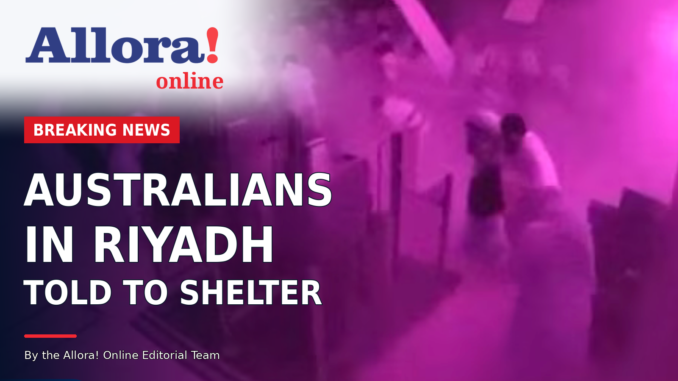
The Australian Embassy in Riyadh has issued an urgent shelter-in-place warning as Saudi Arabia and Yemen’s Houthi rebels exchange deadly missile and drone attacks. Fourteen people have been killed and more than 320 injured in strikes on King Khalid International Airport. The airport remains closed, international flights have been disrupted, and Saudi authorities are investigating why their air defence systems failed to prevent the attacks.
By the Allora! Online Editorial Team
Australians living or travelling in Saudi Arabia’s capital have been urged to remain indoors as escalating hostilities between Saudi forces and Yemen’s Houthi rebels raise serious concerns about civilian safety.
The Australian Embassy in Riyadh has issued renewed shelter-in-place advice, warning citizens to avoid unnecessary movement and follow instructions from local authorities.
The warning follows a series of devastating attacks on King Khalid International Airport, one of Saudi Arabia’s busiest aviation hubs.
According to the latest reports, the strikes have killed 14 people and injured more than 320 others, prompting a major security response and widespread disruption to international air travel.
The Houthi movement, which is aligned with Iran, has claimed responsibility for the attacks and warned airlines, airport employees and travellers to stay away from Saudi aviation facilities.
Riyadh Airport Closed After Deadly Attacks
King Khalid International Airport has remained closed following consecutive missile and drone strikes that caused extensive damage and casualties.
A particularly deadly attack killed 13 people and wounded more than 300, while a subsequent strike claimed another life.
Saudi Arabia’s General Authority of Civil Aviation suspended airport operations while emergency crews and security personnel assessed the damage and continuing risks.
Aviation notices subsequently extended the closure until October 17, although the precise timing of a safe reopening remains subject to further decisions.
Major international airlines have cancelled or suspended flights, including services operated by European and Middle Eastern carriers.
The United States Federal Aviation Administration has also warned airlines to exercise caution when operating within or above Saudi airspace.
European aviation safety authorities have issued additional warnings because of the growing risk posed by missiles and drones.
Australian Embassy Issues Urgent Safety Advice
The Australian Embassy has instructed citizens in Riyadh to remain indoors, follow local safety guidance and avoid unnecessary travel.
Australia’s official Smartraveller service continues to advise citizens to reconsider their need to travel to Saudi Arabiabecause of the deteriorating regional security situation.
A more severe warning applies specifically to King Khalid International Airport, where Australians are advised not to travel.
Those with existing flight bookings are being urged to contact their airlines directly and avoid travelling to airports without confirmed arrangements.
The warning also reflects the possibility of further missile attacks, falling debris from intercepted projectiles and sudden restrictions on movement.
The heightened security situation has affected daily life across the Saudi capital.
Businesses in Riyadh’s financial district have instructed employees to work remotely, while authorities have asked schools to switch to online learning.
Saudi Arabia Investigates Air Defence Failure
Saudi authorities have launched an investigation into why sophisticated air defence systems failed to stop the attacks on Riyadh’s airport.
According to preliminary accounts provided to the Associated Press by regional officials, the Houthi operation involved multiple drones followed by cruise and ballistic missiles.
The initial findings suggest the drones may have complicated the Saudi military’s response, allowing some missiles to reach their targets.
Investigators are examining why advance warnings were apparently insufficient, despite the weapons travelling more than 1,000 kilometres from Yemen.
Saudi Arabia operates advanced air defence systems, including American-made Patriot missile batteries.
However, the attacks have raised questions about the ability of such systems to respond to coordinated waves of missiles and drones.
The investigation remains ongoing, and the preliminary findings have not been presented as final official conclusions.
Saudi Air Strikes Hit Yemen
The conflict has also intensified inside Yemen.
Saudi-led forces have continued military operations against Houthi positions as the two sides exchange attacks.
Houthi-controlled health authorities reported that air strikes in the capital, Sanaa, killed one person and injured 12 others.
Among the locations reportedly hit were a salt-processing facility and a residential property.
The Houthi administration accused Saudi Arabia of carrying out the strikes. The casualty figures and responsibility for individual strikes have not been independently verified.
The renewed fighting follows an escalation in Yemen, where forces aligned with the internationally recognised government have been battling Houthi fighters for control of strategically important territory.
The conflict has raised concerns about the safety of international shipping routes, particularly around the Red Sea and the Bab el-Mandeb Strait.
Iran Offers to Mediate
Iran has expressed concern over the growing confrontation and offered to help facilitate diplomatic discussions between Saudi Arabia and the Houthis.
Iranian Foreign Ministry spokesperson Esmail Baghaei said Tehran remained willing to support efforts aimed at reducing tensions.
He also confirmed that Iranian Foreign Minister Abbas Araghchi had discussed the situation with his Saudi counterpart during a telephone conversation.
Although Iran maintains close political links with the Houthi movement, it has presented its latest diplomatic offer as an attempt to prevent further conflict between neighbouring Muslim countries.
There is currently no confirmed agreement on a ceasefire.
Growing Concerns for Regional Security
The attacks have exposed the vulnerability of civilian infrastructure in a region already affected by wider military tensions.
Beyond the human toll, disruptions to aviation threaten tourism, international business operations and investment.
Riyadh is preparing to host several major international economic and energy events, but the deteriorating security environment has raised concerns about travel arrangements and attendance.
The continued fighting could also increase pressure on regional transport networks and commercial supply chains.
For Australians in Saudi Arabia, the immediate priority remains personal safety.
What Australians in Saudi Arabia Should Do
Australians are advised to monitor official updates, follow local emergency instructions, remain indoors when warnings are issued and avoid military installations, energy infrastructure and affected airports.
Those requiring consular assistance can contact the Australian Embassy in Riyadh on +966 11 250 0900.
For urgent assistance outside normal business hours, Australia’s 24-hour Consular Emergency Centre is available on +61 2 6261 3305 from overseas.
The latest travel advice is available through the Australian Government’s Smartraveller website.
As missile and drone attacks continue, the situation remains volatile, with authorities warning that further disruption to civilian life and international travel is possible.
For Australian citizens in Riyadh, the embassy’s message remains clear: prioritise safety, follow official instructions and avoid unnecessary travel while the security threat continues.