Four nations join forces under the Badr Memorandum of Understanding to strengthen military production, technology sharing and defence capabilities. The agreement signals growing strategic cooperation across the Middle East and Asia as the war involving Iran continues to reshape regional security.
Türkiye, Qatar, Pakistan and Indonesia have signed a major multilateral defence cooperation agreement aimed at strengthening their military industries, expanding technological collaboration and developing new strategic partnerships.
The agreement, known as the Badr Memorandum of Understanding, was signed in Doha and brings together four countries seeking closer coordination in defence manufacturing, military training, research and development.
According to the Turkish Ministry of National Defence, the initiative is designed to combine the industrial and technological capabilities of the participating nations, enabling them to develop more advanced defence systems while reducing dependence on external suppliers.
The agreement comes amid continuing instability across the Middle East, where the conflict involving Iran, threats to critical energy infrastructure and uncertainty over regional security arrangements have encouraged governments to reassess their military partnerships.
For Türkiye, which operates NATO’s second-largest army and has developed a substantial domestic defence industry, the agreement represents another step towards expanding its strategic influence beyond Europe and the Middle East.
For Qatar, Pakistan and Indonesia, the partnership offers opportunities to strengthen national defence capabilities while participating more directly in the development and production of military technology.
What is the Badr defence agreement?
The Badr Memorandum of Understanding establishes a framework for cooperation between the defence institutions and industries of Türkiye, Qatar, Pakistan and Indonesia.
Unlike a conventional military alliance, the agreement primarily concentrates on defence industrial development and technological cooperation.
Its principal objectives include expanding joint military production, improving research capabilities, strengthening technical training and encouraging the transfer of defence technologies.
The Turkish Defence Ministry emphasised the economic importance of the agreement, highlighting the potential benefits of combining the different industrial capabilities of the four participating countries.
The initiative is intended to create opportunities for joint manufacturing, improve the efficiency of defence production and support the development of systems capable of meeting the military requirements of participating and friendly nations.
The memorandum also provides a foundation for closer coordination between government agencies, military institutions, defence companies and research organisations.
While the agreement establishes broad areas for cooperation, specific industrial programmes, financial commitments and implementation schedules have not yet been publicly detailed.
Its practical significance will therefore depend on the joint projects that emerge from the new framework.
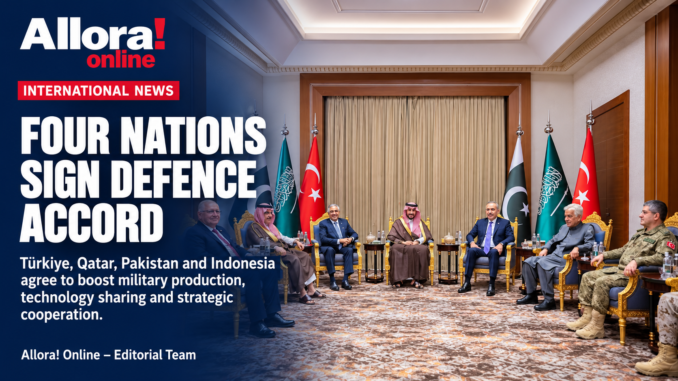
Defence ministers gather for the signing ceremony
The agreement was signed during a ceremony attended by senior defence officials representing the four governments.
Türkiye was represented by Defence Minister Yaşar Güler, while Qatar’s delegation included Sheikh Saoud bin Abdulrahman bin Hassan Al-Thani, Deputy Prime Minister and Minister of State for Defence Affairs.
Pakistan was represented by Defence Minister Khawaja Muhammad Asif, alongside Federal Minister for Defence Production Muhammad Raza Hayat Harraj.
Indonesia’s delegation included Deputy Defence Minister Yusuf Jauhari, responsible for logistics, defence industries and technology affairs.
Also present was Haluk Görgün, chairman of Türkiye’s Presidency of Defence Industries, the government agency responsible for coordinating the country’s defence industrial development.
The participation of senior military and industrial officials underlined the intention to establish cooperation extending beyond diplomatic declarations.
The four governments are seeking a framework through which defence technology, industrial capacity and technical expertise can be developed collectively.
Türkiye expands its role as a defence industry partner
The agreement reflects Türkiye’s growing importance in the international defence market.
Over recent decades, Ankara has invested heavily in developing a domestic military manufacturing sector capable of producing increasingly sophisticated equipment.
Turkish companies manufacture military drones, armoured vehicles, naval vessels, missile systems, electronic warfare equipment and other defence technologies.
The development of these capabilities has allowed Türkiye to reduce some of its dependence on imported equipment while expanding exports to countries across Europe, the Middle East, Africa and Asia.
Its defence industry has also become an important instrument of international cooperation.
Rather than focusing exclusively on the sale of finished weapons, Turkish manufacturers have increasingly pursued agreements involving joint production, technology transfers and the development of local manufacturing facilities.
This approach can make defence partnerships more attractive to countries seeking to build their own technological and industrial capabilities.
Speaking about the Badr agreement, Haluk Görgün stressed the importance of partnerships that go beyond simply purchasing existing equipment.
He identified technology sharing, collaborative development and stronger domestic manufacturing as central elements of a sustainable defence industry.
According to Görgün, the memorandum provides an opportunity to transform the complementary capabilities of the four countries into practical industrial projects.
Qatar strengthens its military and industrial partnerships
For Qatar, the agreement represents a further expansion of its defence relationship with Türkiye and other regional partners.
The Gulf state already maintains close military ties with Ankara, which operates a military base on Qatari territory.
The relationship has developed through military training, defence cooperation and broader strategic engagement.
Qatar has also invested in strengthening its defence capabilities through the acquisition of advanced military systems and cooperation with international suppliers.
The Badr agreement could provide an additional mechanism for building technical expertise and participating in joint industrial initiatives.
Qatar’s financial resources and defence procurement requirements could complement the manufacturing and technological capabilities of its partners.
Such cooperation may also allow Doha to diversify its defence relationships at a time when security concerns have become increasingly prominent across the Gulf.
The agreement does not, however, establish a new automatic collective defence commitment between the four countries.
Its immediate focus remains industrial and technological cooperation.
Pakistan brings military experience and industrial capacity
Pakistan’s participation adds another important dimension to the agreement.
The country maintains one of the largest armed forces in the region and possesses an established defence manufacturing sector.
Its military industries produce equipment including armoured vehicles, aircraft, ammunition and other defence systems.
Pakistan also has substantial experience in military training and cooperation with foreign armed forces.
Islamabad has maintained close defence relationships with Türkiye and Saudi Arabia for many years, covering military exercises, training and industrial collaboration.
The Badr initiative could allow Pakistan to expand these relationships through joint development programmes and closer integration with the defence industries of Qatar and Indonesia.
For Pakistan, strengthening domestic manufacturing capabilities remains particularly important as the country seeks to modernise its military equipment while managing financial pressures and technological requirements.
The new agreement may provide opportunities for joint investment, engineering cooperation and access to additional markets.
However, any economic benefits will depend on the commercial viability and implementation of future projects.
Indonesia connects Southeast Asia to the new partnership
Indonesia’s participation gives the initiative a geographical reach extending from the Gulf and South Asia into Southeast Asia.
As one of the world’s largest countries by population, Indonesia is undertaking a long-term programme to modernise its armed forces and strengthen its domestic defence industry.
Jakarta has already developed significant defence ties with Ankara.
One of the most important recent agreements was Indonesia’s decision to purchase 48 Turkish-designed KAAN fighter aircraft, marking a major development in bilateral military cooperation.
The agreement, announced in 2025, also reflected Indonesia’s interest in technology development and cooperation with Turkish aerospace companies.
The KAAN programme represents Türkiye’s ambition to develop an advanced domestically designed combat aircraft.
For Indonesia, participation in such projects offers potential opportunities to acquire modern equipment while building experience in aviation technology, manufacturing and maintenance.
The Badr agreement could provide a wider framework for similar cooperation across additional defence sectors.
Indonesia’s involvement also demonstrates that the partnership is not confined to the Middle East.
It brings together countries with different geographical interests but shared ambitions to strengthen military industries and technological capabilities.
A separate defence alliance with Saudi Arabia and Pakistan
The new agreement follows another significant development in Türkiye’s regional security policy.
In August, Türkiye, Pakistan and Saudi Arabia signed the Mecca Joint Defence Agreement, establishing a framework for mutual defence cooperation.
Under that separate arrangement, an armed attack against one participating country is to be regarded as an attack against all three.
The agreement reflects a collective security commitment comparable in principle to arrangements used by other military alliances.
Türkiye has subsequently moved towards parliamentary ratification of the pact, while officials have discussed possible defensive support for Saudi Arabia amid attacks on its territory.
The proposed cooperation includes air defence systems, electronic warfare capabilities, military expertise and technical assistance.
Turkish officials have emphasised that the arrangement is defensive and is not intended to support offensive operations against neighbouring countries.
It is important to distinguish the two agreements.
The Mecca pact involves Türkiye, Pakistan and Saudi Arabia and contains mutual defence commitments.
The Badr memorandum involves Türkiye, Qatar, Pakistan and Indonesia and focuses principally on defence manufacturing, research, training and industrial cooperation.
Although the two initiatives reflect a broader expansion of regional security partnerships, they have different participants, legal structures and objectives.
The Iran conflict accelerates regional security cooperation
The signing comes during a period of heightened military tensions across the Middle East.
The continuing conflict involving Iran has disrupted regional security arrangements, affected energy markets and increased concerns about the vulnerability of military and civilian infrastructure.
Attacks on Gulf facilities, threats to maritime shipping and uncertainty over the future of diplomatic negotiations have encouraged countries to review their defence capabilities.
Some regional governments are seeking to diversify military procurement and strengthen partnerships beyond their traditional suppliers.
Türkiye’s expanding defence industry offers one possible source of equipment and industrial cooperation.
At the same time, Qatar and other Gulf countries remain closely connected to Western security arrangements.
The emerging pattern does not necessarily indicate a rejection of existing alliances.
Instead, it suggests that governments are exploring additional partnerships to improve their strategic flexibility, strengthen domestic defence capabilities and reduce vulnerabilities in their supply chains.
Defence analysts have described this trend as the development of overlapping security and industrial relationships rather than the creation of one unified military bloc.
Technology transfer and economic opportunities
One of the most significant aspects of the Badr agreement is its potential industrial impact.
Modern defence manufacturing requires advanced engineering, specialised materials, electronics, software development and extensive research capabilities.
Developing these industries independently can be expensive and technically demanding.
International cooperation can allow participating countries to share research costs, coordinate manufacturing and gain access to expertise that may otherwise be difficult to develop domestically.
Joint projects could also support skilled employment and the growth of associated industries.
Aerospace technology, telecommunications, advanced manufacturing and electronics are among the sectors that can benefit from investment in defence-related research.
For countries seeking greater industrial independence, technology transfers can be particularly valuable.
However, successful cooperation requires agreement on intellectual property, manufacturing responsibilities, export restrictions, financing and control of sensitive technologies.
These issues will need to be resolved as the four countries move from the memorandum to specific projects.
Could other countries eventually join?
According to Qatar News Agency, the Badr framework may allow additional friendly countries to participate, subject to criteria agreed upon by the four founding members.
This provision creates the possibility of expanding the cooperation network beyond its original participants.
Whether other countries seek to join will depend on their defence requirements, diplomatic relationships and assessment of the potential industrial benefits.
No further participants have been formally announced.
The agreement’s future expansion will also depend on whether the initial projects demonstrate practical results.
For now, the priority is expected to be translating the broad principles of cooperation into industrial arrangements and programmes that deliver measurable benefits to the four participating countries.
A changing landscape for global defence cooperation
The Badr memorandum highlights a broader development in international security: an increasing emphasis on building domestic defence industries through multinational partnerships.
For decades, many countries depended heavily on purchasing advanced weapons from a limited number of established suppliers.
While those relationships remain important, governments are increasingly interested in gaining access to production technology, developing local expertise and strengthening their capacity to maintain military systems independently.
Türkiye, Qatar, Pakistan and Indonesia are pursuing these objectives from different economic, geographical and strategic positions.
Their agreement creates a framework through which those capabilities may be combined.
It also demonstrates how cooperation between the Middle East, South Asia and Southeast Asia is becoming an increasingly important feature of the international defence market.
The decisive test will come when the governments identify specific programmes, allocate financial resources and begin implementing joint industrial projects.
The Badr agreement does not create a new four-nation military alliance, but it establishes a potentially significant platform for defence technology, manufacturing and strategic industrial cooperation.
As regional conflicts continue to reshape security calculations, the agreement illustrates the growing importance of industrial capacity and technological independence in the defence policies of countries seeking greater control over their own security.
Allora! Online – Editorial Team