The protection of civilians and humanitarian personnel in conflict zones was placed firmly on the political agenda in Canberra during an event hosted at Australian Parliament House by the Embassy of Switzerland and the International Committee of the Red Cross. According to figures cited by the Swiss Embassy, more than 1,000 aid workers have been killed worldwide over the past three years while assisting communities affected by armed conflict.
Protecting humanitarian workers must move beyond declarations and become a practical political priority.
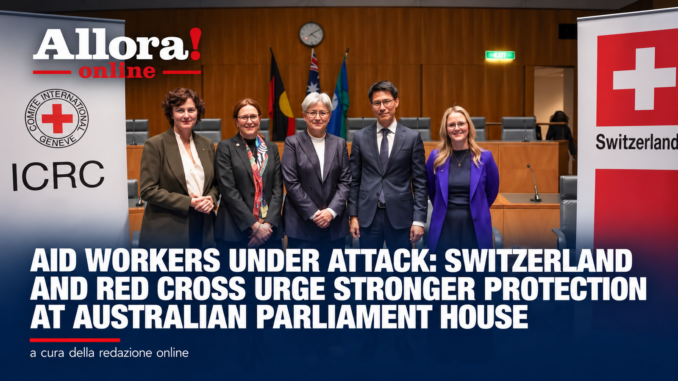
That was the central message of “Humanity in War: Civilians, Humanitarian Personnel and the Rules that Protect Them”, an event held at Parliament House in Canberra by the Embassy of Switzerland, the International Committee of the Red Cross (ICRC) and the Parliamentary Friends of the Australian Red Cross.
The gathering brought together diplomatic, political and humanitarian representatives to focus on the growing risks faced by civilians and those working to provide assistance in conflict zones.
More than 1,000 aid workers killed
In a statement published through its social media channels, the Swiss Embassy highlighted the scale of attacks against humanitarian personnel.
According to figures cited by the Embassy, more than 1,000 aid workers have been killed in armed conflicts around the world over the past three years.
Many were working directly with vulnerable communities in environments where access to food, healthcare, shelter and basic protection had already been severely disrupted.
The message from Canberra was that humanitarian workers cannot be treated as acceptable casualties of war.
Wong among the speakers
The event featured Australian Foreign Minister Penny Wong, alongside ICRC President Mirjana Spoljaric Egger, who delivered a video message.
Also participating were Switzerland’s Ambassador to Australia Nikolas Stürchler and Ann-Marie McCabe, the ICRC’s Head of Mission in Australia.
Their interventions focused on the obligation to protect humanitarian personnel and ensure that assistance can reach civilians during armed conflicts.
The initiative also highlighted cooperation between Australia and Switzerland in maintaining the issue on the international agenda.
International humanitarian law under pressure
The event referred to United Nations Security Council Resolution 2730, which addresses the protection of United Nations and humanitarian personnel in armed conflict.
Australia’s political declaration on the protection of humanitarian personnel was also highlighted as part of broader diplomatic efforts to strengthen accountability and respect for international humanitarian law.
The central problem, however, remains implementation.
Rules already exist to protect civilians, medical personnel and humanitarian workers. Their effectiveness depends on whether parties to conflicts respect them in practice.
A photographic record of humanitarian work
An accompanying exhibition provided a visual account of the ICRC’s work and the realities experienced by civilians and aid workers in conflict zones.
The photographs reinforced the broader message of the event: behind debates about international law and diplomatic commitments are people attempting to provide medical care, food, protection and assistance in some of the world’s most dangerous environments.
For many humanitarian workers, that role now carries an increasing personal risk.
From commitments to action
The Swiss Embassy’s appeal was direct: attacks on humanitarian personnel must stop, humanitarian access must be facilitated and aid workers must be allowed to reach those in need.
The Canberra event therefore placed emphasis not only on political commitments but on their implementation.
International humanitarian law provides a framework for protecting people during war, but its value ultimately depends on respect for those rules on the ground.
With more than 1,000 humanitarian workers reported killed over the past three years, the figures presented in Canberra underline the urgency of that challenge.
The message from Parliament House was clear: protecting those who deliver humanitarian assistance is not secondary to the conduct of war. It is part of the legal and moral responsibility of those involved in armed conflict.