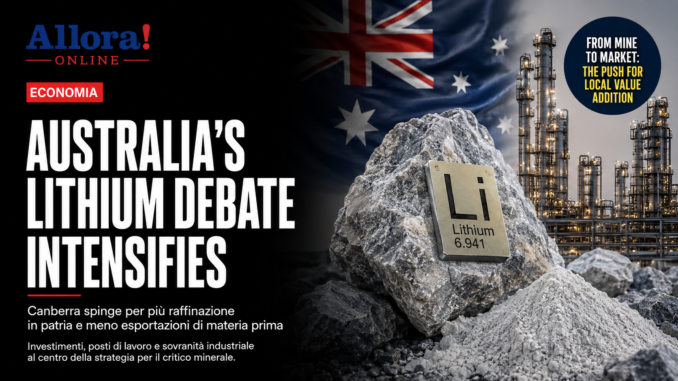
The federal government wants more of Australia’s lithium to be processed at home instead of being exported largely to China, but producers warn many local refining projects are not economically viable at current costs
Australia wants to capture more value from one of its most important critical minerals by moving further down the lithium supply chain.
Canberra is pushing for a greater share of lithium mined in Australia to be refined domestically, rather than exported overseas for processing, particularly to China.
The policy goal is clear: create more high-value jobs, strengthen sovereign industrial capability and reduce Australia’s dependence on foreign processing networks.
The challenge is equally clear. Producers say the economics of refining lithium in Australia remain difficult, with high construction, energy and labour costs making many projects uncompetitive.
Australia wants to move beyond mining
Australia is already one of the world’s major lithium producers.
But much of the value is created after the ore leaves the mine.
Refining, chemical conversion and battery-material production generate significantly more economic value than extraction alone.
By exporting raw or partially processed lithium, Australia captures only part of the commercial opportunity.
The government wants to change that model by encouraging more processing and manufacturing onshore.
China remains dominant
China plays a central role in the global lithium-processing and battery supply chain.
That makes it a major customer for Australian resources, but it also creates a strategic concentration risk.
As governments around the world compete to secure critical minerals, Australia is under growing pressure to develop alternative supply chains with partners such as the United States, Europe and other advanced economies.
More domestic refining would give Australia a stronger position in that emerging market.
Producers warn the numbers do not stack up
The mining industry is cautioning that strategic ambition alone will not make local refining profitable.
Lithium processing plants require enormous upfront investment, reliable energy, highly skilled workers and sophisticated infrastructure.
Australian projects also face higher labour and construction costs than many overseas competitors.
When lithium prices weaken, those disadvantages become even more significant.
The industry argues that if Canberra wants a sustainable local refining sector, it will need to create conditions that allow projects to survive through commodity-price downturns.
The question of government support
That raises the issue of subsidies and public investment.
Tax incentives, concessional finance, infrastructure support and long-term offtake agreements could help improve the economics of domestic refining.
But such measures also expose taxpayers to risk.
The government must avoid two extremes: allowing a strategically important industry to develop entirely offshore, or spending heavily to support projects that may never become commercially sustainable.
Energy costs will be crucial
Energy is one of the biggest factors determining whether Australian refining can compete internationally.
Lithium conversion is energy-intensive.
If Australian industrial power remains expensive, local processing will struggle against established Asian competitors.
But if Australia can combine abundant mineral resources with affordable and reliable energy, it could build a genuine competitive advantage.
From lithium ore to batteries
The longer-term ambition goes beyond refining.
Australia could eventually expand into cathode materials, battery components, cells and possibly finished battery manufacturing.
Each additional stage would create more skilled jobs and keep more value inside the national economy.
The difficulty is that Asian manufacturers already benefit from large-scale integrated supply chains, decades of expertise and strong cost advantages.
Australia would be entering that market from behind.
A strategic choice for Australia
The lithium debate is ultimately about what kind of economy Australia wants to build.
Continuing to export raw materials is familiar, profitable and relatively low risk.
Processing those materials at home is harder and more expensive, but it offers the possibility of creating advanced industries and reducing strategic dependence.
Lithium could become one of the defining resources of Australia’s next industrial era.
The question is whether Canberra can turn that resource advantage into a competitive domestic industry — not just a strategic aspiration.