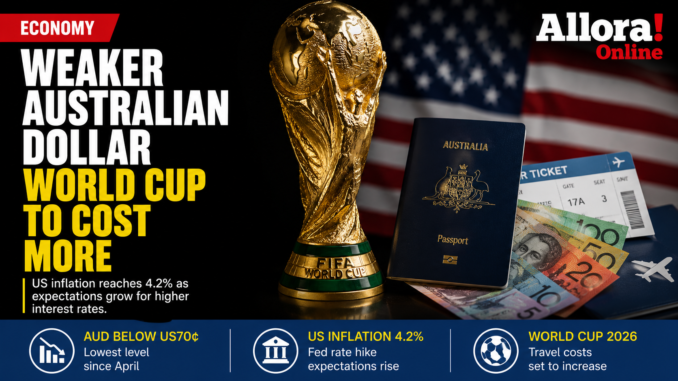
Australians travelling to North America for the FIFA World Cup could face a costly surprise as a weakening Australian dollar threatens to make accommodation, food, transport and entertainment significantly more expensive.
The currency pressure follows stronger-than-expected inflation figures in the United States, raising expectations that the US Federal Reserve may increase interest rates again before the end of the year.
New data released overnight showed annual US inflation reached 4.2 per cent in May, driven by a combination of higher oil prices linked to the conflict with Iran, ongoing tariff pressures and strong economic activity fuelled by America’s rapidly expanding data centre sector.
Financial markets reacted immediately. Investors increased their expectations of further interest rate tightening by the Federal Reserve, boosting demand for the US dollar and pushing the Australian currency lower.
The Australian dollar slipped below US70 cents for the first time since early April. Less than a week ago it was trading close to US72 cents, highlighting how quickly sentiment has shifted in global currency markets.
For Australian travellers planning to attend World Cup matches across the United States, Canada and Mexico, the decline means every hotel booking, restaurant bill and transport fare will cost more when converted into Australian dollars.
Currency movements have become increasingly important as many supporters have already committed thousands of dollars to flights and accommodation for the tournament.
The exchange rate shift reflects changing expectations around monetary policy in both countries.
Only a few weeks ago, markets were pricing in a strong likelihood that the Reserve Bank of Australia would raise interest rates before September, with a reasonable chance of a second increase before Christmas.
That outlook has softened considerably.
Investors now see a much lower probability of further rate rises by the Reserve Bank and are increasingly considering the possibility that Australian interest rates could begin moving lower before the end of next year.
The divergence between the two central banks has placed additional downward pressure on the Australian dollar.
Economists note that a weaker currency can benefit exporters and sectors such as tourism, education and agriculture by making Australian products more competitive overseas.
However, for households and international travellers, the immediate impact is often higher costs.
The timing is particularly unfortunate for football fans preparing for what is expected to be one of the biggest World Cups ever staged across North America.
With accommodation prices already elevated and demand expected to surge as the tournament progresses, the weaker Australian dollar adds another financial challenge for supporters hoping to follow their teams on the global stage.
For now, attention remains focused on inflation trends in the United States and the decisions of central bankers in Washington and Sydney. Those decisions may ultimately determine just how expensive the World Cup experience becomes for thousands of Australians travelling overseas.