
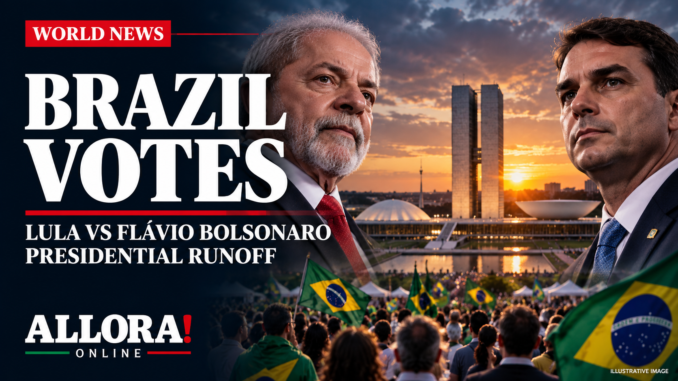
Millions of Brazilians are casting their ballots in one of the country’s closest and most polarising presidential elections. President Luiz Inácio Lula da Silva is seeking a historic fourth term, while conservative challenger Flávio Bolsonaro hopes to return his family’s political movement to power. Inflation, crime, public spending and relations with the United States dominate the contest.
Brazil is voting in a closely contested presidential runoff that could reshape the political and economic direction of Latin America’s largest country. The election pits incumbent President Luiz Inácio Lula da Silva against conservative Senator Flávio Bolsonaro, the eldest son of former president Jair Bolsonaro.
Nearly 160 million Brazilians are eligible to vote in an election marked by economic uncertainty, public security concerns and deep political divisions.
The contest follows a surprising first-round result on October 4, when Flávio Bolsonaro secured approximately 47 per cent of the vote, ahead of Lula’s 45 per cent.
Neither candidate obtained the majority required to win outright, forcing a second round on October 25.
The latest opinion polls suggest an exceptionally close race, with the differences between the candidates generally falling within the surveys’ margins of error.
Lula seeks a historic fourth presidential term
At 80, Luiz Inácio Lula da Silva remains one of the most influential political figures in modern Brazilian history.
A former metalworker and trade union leader, Lula first became president in 2003 and served two consecutive terms before returning to office in 2023.
He is now seeking an unprecedented fourth, non-consecutive mandate.
His campaign has focused on protecting social programmes, improving wages, reducing economic inequality and defending Brazil’s independence in international affairs.
Lula has pledged to maintain increases in the minimum wage above inflation and remove taxes from certain essential food products, including rice and beans.
He has also promised to strengthen federal law enforcement and establish a dedicated Ministry of Public Security.
However, his government faces dissatisfaction over rising living costs, household debt and persistent crime.
Although employment and inequality indicators have improved during his presidency, many voters continue to struggle with the price of food, housing and everyday necessities.
Flávio Bolsonaro seeks to restore his family’s political influence
Challenging Lula is 45-year-old Senator Flávio Bolsonaro, representing Brazil’s conservative Liberal Party.
His campaign has built upon the political movement established by his father, Jair Bolsonaro, who governed Brazil from 2019 to 2022.
The former president was convicted in 2025 over his involvement in an attempted coup following the 2022 election and is serving a prison sentence.
Flávio Bolsonaro has pledged to seek his father’s release, making the issue an important part of his campaign.
The senator has concentrated on public security, government spending and stronger relations with the United States.
Among his proposals are the construction of five maximum-security prisons and tougher measures against organised criminal groups.
He has also promised significant fiscal adjustments intended to reduce government borrowing and encourage private investment.
His supporters see his candidacy as an opportunity to change the country’s economic and security policies, while opponents raise concerns about the political legacy of his father’s administration.
Latest polls show a statistical dead heat
Surveys released immediately before the election indicate that neither candidate has established a decisive lead.
A Datafolha poll conducted on October 23–24 showed Bolsonaro on 48 per cent and Lula on 47 per cent, with a margin of error of two percentage points.
A Quaest survey placed Bolsonaro at 46 per cent and Lula at 45 per cent, also within a two-point margin of error.
The CNT/MDA poll reported Bolsonaro at 46.3 per cent and Lula at 45 per cent, with a margin of error of 2.2 percentage points.
AtlasIntel/Bloomberg recorded 49.9 per cent for Bolsonaro and 48.4 per cent for Lula, with a one-point margin of error.
These figures represent pre-election polling estimates, not actual votes counted in Sunday’s runoff.
With the differences generally within the reported statistical margins, the surveys do not establish a clear outcome.
Cost of living and inflation dominate voters’ concerns
Economic issues remain central to the presidential contest.
Brazil’s annual inflation rate reached 4.58 per cent in the twelve months to September, remaining above the central bank’s 3 per cent target.
The country’s benchmark interest rate stands at 13.75 per cent, creating considerable pressure on consumers, borrowers and businesses.
Public debt has also risen, reaching approximately 82.9 per cent of gross domestic product.
For many Brazilian households, the most pressing questions concern food prices, wages and the ability to pay existing debts.
Lula has emphasised income support and policies intended to improve purchasing power.
Bolsonaro has promoted tighter fiscal management and measures designed to encourage business investment.
The competing proposals reflect different approaches to Brazil’s economic challenges, with voters being asked to consider the implications for public services, household budgets and long-term growth.
Crime and security become decisive campaign issues
Public safety has also featured prominently in the election.
Despite a substantial decline in Brazil’s homicide rate over the past decade, organised crime continues to affect numerous communities.
Violence linked to criminal gangs remains a major concern, particularly in urban centres.
Bolsonaro has proposed a tougher criminal justice strategy, including new high-security prisons and the designation of major criminal organisations as narco-terrorist groups.
Lula has proposed increased investment in the Federal Police and reforms intended to strengthen cooperation between national and state security authorities.
Both candidates have presented public safety as a priority, although their proposed approaches differ substantially.
Donald Trump and the United States enter the debate
The election is attracting considerable attention in Washington.
US President Donald Trump has maintained a close political relationship with Jair Bolsonaro and has publicly praised the former Brazilian president.
Flávio Bolsonaro has also sought closer ties with Trump’s administration and other conservative political leaders across Latin America.
Lula, by contrast, has repeatedly defended Brazil’s sovereignty amid disputes with Washington over trade, tariffs and economic policy.
The campaign has been accompanied by allegations of American interference in Brazilian politics.
A Reuters investigation, citing current and former US officials, reported efforts by figures within the Trump administration to support the Bolsonaro family’s political return.
The US State Department has rejected allegations of improper electoral interference, maintaining that American actions were intended to protect legitimate national interests.
Trump has not formally endorsed either candidate in the runoff.
The next Brazilian administration will face significant decisions regarding trade relations, regional diplomacy and cooperation with the United States.
Voting underway as Brazil awaits the result
Brazil uses an electronic voting system that enables electoral authorities to count ballots rapidly after polling stations close.
Voting is scheduled to end at 5 pm Brasília time on Sunday, October 25.
That corresponds to 7 am on Monday, October 26, in Sydney.
The Superior Electoral Court, known as the Tribunal Superior Eleitoral (TSE), will begin publishing official results after polls close.
The candidate receiving the greatest number of valid votes in the runoff will become Brazil’s next president.
Until the official count is released, the election’s outcome remains undetermined.
A defining moment for Latin America’s largest democracy
The presidential election takes place against a backdrop of political polarisation that has shaped Brazil for much of the past decade.
Lula represents a political tradition centred on social programmes, labour protections and an active role for the state in economic development.
Flávio Bolsonaro represents a conservative movement advocating stronger law enforcement, fiscal restraint and closer cooperation with the United States.
Whoever wins will inherit an economy facing significant challenges, including inflation, public debt and pressure on household finances.
The next president will also need to govern a politically divided country, where building cooperation across Congress could prove essential.
As Brazilians cast their ballots, the choice extends beyond two candidates. It will help determine the direction of economic policy, public security and Brazil’s international relationships for the next four years.
For now, millions of voters are deciding the future of their country — and the final verdict rests with the official election count.
ALLORA! ONLINE | WORLD NEWS
By the ALLORA! ONLINE International News Desk