Iran-backed Houthi forces in Yemen have launched missile and drone attacks against four cities in southern Saudi Arabia, injuring 73 people and setting energy facilities on fire. The strikes hit Khamis Mushait, Abha, Najran and Jazan and appear to mark a significant expansion of the six-month-old regional conflict. Oil markets reacted immediately, with Brent crude reaching $99.46 a barrel as concerns grew over the security of Gulf and Red Sea energy supplies.
The Middle East war has widened again, this time with Saudi Arabia directly hit by one of the largest Houthi attacks on its territory in years.
Yemen’s Iran-backed Houthis said they carried out a broad operation deep inside southern Saudi Arabia using missiles and drones against military and energy targets.
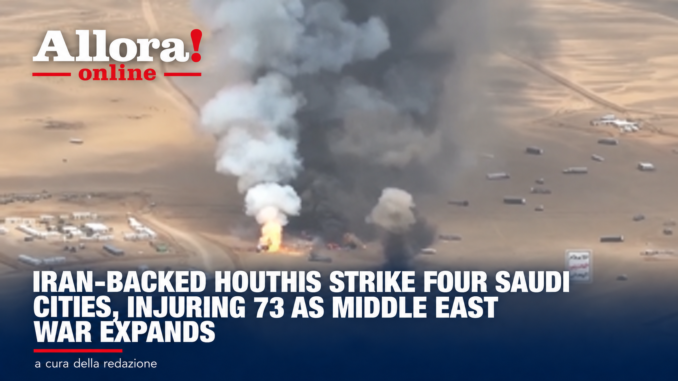
Saudi authorities said 73 people were injured, including women and children, while fires broke out at oil-related facilities.
The scale of the attack suggests a major escalation beyond the maritime confrontation that has dominated much of the conflict.
Four Saudi cities targeted
The Houthis said they struck a Saudi airbase in Khamis Mushait, as well as targets linked to the kingdom’s state oil company in Abha, Najran and Jazan.
Jazan is particularly significant because it is a major Red Sea port and hosts a large refinery and power plant.
NASA satellite imagery showed a thick plume of black smoke over the Jazan refinery and white smoke rising from an oil distribution centre in Abha.
Saudi authorities confirmed fires at the sites.
There were no independently verified ground images immediately available showing the full extent of the damage.
73 people injured
The casualty figure makes the attack one of the most serious carried out against Saudi Arabia since the wider war began earlier this year.
Authorities said 73 people were wounded, including women and children.
The Houthis control most of Yemen’s heavily populated areas, including the capital Sanaa, and have fought a Saudi-led coalition for more than a decade.
That conflict had eased in recent years, but the latest regional war has pushed the Yemeni front back into active confrontation.
Riyadh vows to respond
Saudi Arabia signalled that further military action could follow.
Turki al-Malki, spokesperson for the Saudi-led coalition, said the coalition would take all necessary operational measures to deter the Houthis and confront what Riyadh described as a hostile campaign.
Later on Tuesday, Houthi-controlled media reported that Saudi aircraft had carried out strikes in Yemen’s Jubah district, east of Sanaa, and in Taiz province in the southwest.
Houthi military spokesman Yahya Saree accused Riyadh of escalating the conflict and said the group would respond.
Yemen front intensifies
The attacks come as fighting inside Yemen has also increased.
Saudi-backed Yemeni forces aligned with the internationally recognised government have launched a multi-pronged offensive against Houthi-held territory.
That government, driven from Sanaa 12 years ago, says it now intends to recapture areas still controlled by the Houthis.
The International Organization for Migration said more than 18,500 people had fled their homes over the past three days because of fighting along Yemen’s west coast.
Oil reaches $99.46 a barrel
The escalation immediately added pressure to global energy markets.
Brent crude rose to $99.46 a barrel, its highest level since July 24, while US West Texas Intermediate also reached its strongest level in months.
The attack on Saudi oil infrastructure adds another layer of risk to a market already focused on the confrontation around the Strait of Hormuz.
Until now, much of the concern has centred on shipping restrictions and competing US and Iranian attempts to control traffic through the Gulf.
Strikes on Saudi energy infrastructure raise the possibility that disruption could spread from shipping routes to production, refining and distribution facilities themselves.
Risks to global energy supplies
Saudi Arabia remains one of the world’s largest oil producers and exporters.
Any significant interruption to its infrastructure could have immediate consequences for global supply and prices.
The war has already contributed to shortages of crude and refined fuels, while diesel prices in the United States have reached record levels.
For economies heavily dependent on transport and imported fuel, including Australia, a sustained move above $100 a barrel could feed through into higher petrol, diesel, freight and consumer prices.
Hormuz remains another flashpoint
At the same time, the confrontation between Washington and Tehran around the Strait of Hormuz continues.
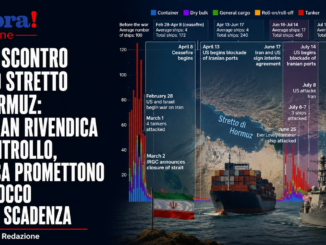
Iran has announced plans for a new “maritime exclusion zone”, while the United States is attempting to keep shipping moving through the waterway and maintain its blockade on Iranian oil exports.
Tehran also said its Revolutionary Guards had captured an unmanned US submersible at the mouth of the strait, a claim that had not been immediately confirmed by Washington.
The combination of attacks on Saudi infrastructure, restrictions around Hormuz and renewed fighting in Yemen is increasing the systemic risk across the region.
A war becoming increasingly regional
The significance of the latest Houthi attack lies in its broader implications.
The conflict is no longer confined to Iran, the United States and Israel.
Saudi Arabia, the United Arab Emirates, Yemen, Red Sea shipping routes and Gulf energy infrastructure are now increasingly exposed.
The Houthis have again demonstrated their ability to strike strategic targets beyond Yemen, while Riyadh has indicated it is prepared to respond.
With Brent crude now just below $100 a barrel and the Saudi front active again, the risk is that the war enters a broader phase with consequences extending well beyond the battlefield and into global energy markets.