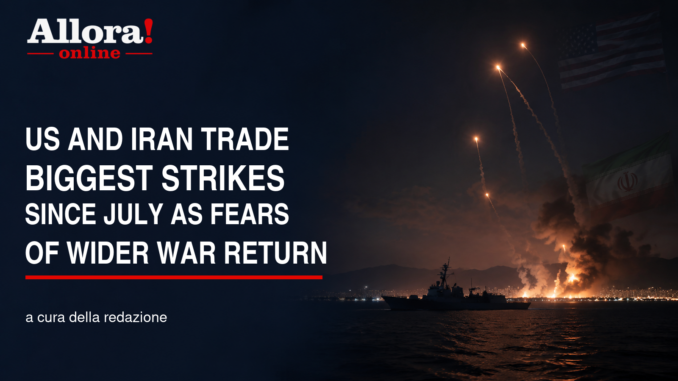
The confrontation between Washington and Tehran has escalated sharply, with US forces striking targets along Iran’s southern coast and around the Strait of Hormuz while Iran retaliated against American military facilities across the region. It is the most intense exchange of fire between the two sides since July. Tehran says at least 12 people were killed in the US strikes, including civilians at a wedding, while Washington says it does not target civilians.
Fears of a wider Middle East war are rising again.
In the latest escalation, the United States struck Iranian air defences, radar systems, maritime assets, mine-laying capabilities and communications sites, while Tehran responded with attacks targeting US-linked facilities in Bahrain, Jordan, Kuwait and Iraq.
The renewed exchange marks a major deterioration after weeks in which the conflict had shifted more towards sanctions, blockades and economic pressure.
Iran strikes back at US bases
Iran said it targeted American assets across several countries in the region and warned that its goal was to increase pressure on the long-standing US military presence in the Middle East.
Tehran claimed US personnel had been killed in Jordan and northern Iraq, but American officials said initial assessments showed no US casualties.
In Kuwait, Iran said it launched missiles and drones at the Ali Al Salem Air Base. Kuwaiti authorities later reported a fire at a residential complex struck by a drone.
Bahrain, which hosts the regional headquarters of the US Navy, said Iranian drones had been intercepted and destroyed.
Iran says wedding party was hit
One of the most serious allegations concerns a reported US strike in the Sirik area of southern Iran.
Iranian authorities said a house hosting a wedding celebration was hit, killing at least four people, including a four-year-old child, and injuring dozens.
Iran says the overall death toll from the latest US strikes is at least 12.
Reuters said it could not independently verify the wedding incident.
A US Central Command spokesperson said American forces do not deliberately target civilians and acknowledged that the reports had originated from Iranian state media.
Strait of Hormuz again at the centre
The Strait of Hormuz remains the most dangerous flashpoint in the confrontation.
Iran says two oil tankers were struck by mines while being escorted through the waterway by US personnel.
Washington says it is continuing to guide commercial shipping through the Strait. US Energy Secretary Chris Wright said more than 17 million barrels of oil passed through on Monday.
A Saudi shipping company also reported that two Filipino crew members were killed aboard an oil tanker in an incident in the Strait.
Hormuz is critical because roughly one-fifth of the world’s oil supply normally passes through the narrow waterway.
Oil rises and markets fall
Financial markets reacted quickly to the escalation.
Asian and European shares fell, while oil prices climbed back to levels not seen since July.
The concern is that a broader conflict could further disrupt energy shipments through the Gulf, pushing up fuel prices, transport costs and global inflation.
Trump threatens more strikes
US President Donald Trump has said Washington is now in a stronger position and claimed near-total control over the Strait.
The administration has also threatened more strikes if Iran continues attacking American targets.
At the same time, the US Treasury is considering additional sanctions targeting airlines, shipping networks and digital assets linked to Tehran.
Iran has shown no sign of backing down.
Its military command has promised “heavier, more widespread and devastating” responses and warned that countries assisting US forces could also face consequences.
Diplomacy under growing pressure
The latest clashes come after months of attempts to contain the conflict through diplomacy and economic pressure.
A memorandum reached in June was supposed to open the way for broader negotiations, but many of the most difficult issues remained unresolved.
Iranian President Masoud Pezeshkian says Tehran is prepared to meet its commitments if Washington does the same.
But on the ground, the logic of retaliation has returned.
Each strike is now being answered by another, increasing the risk that a limited confrontation could again become a full-scale regional war.
The Strait of Hormuz has once more become the point where military conflict, energy security and the global economy meet.
And after the heaviest exchange since July, the question is no longer whether tensions are rising.
It is how far this escalation can go before it becomes impossible to contain.