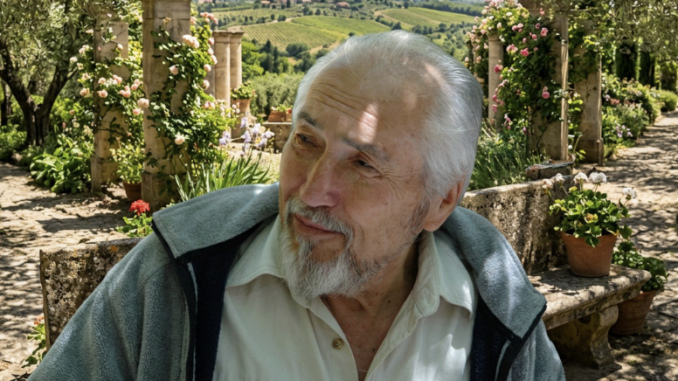
By Tom Padula
I first met Pino Bosi at the Italian Cultural Institute of Melbourne and later, when he moved to Melbourne, he would come to Insegna Bookshop to exchange notes about publishing local Italian authors and personalities. I have many of this later production of books by Pino Bosi. He was a larger-than-life character and loved all that attracted me in Italian literature, theatre and the arts generally, including films, radio and television.
He enjoyed coming to see the plays by Nella and Tom Padula. I remember him with fond affection and great admiration for his contribution to Italian language, culture and history. We would also talk about writers and contributors to humanity in our world. There was not a topic that we spoke about in which he was not erudite and immensely interesting.
I hope that this article will bring to people in Sydney, Melbourne and Australia the importance of our early migration from Italy in our post-WW2 period.
Pino Bosi spoke about the character in They Are a Weird Mob, which depicted him as the main character in that book. His birth and death dates are 18 June 1933 (Gorizia) and 9 October 2017 (Melbourne).
There is much to appreciate about the life and times of Pino Bosi. I invite a few postgraduate students and/or interested people to come to see me regarding most of the published books by this important writer.
Let me delve now into what information is available about him. Pino Bosi is one of the most significant chroniclers of the Italian migrant experience in Australia. Born in Gorizia in 1933, he migrated to Australia as a young man in the early 1950s. His life became closely intertwined with the story of post-war Italian migration, and over several decades he established himself as a journalist, broadcaster, historian, novelist and community writer. His work has helped preserve the memories, struggles, achievements and cultural identity of generations of Italian Australians.
Bosi’s writing is distinguished by its deep understanding of migrant life. He wrote in both Italian and English and explored themes of language, identity, cultural adaptation, social mobility and the challenges faced by immigrants adjusting to a new homeland.
Literary scholars have noted his ability to blend standard Italian with the language and expressions used by migrants, creating a unique voice within Italian-Australian literature.
His best-known literary work is Australia Cane, a collection of stories that became widely recognised in Italian-Australian circles.
Among his major published works are:
Blood, Sweat and Guts (1970), an early and influential account of Italian migration and settlement in Australia.
The Italians (1983), a book introducing young Australians to the history and contribution of Italian migrants.
Figli (e nipoti) d’Italia (2003), documenting thirty years of the Sons of Italy Association in Melbourne and its role in community life.
Ajo in Australia: Let’s Go to Australia (2012), a substantial study of Sardinian migration to Victoria based on 53 oral-history interviews and extensive historical research.
There are many others…
Beyond publishing, Bosi also played an important role in ethnic broadcasting. National Library records identify him as a pioneer and founder within Australia’s ethnic radio movement, helping migrant communities maintain cultural connections and access information in their own language.
His cultural contributions have received significant recognition from community organisations and cultural institutions.