By Tom Padula
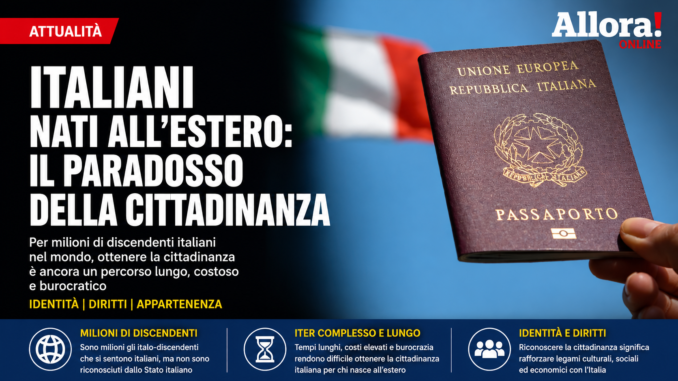
There are many Italy-born citizens no longer classified as Italian.
By acquiring the citizenship of the country of residence, the Italian abroad is no longer Italian. To become Italian again, each person born in Italy must go through a bureaucratic path that includes a lot of wasted time and money. By achieving this new dual citizenship status, nothing really changes for the individual who resides abroad except for their “identity”. They are classified as Italian by the population of their new country of residence. From experience, I am Italian in Australia and Australian in Italy!
Since we are in a celebratory mood for the 80th anniversary of the Republic of Italy, I have looked with great interest at the euphoria of celebrations and events everywhere where Italian clubs and associations have been established in multicultural Australia. My observation and personal interest have combined to lead me to ask a simple question: when are Italy-born Italians only citizens of their new country of residence, which has given them a new life outside of Italy? Why can they not be considered Italians without an Italian government obligation to include such persons in its economic framework?
Automatic recognition of being Italian does not imply an obligation to sustain such individuals, only to recognise the status of Italian citizen for voting rights, if so required. The identity of a person cannot be denied, as is the case when they are regarded by their new fellow citizens of this other country of residence. There is no doubt that this reflection of mine can be looked at from many points of view.
This article aims to point out a few anomalies that still exist between Italy as a nation within its borders and Italy as a nation without borders, all the diaspora of Italians who reside in the world.
A fundamental shift in the way Italy sees itself politically has already been recognised within these 80 years of the Italian Republic. We only need another small push to embrace those Italians who are left out because they no longer feel they can consider themselves Italian, even though they are grateful for and love their new place of residence. They still have their identity intact as Italians; this no one can take away because of their birth and heritage.
The concept of participation in Italian affairs from outside of Italy by Italians worldwide is an interesting one. Many views will no doubt emerge, and some would say that they already have. Let us go further and include an Italy that is present through the identity-driven population born out of the migration process, whether historical or recent. If Italy wants to include its “lost and uncounted citizens”, it is time to recover and claim them as its own, like a long-lost mother.
Moreover, recognising these individuals would strengthen Italy’s cultural, social, and economic connections across the globe. Millions of people of Italian origin continue to promote Italian traditions, language, values, and heritage in their adopted countries.
They serve as informal ambassadors of Italy every day. A modern nation should not measure belonging solely through administrative status but also through shared history, culture, and identity. By acknowledging the enduring bond between Italy and its diaspora, the Republic would reaffirm that being Italian is not merely a legal condition, but also a lifelong connection that transcends borders and generations.
Furthermore, the contribution of Italians abroad should not be viewed only through the lens of economics or citizenship legislation. For generations, emigrants and their descendants have preserved a living connection with Italy, often under circumstances that required great sacrifice. They have built communities, founded cultural associations, supported Italian language schools, and maintained traditions that continue to be passed on to younger generations.
In many cases, their attachment to Italy remains as strong as that of those who never left.