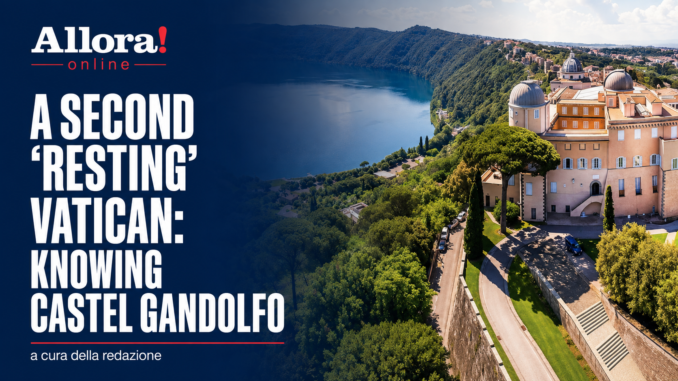
For four centuries, Castel Gandolfo has been closely woven into the history of the papacy. Set among the hills of the Castelli Romani overlooking Lake Albano, just outside Rome, the small town has long provided popes with a place to escape the summer heat, pray, work and reflect away from the pressures of the capital. With Pope Leo XIV returning to Castel Gandolfo, an ancient papal tradition has once again come to life.
The tradition began in 1626 under Pope Urban VIII, who established the custom of leaving Rome during the hottest months for the cooler climate of the Alban Hills. The arrival of the Pope soon became a major event for local residents, who welcomed the papal procession with celebrations and ceremonial gunfire.
Following the fall of the Papal States in 1870, however, the papal residence was largely abandoned for more than six decades. Its fortunes changed with the Lateran Pacts of 1929, which recognised the property’s extraterritorial status under the Holy See and restored its importance as a papal residence.
Today, the papal estate covers around 55 hectares and includes the gardens of Villa Barberini. The grounds occupy the site of the ancient villa of the Roman Emperor Domitian and benefit from a distinctive microclimate. In 2023, Pope Francis launched the Borgo Laudato Si’ project there, inspired by his 2015 encyclical and dedicated to environmental sustainability, education and care for creation.
Pope Leo XIV has revived Castel Gandolfo as a place of residence and retreat. Away from the formal setting of the Vatican, the Pope has been able to enjoy the countryside and outdoor activities, continuing a tradition shared by many of his predecessors. Several popes were known to appreciate horse riding and other activities in the grounds of the estate.
Yet Castel Gandolfo is about much more than papal leisure. Its relationship with the local population has developed over centuries, producing a remarkable collection of personal memories and stories. Residents still recall the more informal side of papal life, including stories of Pope John XXIII, remembered for his concern for ordinary families and their everyday needs.
These memories reveal a more personal dimension of the papacy: popes who were not simply distant figures of authority, but neighbours who walked through the town, spoke with residents and took an interest in their lives.
In 2016, Pope Francis opened the Apostolic Palace to the public as a museum, bringing an end to its traditional role as the Pope’s summer residence. During the early period of his pontificate, Pope Leo XIV instead stayed at Villa Barberini.
The significance of Castel Gandolfo, however, goes well beyond its picturesque setting. St John Paul II famously described it as the “second Vatican”, emphasising that the Pope does not simply come here to rest. Throughout modern history, the summer residence has been a place where popes have continued their ministry, meeting advisers, writing, studying, praying and dealing with important matters affecting the Catholic Church.
That is perhaps the enduring character of Castel Gandolfo. It offers the Pope something the Vatican cannot easily provide: distance without isolation, privacy without complete separation and a setting in which work and contemplation can coexist.
Four centuries after Urban VIII first made the journey from Rome, Castel Gandolfo remains a living chapter in the history of the papacy. Its gardens, palaces and streets preserve the memory of generations of popes, while the return of Pope Leo XIV has given this historic relationship a new chapter.
For the people of Castel Gandolfo, the Pope is not simply a visitor. He is part of the identity of the town itself — a presence that has shaped its history, its traditions and its collective memory for generations.