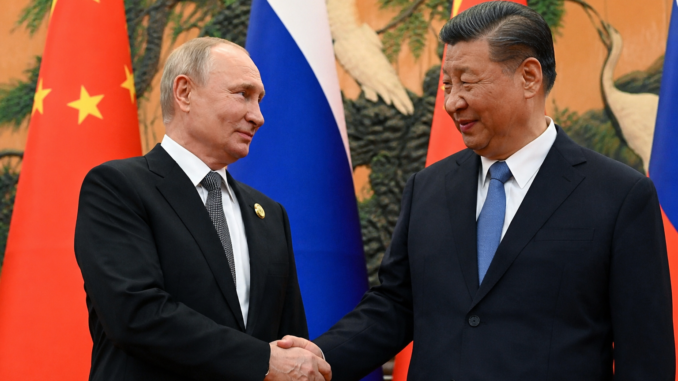
Russian President Vladimir Putin has arrived in Beijing for a high-stakes summit with Chinese leader Xi Jinping, in a visit designed to send a powerful geopolitical message just days after US President Donald Trump concluded his own trip to China.
The carefully choreographed visit highlights the growing strategic partnership between Moscow and Beijing at a time when global tensions are intensifying — from the war in Ukraine to instability in the Middle East and increasing competition between the United States and China.
Putin landed in Beijing late Tuesday evening and was welcomed by Chinese Foreign Minister Wang Yi alongside a military honour guard. The symbolism was unmistakable: Russia and China want the world to see their alliance as strong, stable and increasingly central to a changing global balance of power.
A partnership built against Western pressure
The visit coincides with the 25th anniversary of the 2001 Sino-Russian Treaty of Friendship, a relationship that has dramatically deepened since Russia’s invasion of Ukraine in 2022.
As Western nations imposed sanctions and diplomatic isolation on Moscow, China became Russia’s economic lifeline — buying sanctioned oil, expanding trade and offering political support without openly endorsing the war.
Putin described the relationship as reaching an “unprecedented level,” calling the partnership a stabilising force in global politics.
Beijing, meanwhile, continues to portray itself as a neutral mediator in international conflicts, despite Western accusations that China’s support effectively helps sustain Russia’s war effort.
The message to Washington
Timing matters in diplomacy, and this summit comes immediately after Donald Trump’s highly publicised visit to China.
Although the Kremlin insists there is “no correlation” between the two visits, the optics tell another story. China appears determined to show that while it can engage with Washington, its strategic alignment with Moscow remains intact.
For Xi Jinping, balancing relations with both the United States and Russia is becoming increasingly complex. China needs Western markets and investment, but it also sees Russia as a crucial geopolitical counterweight against American influence.
The summit also reflects a broader global realignment. Nations across Asia, the Middle East and the Global South are watching closely as new alliances emerge in a world that increasingly resembles a multipolar order rather than one dominated solely by the West.
Energy, war and economic survival
One of the key issues expected to dominate talks is the proposed “Power of Siberia 2” gas pipeline, a major project that would deliver Russian natural gas to China through Mongolia.
For Moscow, the project is economically critical. Europe’s reduced dependence on Russian energy after the Ukraine war forced the Kremlin to pivot heavily toward Asia.
For Beijing, securing land-based energy routes has become strategically important, especially amid fears that instability in the Middle East could disrupt maritime oil supplies.
The irony is striking: while the West hoped sanctions would weaken Russia, the crisis may instead be accelerating the creation of an alternative economic and political bloc centred around Moscow and Beijing.
A new Cold War — or something different?
The emerging Russia-China partnership is not a formal military alliance, but it increasingly behaves like one politically and economically.
Unlike the Cold War of the 20th century, today’s divisions are more complicated. China and the United States remain deeply economically interconnected, while Russia acts more as a military and resource power than a true economic superpower.
Still, the direction is clear. Trust between the West and both Beijing and Moscow continues to deteriorate.
As wars, sanctions, inflation and energy insecurity reshape global politics, the Putin-Xi summit may be remembered less as a routine diplomatic meeting and more as another step toward a divided and increasingly unstable international system.