
by Alberto Macchione
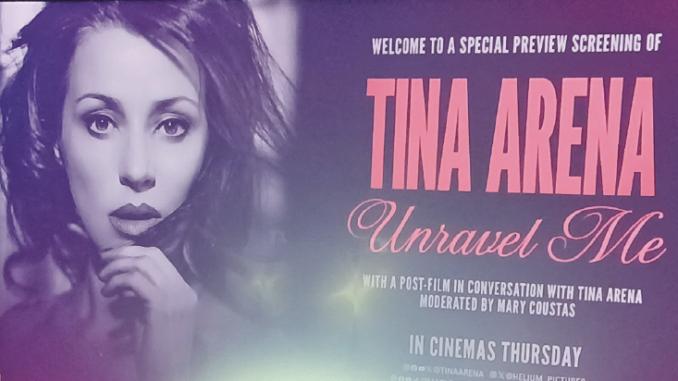
Tina Arena was brought to tears on several occasions as she brought her self-confessed raw honesty to Sydney, premiering her documentary Tina Arena: Unravel Me at the Hayden Orpheum Picture Palace in Cremorne. Moderated by Mary Coustas, a lively Q&A explored Arena’s Italian heritage, early bullying and industry survival across fifty glittering years.
Marking five decades in the music business, Australian icon Tina Arena is stripping back the glossy veneer of stardom. At the special Cremorne preview event, audiences caught an unfiltered look at the forces that shaped her.
“People think they know me, but they really don’t know me at all,” Arena told the crowd. “When you start at seven years old, your childhood is entirely public property. You grow up fast, but the scars take much longer to heal.”
The documentary and subsequent Q&A — expertly guided by comedian and writer Mary Coustas — dove deep into Arena’s Italian-Australian roots. Growing up in Melbourne in a traditional Italian household presented a vivid tapestry of culture and expectation, but it also made her a target.
“Being a little girl with an Italian name in a very Anglo-centric playground meant I stood out, and standing out meant I got bullied,” Arena reflected on stage. “The kids didn’t understand our food, our language, or our passion. But my family background gave me a backbone of steel. Diversity wasn’t a buzzword back then; it was something you had to navigate and survive every single day.”
The songstress remembered the burden of growing up “not the girl next door but the ethnic next door”.
“I was bullied to an inch of my life. Used to have people waiting for me outside the school so they could bash me up, and I’d be like, ‘Wow, you know, wow, they want to bash me up. What have I done?’”
“Treat people the way in which you want to be treated,” said Arena, whose family migrated from a village near Catania in Sicily.
“I was raised by two of the most exquisite humans that I’m still privileged are with us today.”
She described her parents as a beautiful couple who came to Australia seeking opportunities for their daughters after the Second World War.
“All we ever wanted to do was make them proud. They did, and they integrated.”
Arena was always told that she “didn’t have the right look”, her sister noting in the film that she was “the first Italian girl on TV”.
The film shows the multilingual singer performing in Italian. Later, back on stage, Tina gave “thanks to Kim Kardashian” — “for big asses”, Coustas chimed in.
“For bringing the dark, that brooding, dark sort of sensual, that dark European woman into focus,” Arena continued. “She wasn’t cool when I was growing up, so I was very, I felt very ostracized, and I had terrible insecurities about the way I looked.”
Arena noted that the early harsh treatment in the industry forged her fierce artistic independence.
“Art is risk on every level,” she added. “If you try to please everyone, you stand for nothing. I learned early on that my voice was my shield.”
With the documentary’s wider national release scheduled for August 27, 2026, Arena expressed her hope that the film would encourage empathy and resilience.
“We need to embrace our differences instead of weaponizing them,” Arena concluded to rapturous applause. “This film isn’t a retrospective; it’s an awakening. I am finally telling my story, on my own terms.”
The conversation also highlighted Arena’s remarkable ability to reinvent herself while remaining deeply connected to the experiences that first shaped her. From childhood performances to international success, her career has been marked by determination, vulnerability and a refusal to be defined by other people’s expectations.
For audiences watching the documentary, those moments offered more than a portrait of a celebrated performer: they revealed the woman behind the public image, confronting old wounds while looking forward with renewed confidence, honesty and a strong sense of identity.
Her story continues to resonate because it speaks beyond fame and music, touching on belonging, family and the courage required to remain authentic.
In Sydney, Arena’s words transformed the screening into an intimate encounter, leaving audiences with a powerful reminder of resilience and self-acceptance, while celebrating her enduring artistic voice.


Be the first to comment