Two earthquakes measuring 7.2 and 7.5 have devastated Caracas and the country’s north-central region. La Guaira has been declared a disaster zone, the main airport has been damaged, and thousands of people have been forced to spend the night outdoors. Rescue teams, medical personnel and humanitarian aid are arriving from the United States and other countries
The death toll from the two powerful earthquakes that struck Venezuela on Wednesday evening has continued to rise.
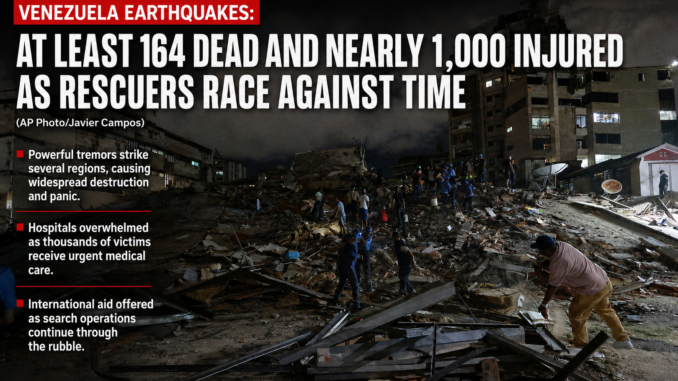
At least 164 people have been killed and 971 injured, while an unknown number remain trapped beneath collapsed buildings.
Acting President Delcy Rodríguez announced the updated toll on Thursday morning, saying authorities were transferring rescue teams from across the country to the worst affected areas.
The most serious situation has been reported in the coastal state of La Guaira, north of Caracas, which has been declared a disaster zone because of the large number of collapsed buildings.
“Dozens of structures have come down, and we are carrying out intensive operations to save lives,” Rodríguez said.
Authorities fear the toll could rise further as rescue workers reach isolated communities and continue digging through the rubble.
TWO EARTHQUAKES WITHIN A MINUTE
According to the United States Geological Survey, the first earthquake, measuring magnitude 7.2, struck Venezuela’s Caribbean coast about 170 kilometres west of Caracas.
Its epicentre was located near Morón, in Carabobo state, at a depth of approximately 22 kilometres.
Less than a minute later, an even stronger 7.5-magnitude earthquake was recorded, with its epicentre about 16 kilometres south-west of Morón and a depth of just 10 kilometres.
The two earthquakes, among the strongest recorded in Venezuela in more than a century, were felt across much of the country and in neighbouring nations.
The tremors were reportedly felt as far away as Brazil’s Amazon region, about 1,700 kilometres from the Venezuelan capital.
CHILDREN PULLED ALIVE FROM THE RUBBLE
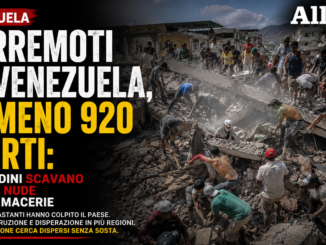
Venezuelan television showed rescue teams using power tools to cut through concrete and metal structures in an attempt to reach people trapped beneath collapsed buildings.
In La Guaira state, three children were pulled alive from the wreckage of a building.
They were covered in dust but conscious and were immediately handed over to medical teams.
Other footage showed dozens of injured people being treated outside hospitals, some lying on the ground and others being carried on improvised stretchers.
The government has appealed to businesses to make excavators, cranes and other heavy equipment available to help remove debris.
Search and rescue teams certified by the United Nations are also travelling to Venezuela.
Authorities are trying to make the most of the available daylight, aware that the first 48 hours are critical when searching for survivors.
CARACAS HIT BY COLLAPSES AND BLACKOUTS
In Caracas, thousands of residents fled their homes as buildings shook and entire walls fell into the streets.
In some neighbourhoods, façades collapsed, leaving furniture and rooms exposed, while large clouds of dust rose above the hardest-hit areas.
Parts of the capital lost power and mobile phone coverage.
Metro services were suspended and natural gas supplies were shut off to reduce the risk of fires and explosions.
Schools will remain closed for several days, and some school buildings will be used as shelters and collection centres for food, water, blankets and medicine.
Many families spent the night in parks, car parks and public squares, fearing further tremors and the possible collapse of damaged structures.
Interior Minister Diosdado Cabello urged people not to return to buildings showing cracks or visible damage.
Aftershocks continue to pose a danger both to residents and emergency workers.
INTERNATIONAL AIRPORT CLOSED
Simón Bolívar International Airport, Venezuela’s main international gateway, was also damaged and temporarily closed.
One of the runways was reportedly cracked, making it difficult for aircraft carrying emergency personnel and supplies to land.
The closure risks delaying international aid and may force authorities to use alternative airports or rely on land and sea routes.
The government has declared a state of emergency and announced an initial US$200 million reconstruction fund for damaged hospitals and homes.
The immediate priority, however, remains the search for missing people and the stabilisation of buildings at risk of collapse.
THOUSANDS SEARCH FOR MISSING RELATIVES
Communication failures have made the situation especially painful for families.
Thousands of people in Venezuela and abroad are trying to contact relatives and friends living in the affected areas.
Photographs of missing people, handwritten lists of names and requests for information from hospitals and shelters have appeared on social media.
The United Nations human rights mission in Venezuela has urged the government to lift local restrictions on social media platforms, stressing that timely access to reliable information is essential to protect the population and reunite families.
With phone lines down and many roads blocked, the internet has become one of the few available tools for reporting missing people, identifying collapsed buildings and requesting assistance.
UNITED STATES PROMISES IMMEDIATE ASSISTANCE
The United States has announced the immediate deployment of specialised search and rescue teams, medical resources and humanitarian supplies.
Secretary of State Marco Rubio promised a coordinated response from the entire US government.
“It will be big. It will be fast. It will be effective,” he said.
Washington has activated a disaster assistance team and a task force to coordinate operations with Venezuelan authorities.
President Donald Trump had already said the United States was “ready, willing and able” to help those affected.
Rodríguez thanked the US president and confirmed that she had spoken with Rubio by telephone, without providing further details.
AID FROM SEVERAL COUNTRIES
Ecuador, Qatar, Mexico and El Salvador have also offered or already sent personnel and supplies.
El Salvador’s President Nayib Bukele expressed solidarity with the Venezuelan people and urged them to remain strong during the emergency.
Further offers of assistance have come from governments across Latin America, Europe and the Middle East.
International support could prove decisive, especially in areas where hospitals have been damaged or lack sufficient beds, medicine and equipment.
The country urgently needs search dogs, heavy machinery, tents, generators, drinking water, food and mobile medical facilities.
The main challenge will be delivering aid quickly to isolated communities despite damaged roads and the temporary closure of Caracas’ airport.
TSUNAMI WARNING WITHDRAWN
A tsunami warning was initially issued for Puerto Rico, the US and British Virgin Islands, Aruba, Curaçao and Bonaire following the earthquakes.
The warning was later withdrawn.
Authorities said there was no longer a threat of dangerous waves, although people were advised to exercise normal caution near coastal areas.
Only minor sea-level fluctuations were expected in the hours following the earthquakes.
DEATH TOLL EXPECTED TO RISE
Venezuela is now confronting one of the worst natural disasters in its recent history.
The confirmed toll of 164 deaths and 971 injuries remains provisional.
Many buildings have not yet been fully inspected, and some communities near the epicentre remain difficult to reach.
Authorities continue to urge people to stay away from damaged structures and keep roads clear for emergency vehicles.
In the ruins of La Guaira and Caracas, rescue teams are fighting against time.
Every passing hour reduces the chances of finding survivors, but the rescue of the three children shows that people may still be alive beneath the rubble.