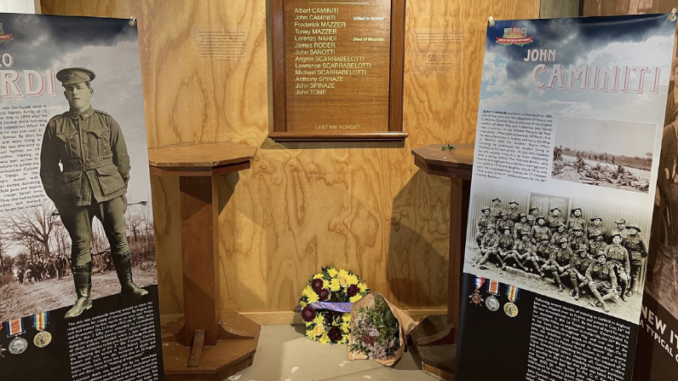
As Australia reflects on its ANZAC legacy each April, a lesser-known chapter of the First World War is gaining recognition: the story of Italian-heritage soldiers who served in the Australian Imperial Force (AIF). In northern New South Wales, the “New Italy ANZACs” Honour Roll preserves the memory of 13 young men born to Italian families who enlisted, fought, and in some cases died under the Australian flag.
The New Italy settlement, founded in 1882 by Italian migrants who survived the ill-fated Marquis de Rays expedition, became home to families who would later produce a generation of Australian-born sons. By the outbreak of World War I in 1914, many of these families had moved away in search of work, spreading across New South Wales and Queensland. Their sons, however, retained a connection to their rural origins and the emerging identity of a new nation.
When Britain called on its dominions for troops, Australia quickly formed the Australian Imperial Force. Despite having no direct ancestral ties to Britain or traditional loyalty to the Crown, young men of Italian descent from New Italy enlisted in significant numbers. According to research compiled by the New Italy Museum, 13 of these men joined the AIF, becoming part of the broader ANZAC story of Australia and New Zealand troops on the Western Front and in the Middle East.
Historians and community researchers suggest their motivations were complex. Some were influenced by gratitude toward Australia, the country that had provided new opportunities for their families. Others were driven by mateship, adventure, or the strong social pressure of enlistment during the early patriotic fervour of the war. These factors reflect the broader experience of many Australian soldiers at the time, regardless of background.
The contributions of the New Italy ANZACs were significant but came at a heavy cost. Of the 13 men identified, two were killed in action on the Western Front, seven were wounded, and two received decorations for bravery. Their service took them through some of the most brutal theatres of the war, including the muddy trenches of France and Belgium, where artillery bombardments and attritional warfare defined daily survival.
Two of these soldiers, John Caminiti and Lorenzo Nardi, never returned home. Caminiti, a fisherman from Sydney, was killed in 1917 during the fighting at La Potterie farm in France. His body was never recovered, and his name is now engraved among the missing at the Menin Gate Memorial in Ypres. Nardi, serving in the Australian Divisional Ammunition Column, died in 1917 after being fatally wounded by an exploding fuse while supplying ammunition near the Somme sector.
Their stories illustrate the often-overlooked role of support and frontline logistics units in the war. Ammunition columns like Nardi’s operated under constant danger, transporting shells and supplies to artillery positions close to the front line—work that was essential but frequently exposed soldiers to sudden and lethal hazards.
The New Italy ANZACs Honour Roll, unveiled in 2015, is now a focal point for remembrance ceremonies in the region. Constructed from Australian red cedar and inscribed with gold leaf, the memorial symbolically links Italian heritage with Australian service. It also reflects broader efforts to recognise multicultural contributions to Australia’s wartime history.
Community commemorations continue to highlight the legacy of these men. At annual ANZAC Day services, descendants and locals gather at the New Italy Museum to lay wreaths and reflect on their sacrifice. These ceremonies underscore a growing understanding that the ANZAC story is not only Anglo-Australian, but also includes diverse migrant communities whose sons fought under the same flag.
Today, historians view the New Italy ANZACs as part of a wider re-examination of Australia’s military identity. Their story challenges traditional narratives of early 20th-century Australia by showing how migrant families became deeply embedded in the nation’s wartime experience.