
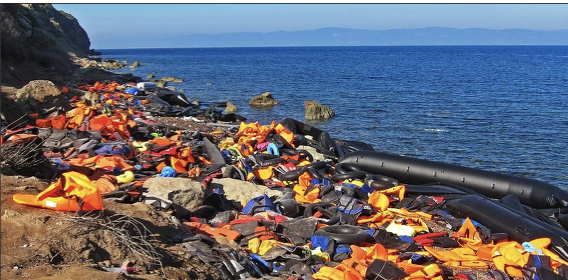
Along the western coasts of Sicily and Calabria, from Pantelleria to Scalea, a trail of lifeless bodies stretches across shorelines and the waters of the Tyrrhenian Sea. In recent days, beaches have returned corpses in advanced states of decomposition—some partially identifiable, others rendered unrecognizable after days adrift at sea. Between February 6 and 17, at least thirteen bodies were recovered, and authorities fear the number may rise further.
Prosecutors in Paola, Vibo Valentia, and Trapani have opened investigations to determine what happened. Early indications suggest the victims may have been migrants lost in so-called “ghost shipwrecks,” tragic maritime disasters that leave behind no survivors, no distress calls, and often no official record.
This grim procession is not an isolated episode. It is a stark reminder of the ongoing humanitarian crisis unfolding in the Mediterranean, one of the world’s deadliest migration routes. Humanitarian organizations believe the recent recoveries may be linked to Cyclone Harry, which battered the Central Mediterranean between January 18 and 21 with winds exceeding 120 kilometres per hour, creating treacherous currents and devastating conditions for overcrowded and unseaworthy boats.
According to several humanitarian sources, as many as one thousand people may have perished at sea during those days. Many were never linked to a specific vessel, departure point, or rescue operation. They simply disappeared.
The bodies washing ashore are tangible evidence of a collective failure—not only the failure to provide safe migration pathways and effective search-and-rescue operations, but also the failure of European and international policies that continue to push desperate people toward increasingly dangerous crossings.
The political narrative of “reduced arrivals,” frequently presented as a success by several European governments, collapses when confronted with the reality of anonymous corpses on Mediterranean beaches. Official arrival figures may decline, but deaths do not. Men, women, and children fleeing war, persecution, poverty, and instability continue to risk everything. For many, the Mediterranean is no longer a passage to safety but a vast and unforgiving graveyard.
Responsibility extends well beyond Italy. European deterrence policies, cooperation agreements with transit countries, funding for foreign coast guards, readmission arrangements, and detention practices have transformed the sea into a lethal barrier. Brussels continues to promote migration management strategies centred on containment, deportations, and externalized border controls, often relying on authoritarian governments in North Africa.
Critics argue that these measures may reduce visibility rather than solve the underlying problem. Migrants do not stop moving because barriers increase; instead, they are forced onto longer, more dangerous routes controlled by criminal smuggling networks that profit from desperation.
The Mediterranean crisis has become Europe’s blind spot. Each recovered body briefly captures headlines before disappearing from public attention. Yet every victim represents a human story interrupted—a family left without answers, a journey ending in tragedy, and a reminder that migration is not merely a security issue but a human one.
As investigations continue along the Italian coastline, the recovered bodies demand more than forensic identification. They demand political reflection. The question facing Europe is no longer whether migration can be stopped. The question is how many more lives will be lost before migration policies place human dignity and protection at their centre.
The Mediterranean has become a mirror reflecting Europe’s values. What continues to wash ashore is not only the evidence of human tragedy, but also the cost of political choices made far from the sea itself.

Be the first to comment