The Australian gymnast claims third place in the men’s individual all-around, while the Dolphins continue their outstanding Glasgow campaign with gold for Tim Hodge and more podium finishes across the swimming program
Australia has continued its impressive start to the Glasgow 2026 Commonwealth Games, adding another gymnastics medal and a string of strong results in the pool.
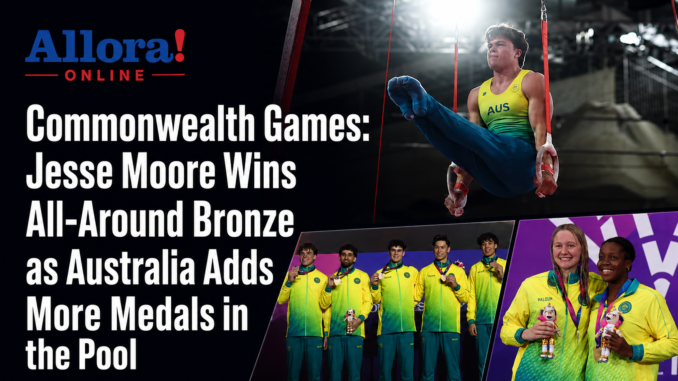
Jesse Moore claimed bronze in the men’s individual all-around gymnastics competition, building on Australia’s earlier third-place finish in the men’s team event.
In swimming, the Dolphins again demonstrated the depth of the Australian program, collecting medals in individual and para events while qualifying several leading contenders for upcoming finals.
Jesse Moore Claims All-Around Bronze
Moore secured third place in one of artistic gymnastics’ most demanding events, which requires competitors to perform consistently across every apparatus.
The result follows Australia’s bronze medal in the men’s team competition, won by Benjamin Foster, Tru Hagens, James Hardy, Ritam Malik and Moore.
It represents another important achievement for the Australian men’s program after the team narrowly missed the podium with a fourth-place finish at the previous Commonwealth Games.
Tim Hodge Wins Gold
Australia’s biggest swimming success of the session came from Tim Hodge, who won the men’s 100-metre backstroke S9 final.
Hodge established an early lead and resisted a strong challenge from Northern Ireland’s Barry McClements on the final lap.
Australian teammate Harrison Vig completed the podium by taking bronze, while Liam Togher finished fourth.
The result reinforced Australia’s strength in para swimming and added another Commonwealth title to Hodge’s successful career.
Sellick and Nicholson Share the Podium
Australia also secured silver and bronze in the women’s 100-metre backstroke S9 final.
Gemma Sellick finished second in a personal-best time of 1:14.06, while Victoria Belando Nicholson claimed bronze in 1:15.11, also setting a personal best.
The result was particularly meaningful for the close friends, who celebrated sharing a Commonwealth Games podium.
Jasmin Fullgrabe finished fourth in 1:16.22.
England’s Alice Tai, an S8 athlete racing in the S9 classification, dominated the final and won gold in 1:11.93.
Sienna Toohey Wins Bronze on Games Debut
Teenager Sienna Toohey produced one of Australia’s most encouraging performances by claiming bronze in the women’s 100-metre breaststroke.
The Albury swimmer was competing at her first Commonwealth Games and found extra speed over the final 25 metres to secure a place on the podium.
“That was a close race. I really had to dig deep, but I’m very happy,” Toohey said after the final.
“I’m always getting better with my times, and that’s all I want.”
Ella Ramsay also delivered a strong performance, finishing just outside the medals in fourth place.
Matthew Temple Misses Gold by One Hundredth
The men’s 100-metre butterfly produced one of the closest finishes of the Games.
Canada’s Joshua Liendo won gold in a Commonwealth Games record of 50.42 seconds, beating Australia’s Matthew Temple by just one hundredth.
Temple claimed silver in 50.43, while Ben Armbruster completed a double Australian podium by winning bronze in 50.58.
The result required a record-breaking swim from Liendo to deny Temple the title.
Harrison Turner was the third Australian in the final, underlining the nation’s depth in the event.
Three Australians Reach the 100m Freestyle Final
Australia dominated the women’s 100-metre freestyle semifinals, with Mollie O’Callaghan, Meg Harris and Shayna Jack recording the three fastest qualifying times.
O’Callaghan won the first semifinal in 53.29, while Harris touched first in the second race in 53.39. Jack finished immediately behind her in 53.67.
The results set up a blockbuster final in which Australia will have a strong chance of claiming all three medals.
O’Callaghan appeared comfortable during her semifinal and may have further improvement available, although Harris and Jack both showed they are capable of challenging for gold.
Sam Williamson Books His Place in the Final
Sam Williamson won the first men’s 50-metre breaststroke semifinal to qualify confidently for the medal race.
Bailey Lello finished fifth in the same semifinal and was forced to wait for the second race before learning whether he had also progressed.
Williamson remains one of Australia’s leading medal hopes in the breaststroke events.
Anticipation Builds for McEvoy and Pallister
Australia also had two of its biggest swimming stars preparing for major finals.
World-record holder Cam McEvoy was scheduled to contest the men’s 50-metre freestyle alongside Jamie Jack and Flynn Southam.
Attention was focused on whether McEvoy could challenge his world mark in swimming’s fastest event.
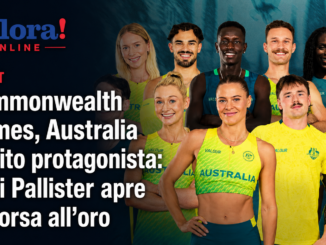
Distance champion Lani Pallister was also set to begin her 1,500-metre freestyle campaign after winning Australia’s first gold medal of the Games in the 400 metres.
Tiana Kritzinger and Molly Walker were also representing Australia in the final.
The session was due to conclude with the men’s 4×200-metre freestyle relay, another event in which Australia entered as a strong favourite.
Godwin and Scott Return to Competition
Following Australia’s gold medal in the women’s gymnastics team event, Georgia Godwin and Breanna Scott returned for the individual all-around final.
Defending champion Godwin and Scott began on vault.
Scott scored 13.100 for her full-twisting Yurchenko, while Godwin received 12.900 for her full-twisting Tsukahara.
After the opening rotation, Scott sat seventh and Godwin was tenth, with uneven bars, balance beam and floor still to come.
Another Frightening Gymnastics Fall
The competition was again disrupted by a serious-looking fall.
Singapore gymnast Jovi Loh was completing his parallel bars routine when he landed awkwardly following a double front somersault with a half twist.
He immediately grabbed his knee and was attended to by medical staff before being removed from the arena on a stretcher.
The incident followed the fall of England’s Gabriel Langton during the men’s team competition.
Langton landed on his head and neck after falling from the high bar but was later discharged from hospital without serious injuries.
Australia’s Commonwealth Swimming Dominance
Australia’s results in Glasgow continue a record of extraordinary success in swimming and para swimming.
Before the 2026 Games began, Australia had already won 331 gold, 246 silver and 220 bronze medals in Commonwealth aquatic events.
The medals collected in Glasgow have pushed the national total beyond 800.
Australia now holds more than 300 additional Commonwealth swimming medals than England, which sits second on the all-time list.
The figures reflect a tradition continually renewed by established champions, teenage debutants and para athletes competing at the highest level.
Australia Keeps Setting the Pace
Moore’s gymnastics bronze, Hodge’s gold and the multiple podium finishes in the pool have strengthened Australia’s position after another outstanding day.
The qualification of O’Callaghan, Harris, Jack and Williamson creates further medal opportunities, while McEvoy and Pallister remain among the leading contenders for upcoming titles.
At Glasgow 2026, Australia is not merely adding to its historic Commonwealth Games record.
It is once again setting the standard.