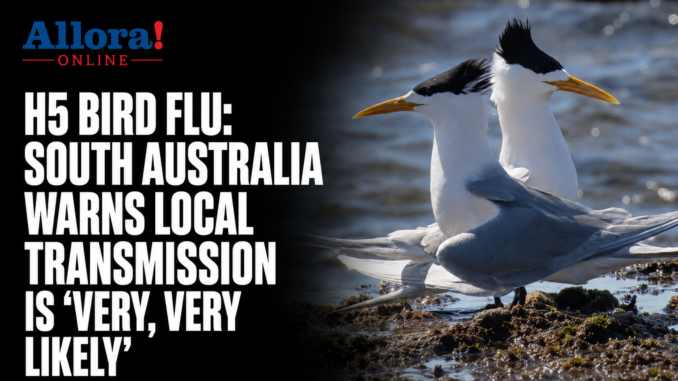
Eleven new suspected cases have been identified across the state’s south-east and Kangaroo Island, with final laboratory results expected within hours
South Australian authorities say it is “very, very likely” that H5 bird flu is spreading locally among wild birds.
If confirmed, the cases would represent the first known local transmission of the virus in the state.
Officials have identified 11 additional suspected cases, including seven in South Australia’s south-east and four on Kangaroo Island.
Primary Industries Minister Clare Scriven said final test results were expected today or tomorrow. However, the pattern of the cases already makes it “extremely likely” that the state is dealing with localised transmission.
Cases detected in two separate areas
The latest suspected infections involve wild birds found in two distinct parts of South Australia.
The concentration of cases in the south-east and on Kangaroo Island has increased concerns that the virus may no longer be limited to isolated infected birds arriving from elsewhere.
Authorities are investigating whether the virus is now being passed between birds within the state.
Greater crested terns are among the latest species linked to the suspected cases.
Samples have been collected, and surveillance is being expanded to determine how widely the virus may have spread.
Laboratory confirmation still pending
The cases remain officially classified as suspected until laboratory testing is completed.
The results will confirm whether the birds were infected with H5 and may also provide more information about the specific strain, the relationship between the cases and the likely source of transmission.
Ms Scriven said the evidence gathered so far strongly points towards localised spread.
That distinction is significant. A single imported case may be managed through targeted action, while established circulation among wild birds requires broader monitoring and stronger biosecurity controls.
Poultry farms on alert
Authorities will now focus on preventing the virus from entering commercial and backyard poultry flocks.
Bird flu can spread rapidly among chickens, turkeys and other farmed birds, causing high mortality and potentially forcing large-scale culling to contain outbreaks.
Poultry producers may be required to strengthen biosecurity measures, including limiting contact between domestic and wild birds, controlling access to farms and disinfecting equipment, vehicles and footwear.
Properties near wetlands, coastal areas and bird migration routes are likely to face particular scrutiny.
Public urged not to touch dead birds
Members of the public should avoid touching dead, sick or unusually behaving wild birds.
Any sightings should be reported to the relevant authorities so trained personnel wearing protective equipment can collect the birds and conduct testing.
Dogs and other pets should also be kept away from bird carcasses.
No immediate risk to the general public has been announced, but direct and unprotected contact with potentially infected animals should be avoided.
Situation remains under investigation
South Australian authorities are continuing to assess new reports and increase surveillance in affected areas.
The laboratory results expected within the next day will be crucial in confirming whether local transmission has occurred and determining what additional measures may be required.
No cases have yet been announced in commercial poultry farms, and there has been no reported impact on the food supply.
However, the emergence of 11 suspected cases across two separate regions is being treated as a serious warning that H5 bird flu may already be circulating within South Australia.