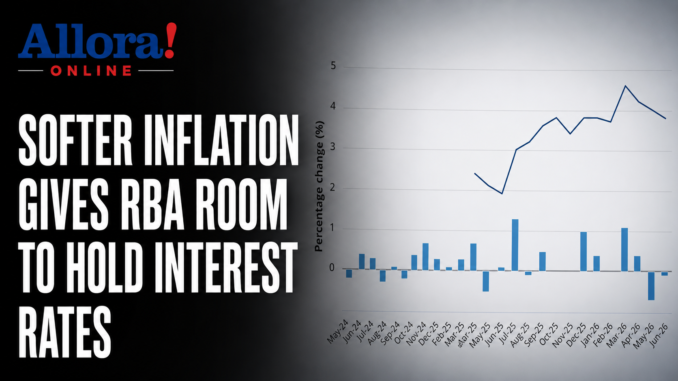
Markets slash the chance of an August rate rise to just 4 per cent. Westpac no longer expects another increase this year, although services, rents and new home construction continue to drive price pressures
Weaker-than-expected inflation has given the Reserve Bank of Australia more room to keep interest rates unchanged after raising the cash rate three times this year.
The latest figures suggest softer consumer spending and a cooling housing market may finally be starting to ease price pressures across the economy.
Financial markets reacted immediately. Following the release, the implied probability of an interest rate increase in August fell from 20 per cent to just 4 per cent.
The chance of another rise before the end of 2026 was also sharply reduced, dropping from 82 per cent to 45 per cent.
Westpac no longer expects another rise this year
Westpac chief economist Luci Ellis said she no longer expected the RBA to increase interest rates again in 2026.
According to Ellis, inflation has been more moderate than both Westpac and the central bank had feared.
The substantial increase in energy costs seen during the early phase of the Middle East conflict has not been followed by the broader price surge many economists had anticipated.
The result marks a significant shift in expectations. Until recently, the possibility of further monetary tightening remained high.
The RBA can now take more time to assess the impact of the three rate increases already delivered before deciding whether another move is necessary.
Bullock had warned of “difficult decisions”
Only a day before the inflation release, RBA Governor Michele Bullock warned that Australia’s inflation problem existed before the conflict in the Middle East.
She said the economy was still operating above its productive capacity, creating persistent price pressures.
Ms Bullock made clear that if inflation failed to continue falling, the RBA board could face “difficult decisions” about whether to raise interest rates again.
The softer result reduces the immediate pressure on the central bank, but it does not completely remove the risk of further tightening.
Services inflation remains a concern
Services inflation remains one of the biggest problems for the RBA, accelerating to 4 per cent in June, its highest annual rate in six months.
In many industries, wages are continuing to grow faster than productivity. Businesses are therefore passing some of their higher operating costs on to customers.
The price of a haircut rose 4.2 per cent over the past year, while restaurant meals became 3.7 per cent more expensive.
These increases are particularly difficult to control through interest rates because they are closely linked to labour costs and weak productivity growth.
The RBA will be concerned that services inflation could remain high even as prices for goods and energy begin to stabilise.
Rents and new homes continue to rise
Housing remains another major source of inflation.
Persistent supply shortages and high construction costs pushed rents up 3.6 per cent over the year.
The cost of building a new home increased by 5.8 per cent, the strongest rise in almost three years.
The housing sector continues to face labour shortages, expensive materials, slow approval processes and insufficient supply.
These structural problems could keep prices elevated even as household demand weakens.
Signs the economy is cooling
The RBA expects higher interest rates to slow demand and gradually return inflation to its target range.
There are tentative signs that this adjustment is already under way.
Recent data has shown softer consumer spending and some weakening in the labour market. The housing market has also cooled more than the central bank expected in May.
Ms Bullock linked the slowdown to the three interest rate rises and to recent government policy changes, an apparent reference to reforms involving negative gearing and the capital gains tax discount.
A weaker property market can help reduce consumer spending and inflationary pressure, although it may also weigh on overall economic growth.
Chalmers calls the figures encouraging
The inflation result provides some political relief for the federal government, which has been trying to convince households that cost-of-living pressures are beginning to ease.
Treasurer Jim Chalmers described the figures as encouraging, while acknowledging that many Australians remain under financial strain.
“We know that inflation is still higher than we would like it to be,” he said, also pointing to the risks created by the Middle East conflict and broader global uncertainty.
For the government, the data supports the argument that economic conditions are gradually stabilising.
However, rents, food, insurance, services and mortgage repayments remain expensive for many households.
Economists remain cautious
Not all economists believe the RBA can consider the inflation fight over.
Betashares chief economist David Bassanese expects Australia to avoid an August rate rise, but said the figures would provide only limited comfort to the central bank.
Inflation in market services and housing remained uncomfortably high over the quarter.
The labour market is still relatively tight, energy risks have not disappeared, and rents and new home prices may continue to rise.
Headline inflation has softened, but the areas most sensitive to domestic demand remain above levels consistent with the RBA’s target.
Relief for borrowers, but no immediate rate cuts
For mortgage holders, the data significantly reduces the risk of another increase in repayments in August.
It does not mean that rate cuts are imminent.
After three increases in a short period, the RBA will want to see clear evidence that inflation is falling sustainably rather than temporarily.
The central bank will closely monitor upcoming employment, wage, consumer spending and services inflation data.
For now, holding rates appears to be the most likely outcome.
The RBA has more room to breathe, but the inflation battle is not yet over. Price growth is slowing, while services, rents and construction costs continue to show that the return to normal conditions will take time.