
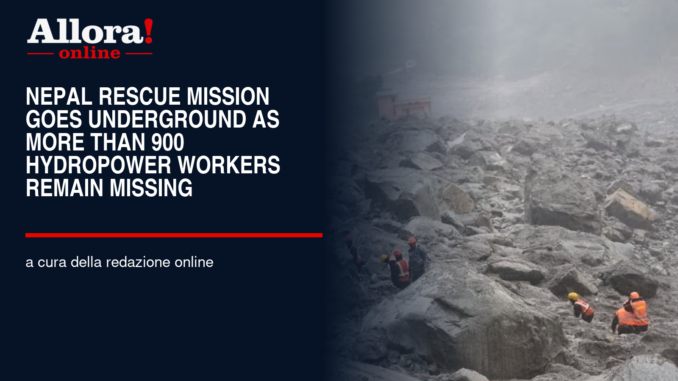
As rescue teams continue searching across the devastation left by the Nepal-Tibet floods, another emergency is unfolding deep underground. More than 900 workers linked to hydropower projects in the affected districts are feared missing. Rescuers are now trying to reach what engineers call “Goldilocks zones” — elevated areas inside underground power stations where pockets of air may have allowed some workers to survive. Australian geologist and engineer Arnold Dix is among the experts providing technical advice on the operation.
The hope is now buried inside the mountains.
Tunnels originally built to harness the immense power of Nepal’s rivers have become the focus of one of the most difficult rescue operations following the catastrophic floods.
More than 900 workers associated with hydropower projects remain unaccounted for after a torrent of ice, rock, mud and water swept through the region near the Nepal-Tibet border.
It is still unclear how many workers were actually underground when disaster struck.
Australian tunnel expert joins rescue mission
Among those assisting emergency crews is Arnold Dix, a Melbourne-based geologist and engineer with extensive experience in underground rescue operations.
Dix became internationally known after helping with the rescue of 41 workers who spent 17 days trapped inside a collapsed tunnel in India.
He believes that, under the right conditions, survivors in Nepal could potentially remain alive for a similar period.
The critical question is whether sections of the underground power stations survived the initial impact and remained protected from flooding and debris.
The “Goldilocks zones”
Rescuers are focusing on the highest sections of the underground facilities.
Dix describes these areas as “Goldilocks zones” — places where conditions may be sufficiently favourable for workers to have survived the initial disaster and found pockets of breathable air.
At the Trishuli 3A Hydropower Project, the underground powerhouse is about 33 metres high, equivalent to an 11-storey building buried inside the mountain.
Experts believe the most promising area is near the top of the structure, above the generator and electrical equipment levels.
Those spaces could potentially contain air, supplies and areas that escaped the worst of the flooding.
Forty-two missing at Trishuli 3A
At least 42 workers are reported missing at Trishuli 3A.
Rescue teams are trying to locate and reopen the access tunnel leading to the underground powerhouse.
But the landscape has been transformed.
The Trishuli River once flowed well below the tunnel entrance. After the flood, the riverbed, roads and access points were buried beneath enormous quantities of debris.
Teams have had to use high-resolution satellite images, engineering plans and helicopter footage simply to determine where the entrances are now located.
Dix described the area as a “lunar landscape”, with familiar landmarks erased and boulders larger than houses scattered across the valley.
Rescuers may have to drill from above
If the original access tunnels cannot be cleared, another strategy is being considered.
Teams may need to drill vertically through the mountain before breaking through the reinforced concrete roof of the underground powerhouse.
It is a highly technical operation that requires extraordinary precision.
A similar rescue effort is underway at the Chilime Hydropower Station, where engineers also believe survivors may have reached the upper section of the underground powerhouse.
Water inside the tunnels is a major concern
There is, however, a worrying sign.
Mud and water found around some tunnel entrances could indicate that flooding penetrated deep into the facilities.
If water reached the upper areas identified as potential survival zones, the chances of finding people alive would be significantly reduced.
At some sites, rescuers have described the tunnels as being filled with mud “like toothpaste in a tube”.
A drone sent through one tunnel reached its far end without detecting any sign of life.
Heavy machinery cannot reach the sites
The terrain is also severely limiting the equipment rescuers can use.
Helicopters can transport personnel and supplies, but the weight restrictions mean many of the machines normally required for a major underground rescue cannot be flown into the area.
“We can get in any machinery we want as long as it’s less than three tonnes,” Dix said, illustrating the scale of the problem.
In many locations, emergency workers are therefore digging with shovels and hand tools.
Dix described the operation as being “well outside any textbook rescue”.
279 workers already rescued
Nepalese Prime Minister Balendra Shah has said that 279 workers have been rescued so far.
That figure is giving emergency teams hope that others may also have survived in underground spaces.
But time is becoming increasingly important.
Even if pockets of air remain intact, survival will depend on access to water, food, temperature conditions and the health of those trapped.
Dix remains cautiously optimistic.
“If there are people alive out there, we are doing our best to find them,” he said.
Under metres of mud, rock and reinforced concrete, rescue teams are searching for spaces that appear small on engineering drawings but could now hold the key to survival. Those “Goldilocks zones” may be the last places where trapped workers are still waiting to be found.