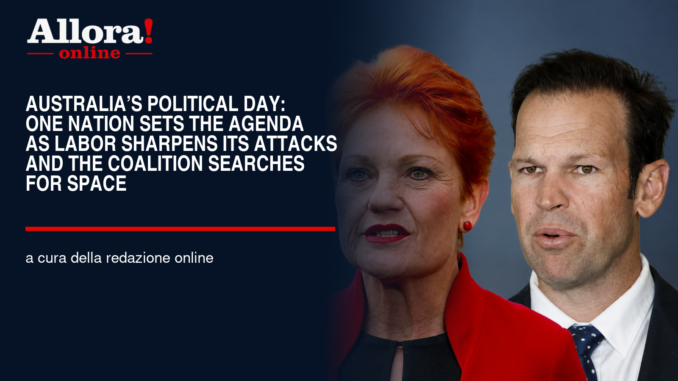
Tax pressure, the clash between Michelle Rowland and Pauline Hanson, and the controversy over racist comments about Australians missing in Nepal-Tibet have dominated the political debate. The common thread is increasingly clear: One Nation is no longer merely part of the conversation — it is forcing Labor and the Coalition to rethink their strategies.
The most important political story of the day is not contained in a single statement. It is in the pattern.
On one front, Australia is again debating the tax burden and whether public frustration over taxation could create an opening for One Nation or the Coalition to argue for a broader overhaul of the system.
On another, the confrontation between Attorney-General Michelle Rowland and Pauline Hanson continues after Rowland referred to extremist and neo-Nazi figures in connection with One Nation.
Then there is a third dispute: a One Nation MP has accused the Race Discrimination Commissioner of going beyond his role after linking far-right rhetoric to racist social media comments directed at Australians missing in the Nepal-Tibet disaster.
Different issues, but one political conclusion: One Nation is increasingly at the centre of Australian politics.
Labor has chosen direct confrontation
The Albanese government’s strategy is becoming clearer.
After One Nation’s breakthrough result in the Secret Harbour by-election and its rise in polling, Labor appears unwilling to treat Pauline Hanson simply as another electoral competitor.
Prime Minister Anthony Albanese has described One Nation as “dangerous” and “divisive”. Rowland has pushed the argument further into the territory of extremism.
That is a deliberate political choice, but it carries risk.
The more Labor frames the contest as a moral battle, the easier it becomes for Hanson to present herself to supporters as the target of an establishment trying to delegitimise her rather than confront the reasons people are voting for her.
That does not mean extremist associations should be ignored. It means political accusations need to be precise and supported, especially when made by senior office-holders.
The Rowland-Hanson clash
That is why the dispute involving Michelle Rowland matters.
Rowland is not just another MP. As Attorney-General, her comments carry additional institutional weight.
References to criminality, extremism or neo-Nazism therefore land differently when they come from the nation’s first law officer.
The Nationals, through Matt Canavan, have already seized on this point, arguing that the government is crossing from political criticism into personal and political delegitimisation.
Labor’s response is that scrutiny of extremist links is a legitimate democratic responsibility.
That argument will not disappear quickly.
Then comes the racism debate
The controversy surrounding racist comments aimed at families of Australians missing in Nepal-Tibet adds another layer.
Some relatives have reported social media comments claiming Australians of Indian heritage are somehow not “real Australians”.
There should be little ambiguity about that proposition: questioning a citizen’s Australian identity because of ethnicity is plainly a serious issue.
The political dispute concerns what follows from it.
One Nation MP David Farley has accused the Race Discrimination Commissioner of going beyond his role by connecting such comments to broader far-right rhetoric.
That raises a legitimate institutional question: combating racism is essential, but attributing political responsibility requires evidence and care, particularly when moving from individual comments to judgments about an entire party.
And underneath it all sits the economy
While politicians argue about extremism, racism and political language, the issue most likely to determine votes remains much simpler: money.
Taxes, mortgages, rents, household bills and purchasing power continue to dominate the concerns of many Australians.
It is significant that the tax debate itself is now being discussed through the prism of whether One Nation or the Coalition can benefit from public frustration.
That should concern Labor.
If the government spends most of its energy fighting Hanson on values and political legitimacy while One Nation succeeds in talking about taxes and the cost of living, the contest may end up being fought on very different ground.
The Coalition has its own problem
The Coalition cannot simply sit back and watch.
One Nation is not taking support only from Labor. In many areas it is competing directly for conservative voters who would traditionally have backed the Liberals or Nationals.
That helps explain why Canavan is attacking Rowland.
But the broader challenge for the Coalition is more difficult: it needs an economic and political agenda of its own strong enough to stop Hanson occupying the entire space of anti-establishment opposition.
The political point of the day
Australian politics is entering a phase in which One Nation does not need to govern to shape the national agenda.
It only needs to force every other major party to respond to its voters, its rhetoric and its rise.
Labor must decide whether to keep treating Hanson primarily as a threat to political norms or to focus more directly on the economic conditions driving protest votes.
The Coalition must decide whether to chase One Nation or offer voters a distinct conservative alternative.
And One Nation, meanwhile, can occupy the easiest political position of all: the party that says everyone else is trying to stop it.
That, more than any single controversy today, is the political development worth w