
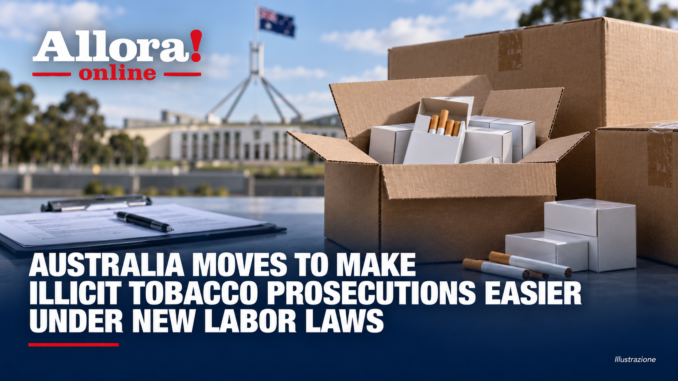
The federal Labor government is preparing a fresh crackdown on Australia’s illicit tobacco market, with new laws designed to make it easier to prosecute organised crime figures, distributors and retailers selling illegal cigarettes. The bill, to be introduced on Thursday, would allow prosecutors to rely on factors such as suspiciously low prices, non-compliant packaging and a lack of documentation to show tobacco was likely imported unlawfully. It would also strengthen powers to seize money and assets linked to the black market.
The federal government is moving to make it easier to prosecute people involved in the illegal tobacco trade.
Assistant Minister for Customs Julian Hill will introduce legislation to modernise the Customs Act, arguing that existing offences were designed for a very different era and are no longer adequate for the scale and sophistication of organised crime operating in the market.
Under current laws, prosecutions can be difficult because authorities often need to prove that an accused person knew the tobacco had been illegally imported and was subject to customs duty.
The new laws are intended to reduce that hurdle.
Suspiciously cheap cigarettes could become evidence
The bill would create separate offences covering the illegal importation of tobacco and the possession or movement of illicit tobacco within Australia.
Prosecutors would be able to point to circumstances that would lead a reasonable person to suspect the product was unlawful.
Those factors could include cigarettes being sold for less than the value of the excise and GST that would apply to a legal product, missing documentation about where the tobacco came from, or packaging that does not comply with Australian rules.
Non-compliant products, including prohibited variants such as menthol cigarettes, could also be used as indicators.
Retailers and companies also in the firing line
The government says the laws are aimed at the entire supply chain.
That includes senior organised crime figures, mid-level operators, distributors, warehouse businesses and retail outlets selling illegal tobacco.
Hill warned that people involved in the illicit tobacco and vape trade should “get a new job and do so quickly”.
He said the government’s focus would remain on serious criminals, but the changes would also make it easier for law enforcement agencies to take action against shops found in possession of illegal products.
Stronger powers to seize criminal assets
The bill would also strengthen proceeds of crime laws.
Investigators would gain broader powers to obtain documents, while rules designed to stop criminals from hiding assets would be tightened.
The aim is not just to secure convictions, but to make it easier to seize cash, cars, houses, boats and other propertypurchased with profits from illegal tobacco sales.
According to Hill, taking away the financial rewards of the trade is one of the most effective ways to hurt organised crime networks.
Tobacco excise remains a major political fight
The crackdown comes as the federal parliament remains divided over the level of tax on legal tobacco.
The Coalition has proposed cutting the tobacco excise by 80 per cent, which it says would reduce the tax on a packet of 20 cigarettes by about A$24.
It has also proposed legalising and taxing nicotine vapes and pouches for adults, along with an additional A$200 million for enforcement and A$60 million for a public education campaign.
One Nation has separately proposed cutting the tobacco excise by 75 per cent, arguing that bringing down the legal price would weaken the black market.
Labor backs enforcement over tax cuts
Labor has taken a different approach.
Health Minister Mark Butler has argued that stronger enforcement is the best way to tackle the black market without undermining Australia’s public health strategy.
The government has said it remains open to other “sensible ideas”, but has not backed the large excise cuts proposed by the Coalition and One Nation.
The political divide is clear.
The opposition argues that very high tobacco taxes have helped create demand for cheap illegal cigarettes.
Labor argues that dramatically reducing the excise could undermine decades of public health policy without necessarily eliminating organised crime.
A two-front battle
The debate now centres on two separate questions.
One is how much legal tobacco should be taxed.
The other is how effectively authorities can prosecute and strip the profits from people selling illegal products.
Labor’s new bill is focused mainly on the second.
The key test will be whether easier prosecutions and stronger asset-seizure powers can significantly reduce a black market that has become increasingly profitable and closely linked to organised crime.

Be the first to comment