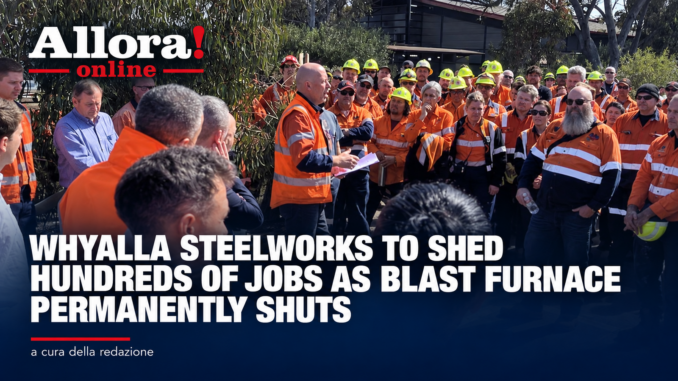
Hundreds of workers are set to lose their jobs at the Whyalla steelworks after administrators confirmed the site’s blast furnace will be permanently shut down. About 500 employees and more than 100 labour-hire workers are expected to be affected, marking a major turning point for one of South Australia’s most important industrial sites.
The decision was communicated to workers on Monday morning, with administrators KordaMentha confirming that steelmaking at the site will cease until new facilities using modern steelmaking technologies are built.
The blast furnace has been offline since April and, despite repeated efforts to restart it, workers have been unable to return it to operation.
The furnace was central to the Whyalla operation, converting iron ore into liquid pig iron before it was processed into steel.
About 600 jobs affected
A letter distributed to workers warned that the shutdown and restructuring would lead to significantly fewer jobs across the business.
Administrators said the changes were expected to affect around 500 employees and 100 labour-hire workers.
KordaMentha partner Sebastian Hams told workers that not everyone would be able to remain with the business.
The company’s first preference would be redeployment, followed by voluntary redundancies and, if necessary, forced redundancies.
Workers facing job losses are being provided with information about retraining, financial advice and mental health support.
Premier in Whyalla as decision lands
South Australian Premier Peter Malinauskas was in Whyalla on Monday and is expected to provide further details about support for affected workers.
The government is also expected to outline potential employment opportunities with other major employers, including BHP.
The scale of the job losses represents a significant change from the cautious optimism surrounding the steelworks when the business entered administration in February 2025.
At the time, Malinauskas said the appointment of KordaMentha was intended to stabilise the operation and prevent immediate job losses.
However, both the government and administrators had increasingly acknowledged in recent months that redundancies could become unavoidable.
Sale process continues
Despite the closure of the blast furnace, the sale of the Whyalla steelworks remains underway.
Jindal Steel and M Resources are still in the running to acquire the business, while BlueScope Steel retains a right of last offer.
Malinauskas said on Sunday that the transaction was still expected to be finalised by the end of the year.
The government has argued that a sale could unlock a major new injection of capital and provide the basis for a long-term industrial future for Whyalla.
The restructuring now makes clear, however, that any future steelmaking operation is expected to look very different from the existing plant.
Steelmaking to stop until new technology is built
The letter to workers stated that steel production would cease until new steelworks assets were constructed using modern technology.
That means the permanent closure of the blast furnace is not simply a temporary operational setback, but part of a broader transition in the plant’s future.
The announcement confirms that some parts of the existing business will disappear entirely, while others will operate with reduced staffing levels.
A long history of instability
The latest development adds another chapter to Whyalla’s difficult industrial history.
The South Australian government took control of the steelworks from Sanjeev Gupta’s GFG Alliance in early 2025 after the company fell into financial crisis, including unpaid government royalties and large debts to creditors.
The intervention involved urgent changes to the Whyalla Steel Works Act and the appointment of administrators.
Whyalla had already endured a major corporate collapse in 2016, when previous owner Arrium entered voluntary administration after reporting heavy financial losses.
A defining moment for Whyalla
For the city, the latest decision is about far more than one piece of industrial equipment.
The steelworks is deeply tied to Whyalla’s economy, identity and employment base.
The permanent closure of the blast furnace and the loss of hundreds of jobs will place immediate pressure on workers, families and local businesses while the government and administrators attempt to secure a buyer and a new industrial model.
The next major questions are how many affected workers can be redeployed, how quickly alternative jobs can be found, and whether a new owner can deliver the promised transition to modern steelmaking.
For Whyalla, the future of steel may still be alive — but the industry that emerges from this crisis is now certain to be smaller, more modern and very different from the one workers have known.