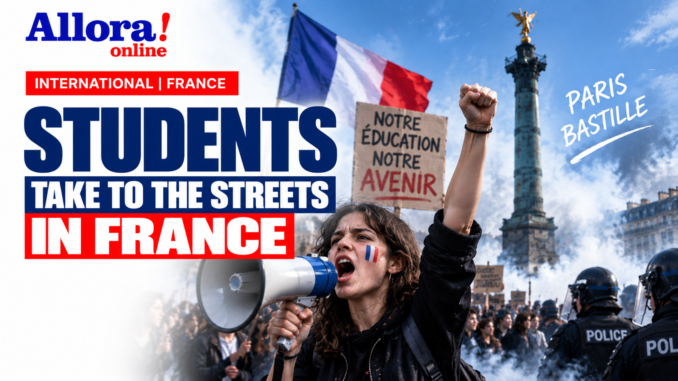
Thousands of students have returned to the streets across France, demanding greater investment in public education, more teachers and improved school conditions. Demonstrations in Paris and other major cities have been marked by clashes with police, tear gas, water cannons and hundreds of detentions. Student organisations warn that protests will continue until the government commits €10 billion to education, while Prime Minister Sébastien Lecornu promises emergency measures by the end of October. UNICEF has called for greater protection of minors as tensions continue to rise ahead of the presidential election.
By the Allora! Online Editorial Team
France is facing one of its most significant waves of student unrest in recent years, as thousands of young people take to the streets demanding substantial improvements to the country’s public education system.
What began as protests against teacher shortages, deteriorating school buildings and overcrowded classrooms has developed into a nationwide movement that is placing increasing pressure on President Emmanuel Macron’s government.
According to France’s Interior Ministry, approximately 71,500 people participated in the latest demonstrations across the country, including 24,500 in Paris.
The authorities reported 504 detentions during the day and 48 injured police officers and gendarmes, as confrontations broke out in several cities.
In Paris, Place de la Bastille became the symbolic centre of the mobilisation, with students gathering to demand immediate government action.
Police used tear gas and water cannons during clashes with groups of demonstrators, while organisers insisted that the movement would continue until their demands were taken seriously.
At the heart of the dispute is a clear financial demand: an additional €10 billion for the education system.
The Bastille becomes the centre of a new student movement
Thousands of students gathered in central Paris for what organisers described as the fourth major coordinated day of nationwide mobilisation.
Demonstrators marched through the capital, carrying banners calling for improved education, equal opportunities and an end to what they describe as the systematic deterioration of public schools.
Many arrived from secondary schools across the Paris metropolitan area, including institutions in disadvantaged suburbs where shortages of teachers and educational resources have become particularly severe.
Other rallies took place in Marseille, Lyon, Nantes, Strasbourg, Lille, Rennes and several smaller cities.
Sabrine Kharbach, spokesperson for the Union Étudiante student organisation, delivered one of the movement’s clearest messages during the demonstration at Place de la Bastille.
She declared that students would continue mobilising until the government committed €10 billion to addressing the crisis.
The demand reflects growing frustration among young people who believe that successive governments have failed to provide adequate investment in public education.
Student organisations have already called for another nationwide day of demonstrations and strikes on Tuesday, October 13.
Education unions are also supporting the initiative, increasing the possibility of further disruption across schools and universities.
Why French students are protesting
The movement is rooted in concerns about the everyday conditions experienced by thousands of students.
Among the most frequently cited problems are teacher shortages, inadequate replacement arrangements when teachers are absent, overcrowded classrooms and school buildings requiring urgent repairs.
Students also complain about inequalities between schools in different regions and social environments.
In some disadvantaged communities, the lack of teaching staff means classes can remain without a qualified teacher for extended periods.
This creates difficulties for students preparing for examinations and university applications.
The problem extends beyond academic performance.
School buildings in poor condition, insufficient support staff and limited access to counselling services are also affecting the learning environment.
Many students argue that these conditions undermine the principle of equal access to quality public education.
Another major source of dissatisfaction is Parcoursup, the French platform used to manage applications for higher education.
Critics argue that the system creates excessive anxiety and can reinforce inequalities between students from different educational and social backgrounds.
The protesters want greater transparency in university admissions and a broader review of how educational opportunities are distributed.
Hundreds of schools disrupted
The demonstrations have caused widespread disruption to the French education system.
Government estimates indicated that classes had been fully or partially suspended at 375 of the country’s approximately 3,700 secondary schools during the latest mobilisation.
Of those institutions, 224 were initially reported completely closed, while another 151 were operating only partially.
Later figures showed that many schools had reopened, although blockades and demonstrations continued in several regions.
The movement has also extended to universities, where students have joined protests over funding, educational opportunities and public services.
Despite the disruption, organisers insist that their intention is not simply to interrupt lessons.
They argue that the protests are designed to secure better conditions for future generations.
For many participants, the central issue is the belief that young people are being asked to accept a declining standard of education while facing an increasingly uncertain economic future.
Clashes in Paris: tear gas and water cannons
The latest demonstrations have again been marked by confrontations between protesters and security forces.
At Place de la Bastille, police deployed tear gas and water cannons after clashes involving groups of demonstrators.
According to the Paris police prefecture, some individuals threw objects and street furniture towards officers.
Authorities also reported the presence of a small group described as belonging to the black bloc movement.
Police said the measures were necessary to prevent attacks on officers and restore public order.
Videos circulated by French media showed groups of protesters confronting police lines and officers using crowd-control equipment.
Student organisations, however, have accused security forces of responding disproportionately to demonstrations involving large numbers of minors.
They maintain that the actions of a relatively small number of violent individuals should not be used to characterise the wider protest movement.
Many of the marches were peaceful, with students, teachers and trade union representatives participating together.
The distinction between peaceful demonstrators and those responsible for violence has become one of the central issues in the national debate.
Serious injuries raise questions about police tactics
The controversy surrounding policing has intensified following several incidents in which young demonstrators sustained serious injuries.
One of the most disturbing cases involved a 15-year-old student in Lens, northern France, who lost a hand after a police-issued stun grenade exploded.
The circumstances surrounding the incident are under investigation.
In another case, a 14-year-old boy suffered serious facial injuries after being struck by a tear gas projectile during a confrontation with police near Paris.
A police officer has been placed under formal investigation in connection with that incident.
The injuries have prompted public concern over the use of crowd-control weapons at demonstrations involving children and adolescents.
France’s police oversight body, the Inspection Générale de la Police Nationale, has opened 18 investigations into allegations of misconduct connected with the protests.
Interior Minister Laurent Nuñez has announced the suspension of certain stun grenades during student demonstrations while investigations continue.
The government has defended the overall conduct of security forces, maintaining that officers are instructed to act proportionately and intervene when violence threatens public safety.
Critics argue that the number and severity of injuries raise serious questions about whether those standards have consistently been met.
UNICEF calls for protection of minors
UNICEF France has intervened in the debate, urging both authorities and protesters to prevent further violence.
The organisation has reminded the French government that children and adolescents have the right to participate peacefully in demonstrations and express their views on decisions affecting their lives.
Under the United Nations Convention on the Rights of the Child, young people are entitled to freedom of expression and peaceful assembly, subject to lawful restrictions.
UNICEF has emphasised that police operations must take account of the age and vulnerability of minors.
It has also called on security forces to distinguish clearly between peaceful protesters and individuals involved in violence.
The organisation warned against treating large groups of young demonstrators as though all participants represented the same level of threat.
UNICEF has stressed that legitimate concerns about vandalism and attacks on police officers must not undermine the fundamental rights of children participating peacefully in public demonstrations.
The intervention has added an important human rights dimension to the dispute.
What began as a campaign over school funding has become a broader debate about the relationship between young citizens and the institutions responsible for protecting them.
Violence also affects teachers and school staff
The unrest has not been limited to confrontations between protesters and police.
Several members of school staff have reportedly been injured during incidents involving blockades, vandalism and attacks on educational institutions.
In Marseille, a deputy headteacher at Lycée Victor Hugo was reportedly assaulted while attempting to extinguish a fire involving burning rubbish.
According to local authorities, the staff member was pushed to the ground and attacked.
A complaint has been lodged and an investigation opened.
Other incidents have involved damage to school entrances, fires and attacks on public infrastructure.
French authorities have condemned these acts and argued that violence is undermining the legitimacy of the students’ demands.
Education Minister Édouard Geffray has urged parents to help ensure their children’s safety and has expressed concern that some demonstrations are being exploited by individuals seeking confrontation.
Student representatives have also been forced to address the issue of violence within and around the movement.
The challenge for organisers is to maintain public support while preventing violent incidents from overshadowing the original educational demands.
The government promises an emergency response
Prime Minister Sébastien Lecornu has acknowledged the seriousness of the students’ concerns.
In an address from Matignon, the official residence of the French prime minister, he said that the frustration expressed by young people could not be ignored.
Lecornu promised that the government would present its first concrete decisions by the end of October.
However, student organisations have criticised the timetable, arguing that the problems require immediate solutions.
Education Minister Édouard Geffray has announced plans for an emergency programme focusing particularly on the replacement of absent teachers.
The initiative is expected to include measures designed to improve the availability of teaching staff and address some of the most serious disruptions to classroom learning.
The government is also examining school timetables, student participation in school governance and concerns surrounding university admissions.
Officials have held discussions with representatives of major student organisations in an attempt to identify areas of agreement.
Nevertheless, the government has not committed to meeting the €10 billion funding demand.
That remains the central unresolved issue.
France’s budget crisis complicates the negotiations
The demands come at a difficult time for French public finances.
The government is preparing its 2027 budget while facing pressure to reduce public spending and contain one of Europe’s highest levels of government debt.
Lecornu has indicated that significant fiscal adjustments will be necessary to stabilise public finances.
The prospect of committing an additional €10 billion to education therefore raises questions about how such expenditure would be financed.
Students and education unions argue that schools should be considered a national investment priority rather than an area where expenditure can be continually restricted.
The government faces the competing task of responding to educational needs while controlling deficits and reassuring financial markets.
This tension is likely to shape the negotiations.
Increasing spending on education could require changes elsewhere in the budget, additional revenue or a revision of existing fiscal targets.
But failing to address the concerns could prolong demonstrations and contribute to wider social dissatisfaction.
A political crisis ahead of the presidential election
The student protests have also become an important issue in French politics.
With the presidential election approaching in 2027, the movement is attracting increasing attention from political parties.
Jean-Luc Mélenchon, leader of La France Insoumise, has publicly supported the students and criticised the government’s handling of the demonstrations.
He has accused the authorities of responding to legitimate social concerns with excessive force.
Government representatives reject that characterisation and argue that police intervention is necessary when demonstrations become violent.
Parties on the right have also criticised the government’s management of the crisis, although they differ significantly from the left over public spending and responses to disorder.
The situation has intensified debates about the future of public services, government spending and the role of young people in political decision-making.
For the French government, the challenge is not merely to restore order.
It must also demonstrate that the concerns expressed by students can be addressed through democratic institutions.
Italian students join the movement
The protests have attracted attention beyond France.
Delegations of Italian students have travelled to Paris to express solidarity with their French counterparts.
Representatives of the Rete degli Studenti Medi and other student organisations have participated in demonstrations and meetings with French activists.
Italian student groups argue that many of the problems raised in France have parallels in Italy.
These include inadequate investment in school buildings, inequalities in educational opportunities and concerns about the financial difficulties facing young people.
The mobilisation has also inspired school occupations and demonstrations in Italian cities, including Rome and Turin.
Student representatives see the French protests as part of a broader European debate about the future of public education.
However, the political and educational circumstances differ between countries, and the movements retain their own specific national demands.
The next mobilisation is already planned
Despite the government’s promises, student organisations show little sign of ending their campaign.
The next nationwide day of action is scheduled for Tuesday, October 13, with calls for students, teachers and university staff to participate.
Union leaders insist that meaningful financial commitments are necessary before the movement can be brought to a conclusion.
The government hopes that dialogue, emergency measures and the reopening of schools will gradually reduce tensions.
But the protests have demonstrated that dissatisfaction extends beyond a small number of institutions.
The movement has brought together students from disadvantaged suburbs, prestigious schools and different social backgrounds, united by concerns about the quality and accessibility of education.
Whether the planned government measures will satisfy those concerns remains uncertain.
A generation demanding to be heard
The French student protests reveal a deeper tension between young people and the institutions responsible for preparing them for the future.
For many demonstrators, the issue is not simply the number of teachers or the condition of school buildings.
It is the belief that their education, opportunities and future prospects are not receiving sufficient political attention.
Their demands are being expressed through a movement that has become both a challenge for public authorities and a test of the country’s commitment to democratic participation.
Violence against police officers, school staff or civilians cannot be justified by political demands.
At the same time, the right to demonstrate peacefully and the obligation to protect minors remain essential principles.
Those two responsibilities must be addressed together rather than treated as mutually exclusive.
France now faces a choice between allowing the confrontation to deepen and developing a credible response capable of addressing the structural problems that brought students into the streets.
The government has promised action. Student organisations are demanding funding and measurable results.
The next days will determine whether dialogue can begin to bridge that gap.
For thousands of young people across France, the message remains clear: education is not simply another item in the national budget. It is the foundation of their future.