
Allora! Online – Redazione
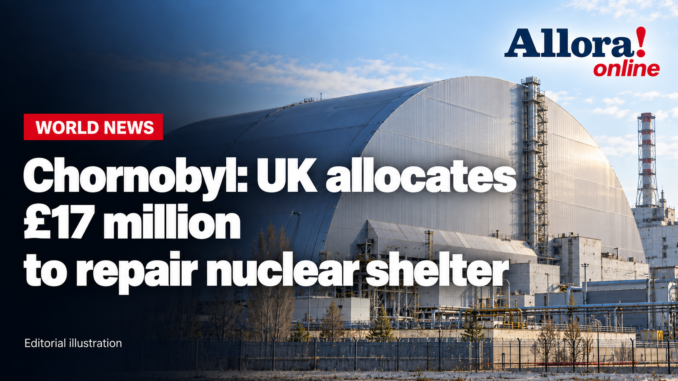
The United Kingdom announced a further £17 million contribution on 15 October to repair the protective structure at the Chornobyl nuclear power plant, damaged by a drone in February 2025. The funding will go towards the international program coordinated by the European Bank for Reconstruction and Development, alongside the Ukrainian government and G7 donors.
According to the British statement, which attributes the attack to Russia, the work must restore the shelter’s confinement and ventilation functions and preserve its intended lifespan. London warns that, without adequate repairs, corrosion could undermine the investments already made and increase environmental and safety risks over time.
The large metal arch, known as the New Safe Confinement, encloses the remains of reactor number four, destroyed in the 1986 disaster, and the old sarcophagus built immediately after the accident. As the European Court of Auditors notes, the new structure was completed in 2019 to limit contamination outside the shelter and allow the previous enclosure to be dismantled. The entire plan to make the site safe cost around €2.2 billion.
Technical preparations for the restoration have already entered a new phase. The plant operator said a contract for initial engineering work was signed with the Novarka 2 consortium in Vienna on 16 September. This work includes gathering available information, targeted studies and inspections, and developing initial restoration designs. It is expected to take around seven and a half months.
The contract is part of a broader first phase, backed by €30 million in funding and scheduled to run for around seventeen months. The operator’s stated aim is to restore the structure’s full functionality by 2030. In the meantime, temporary repairs are continuing to keep it stable while the permanent work is prepared.
The damage to the shelter requires attention, but the technical findings need to be understood in context. In its 14 April update, the operator reported that no radioactive releases above the prescribed limits had been recorded and that the load-bearing structures were not damaged. The same document nevertheless confirmed that the enclosure was no longer fully sealed and that this needed to be restored.
The contribution announced today therefore supports a multi-year effort to protect the site while repairs are designed and carried out. Full restoration by 2030 remains a program target, with technical assessments and work still to be completed.