
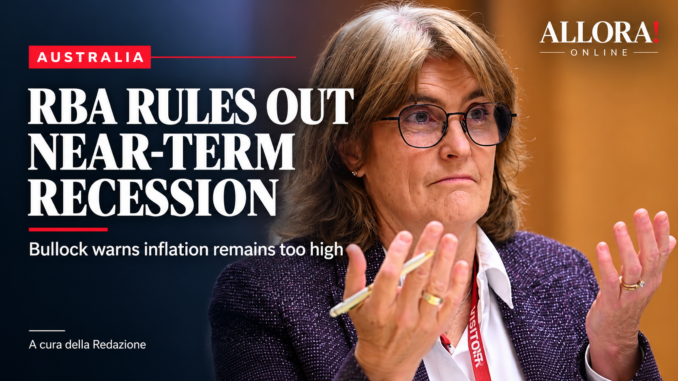
Australia’s annual inflation rate has risen to 4.3%, while unemployment stands at 4.7%. Reserve Bank Governor Michele Bullock warns that price pressures remain persistent, despite assurances from chief economist Sarah Hunter that the economy shows no immediate signs of recession. With the official cash rate at 4.60%, another crucial interest rate decision is approaching on November 3.
Australia is showing no immediate signs of entering a recession, but the Reserve Bank has issued a fresh warning that inflation remains dangerously persistent, raising concerns about the possibility of further interest rate increases.
Reserve Bank of Australia Governor Michele Bullock and chief economist Sarah Hunter delivered their assessment during a Senate Economics Legislation Committee hearing, as new figures revealed another acceleration in consumer prices.
According to the Australian Bureau of Statistics (ABS), annual inflation reached 4.3% in September 2026, up from 4.0% in August, moving further above the central bank’s target range of 2–3%.
Underlying inflation, measured by the trimmed mean, also increased to 3.6%, compared with a revised 3.5% in August.
The figures arrive at a difficult moment for Australian households, already facing higher mortgage repayments, rising living costs and a labour market that has begun to weaken.
Despite these pressures, the Reserve Bank maintains that the economy is not currently displaying the warning signs associated with an imminent recession.
RBA chief economist dismisses immediate recession fears
Questioned by Greens Senator Nick McKim about the impact of interest rates and rising unemployment, Sarah Hunter said the central bank was examining a broad range of indicators to assess Australia’s economic health.
These include employment, household spending, business investment, output and overall demand.
Hunter told the hearing that none of the indicators currently monitored by the Reserve Bank suggested the economy was already in recession or heading towards one in the immediate future.
Her assessment provides some reassurance to households and businesses concerned that higher borrowing costs could push Australia into an economic downturn.
However, the distinction is important.
The Reserve Bank is not guaranteeing that Australia will avoid a recession. Rather, its current assessment is that the available evidence does not point to an imminent contraction.
The central bank is attempting to achieve what economists commonly call a soft landing: reducing inflation without causing a sharp decline in economic activity or widespread job losses.
Achieving that balance is becoming increasingly complicated.
Michele Bullock: inflation remains far too high
Governor Michele Bullock delivered a firm warning after the release of the latest inflation figures.
Speaking before the Senate committee, Bullock said the evidence showed that inflation remained far above acceptable levels.
She rejected the suggestion that Australia’s inflation problem could be explained entirely by international supply disruptions.
Although higher global oil prices and instability in the Middle East have pushed up costs, the Governor stressed that domestic demand is also contributing to persistent inflation.
The Reserve Bank believes that demand in parts of the economy remains too strong relative to available productive capacity.
When demand exceeds supply, businesses can face greater pressure on costs and prices.
Higher interest rates are intended to slow spending and borrowing, bringing demand into better balance with the economy’s ability to produce goods and services.
Bullock defended this approach, arguing that monetary policy remains an appropriate tool for controlling inflation.
The challenge is that the same mechanism places financial pressure on mortgage holders, consumers and businesses.
Inflation rises to 4.3% as housing and transport costs surge
The latest ABS figures reveal that inflationary pressure is affecting some of the most important areas of household spending.
Housing costs increased by 5.2% over the year to September, making them the largest contributor to annual inflation.
Transport costs rose by 8.7%, driven largely by higher fuel prices.
Automotive fuel prices increased by 9.4% in September alone, reflecting the impact of international oil markets.
For Australian families, these increases are particularly difficult to avoid.
Housing, transport and other essential services account for a substantial share of household budgets, leaving less money available for discretionary spending.
The trimmed mean measure, which reduces the influence of unusually large price movements, shows that inflation is not confined to a handful of volatile items.
At 3.6%, underlying inflation remains above the Reserve Bank’s target, suggesting that broader price pressures have not yet been brought under control.
The September-quarter trimmed mean, measured using the ABS’s traditional quarterly methodology, stood at 3.7% over the year.
Although these measures are calculated differently, both indicate that inflation remains persistent.
Unemployment reaches 4.7%
While inflation continues to trouble the Reserve Bank, Australia’s labour market is showing signs of weakness.
The seasonally adjusted unemployment rate reached 4.7% in September, compared with 4.1% at the beginning of 2026.
The ABS reported that employment fell by approximately 39,300 people during September, while the number of unemployed Australians increased by around 8,900 to 732,000.
The employment-to-population ratio declined to 63.6%, reflecting a reduction in the proportion of Australians currently employed.
These figures suggest that economic conditions are becoming more challenging, particularly for workers seeking employment and businesses managing higher costs.
However, the Reserve Bank believes that parts of the labour market remain relatively tight.
In her opening statement, Bullock noted that underlying inflation continues to reflect domestic capacity constraints, despite the recent increase in unemployment.
This creates a difficult policy dilemma.
If interest rates remain elevated for too long, employment and household spending could weaken further.
If rates are reduced before inflation is sustainably under control, price pressures could persist and potentially require more aggressive action later.
Four interest rate increases in 2026
The Reserve Bank has already raised the official cash rate four times during 2026, by a cumulative 100 basis points.
The rate currently stands at 4.60%, following the latest increase in September.
For mortgage holders, these decisions have meant progressively higher borrowing costs, particularly for households with variable-rate home loans.
A one-percentage-point increase in interest rates can translate into substantial additional repayments over the life of a mortgage.
The precise impact depends on the outstanding loan balance, remaining term, interest rate and lender.
The consequences also extend beyond homeowners.
Small businesses face higher financing costs, while households without mortgages can still experience the effects of tighter credit conditions through employment, rental markets and consumer spending.
The Reserve Bank acknowledges these difficulties but argues that persistently high inflation would ultimately weaken purchasing power and economic stability.
Bullock has repeatedly emphasised that inflation particularly affects lower-income households, which typically spend a greater proportion of their income on essentials.
Global oil prices add another layer of pressure
The RBA’s inflation challenge is being complicated by international developments.
The conflict in the Middle East has contributed to higher global energy prices, increasing costs for transport, production and distribution.
These pressures can eventually spread throughout the economy as businesses pass additional expenses on to their customers.
Bullock also highlighted the impact of extreme weather and growing demand for technology associated with artificial intelligence.
The global AI boom is increasing demand for certain electronic components and data-centre infrastructure, contributing to higher costs in some technology markets.
However, the Governor stressed that Australia’s inflation problem existed before the latest international energy shock.
In her assessment, overseas developments are intensifying pressures that were already present in the domestic economy.
The Reserve Bank’s August forecasts suggested inflation could return towards the midpoint of its target range by late 2027.
Recent developments now indicate that the return to price stability could prove more difficult than previously expected.
The housing market is also under pressure
The effects of higher interest rates are increasingly visible in Australia’s property market.
According to the Reserve Bank, housing conditions have softened, with prices declining across most capital cities and demand for new housing loans easing.
Nevertheless, Australian property remains considerably more expensive than it was before the pandemic.
Bullock noted that housing prices are still around 50% higher than in early 2020.
Australia’s longstanding shortage of housing continues to complicate the outlook.
The Governor also stressed that the RBA does not set interest rates with the objective of raising or lowering property prices.
Its monetary policy decisions are directed towards inflation, employment and economic stability.
For prospective buyers and existing homeowners, however, the relationship between rates, lending capacity and housing affordability remains a central financial concern.
November 3: the next critical interest rate decision
Attention now turns to the Reserve Bank’s next Monetary Policy Board meeting, scheduled for November 2–3.
The official interest rate decision will be announced at 2:30 pm AEDT on Tuesday, November 3, 2026.
Policymakers will need to consider whether the four rate increases already delivered this year are sufficient to bring inflation sustainably back towards target.
The latest CPI figures have increased concern about inflation, but they do not automatically mean another rate rise will occur.
The Board must also assess unemployment, business investment, household spending and the delayed effects of earlier tightening.
Interest rate changes do not affect the entire economy immediately.
Some borrowers experience the effects relatively quickly, while adjustments in spending, business investment and employment can take considerably longer.
The RBA has not announced its next decision in advance.
Australia faces a difficult economic balancing act
The latest economic figures present two contrasting realities.
Australia’s economy continues to demonstrate resilience, and the Reserve Bank does not currently expect an imminent recession.
At the same time, inflation remains stubbornly above target, unemployment has increased and many households are struggling with higher expenses.
For the central bank, the challenge is to bring inflation down without weakening the economy unnecessarily.
For Australian families, the concerns are more immediate: mortgage repayments, groceries, fuel, rent and the security of their employment.
The November interest rate decision will provide an important indication of how the Reserve Bank intends to manage these competing pressures.
Australia may be avoiding recession for now, but the cost-of-living crisis is far from over. With inflation rising again, the Reserve Bank faces a difficult question: can it restore price stability without placing even greater pressure on households already struggling to make ends meet?


