Amid the growing regional crisis linked to the conflict with Iran, Pakistan has reportedly deployed thousands of troops, fighter jets and air defence systems to Saudi Arabia under a bilateral military agreement that could significantly reshape the strategic balance of the Middle East.
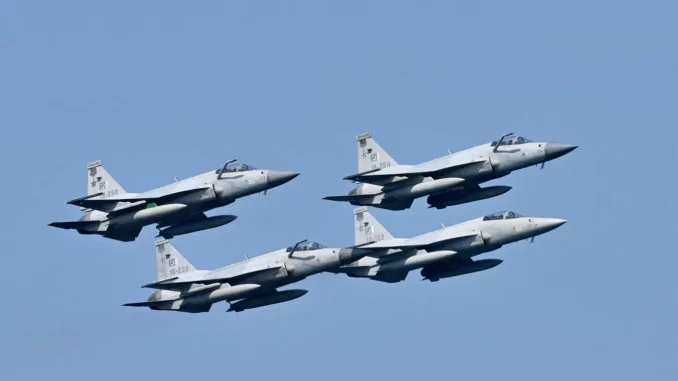
According to an exclusive report published by Reuters, Islamabad has sent around 8,000 soldiers, a squadron of JF-17 fighter jets jointly developed with China, and HQ-9 missile defence systems to strengthen Saudi Arabia’s military capabilities.
The move highlights how the Middle East is entering a new phase of silent militarisation, where regional alliances, energy interests and geopolitical rivalries are increasingly intertwined with the global competition involving the United States, China and Iran.
A strategic alliance growing stronger
Relations between Pakistan and Saudi Arabia are not new. For decades, Islamabad has provided military assistance, training and strategic cooperation to Riyadh.
This time, however, the scale of involvement appears far deeper.
According to Reuters sources, the new mutual defence agreement signed last year could allow for the deployment of up to 80,000 Pakistani troops inside Saudi territory in the event of a direct threat.
Such a number would effectively transform Pakistan into one of the kingdom’s main security pillars.
China’s growing influence behind the scenes
One of the most significant aspects of the deployment is the presence of HQ-9 air defence systems and JF-17 fighter jets, both heavily tied to Chinese military cooperation.
This suggests that China is indirectly expanding its military influence in the Gulf without deploying its own armed forces directly.
China is currently Saudi Arabia’s largest trading partner and one of the biggest buyers of Iranian oil, while also maintaining close strategic ties with Pakistan.
The result is an extremely delicate geopolitical triangle in which Beijing manages to preserve economic and military relations with all the region’s key players simultaneously.
Islamabad balancing mediation and deterrence
Pakistan’s position appears both strategic and contradictory.
On one hand, Islamabad has acted as a major diplomatic mediator between Washington and Tehran, hosting peace talks and helping broker a ceasefire that has reportedly held for several weeks.
On the other hand, Pakistan is simultaneously strengthening Saudi Arabia militarily while tensions with Iran continue to escalate.
This dual role reflects Islamabad’s complicated strategic reality.
Pakistan cannot afford a complete rupture with Iran, with which it shares a long border and sensitive regional dynamics. At the same time, it remains heavily dependent on Saudi financial support.
Over recent years, Riyadh has repeatedly assisted Pakistan during financial crises and debt pressures, becoming one of Islamabad’s most important economic partners.
The nuclear question
One of the most sensitive aspects concerns previous remarks made by Pakistani Defence Minister Khawaja Asif, who implied that Saudi Arabia could effectively fall under Pakistan’s “nuclear umbrella.”
Pakistan remains the only officially nuclear-armed Muslim country in the world.
Although no formal nuclear agreement between Islamabad and Riyadh has ever been confirmed publicly, analysts have long speculated about deeper strategic cooperation between the two nations.
Should regional tensions escalate further, this issue could become one of the most destabilising factors across the Middle East.
The risk of a wider regional conflict
The Reuters report comes at an extremely fragile moment.
According to the agency, Saudi Arabia has allegedly carried out unpublicised retaliatory strikes against Iranian targets following attacks on Saudi territory.
If confirmed, this would suggest that the confrontation between Iran and Saudi Arabia has already entered a more direct phase, even if it still falls short of a declared open war.
And that is precisely the greatest danger: a regional spiral in which every attack triggers new retaliation, gradually pulling more countries into the conflict.
A new Middle Eastern order emerging
Pakistan’s deployment also signals a broader transformation.
The Middle East is no longer shaped exclusively by American influence. Today, the region is increasingly defined by hybrid alliances involving Saudi interests, Chinese technology, Pakistani diplomacy and Iranian tensions.
Modern conflict is no longer fought only with tanks and invasions.
It is fought through confidential defence agreements, missile systems, drones, intelligence operations, energy leverage and strategic deterrence.
And behind the silence of official diplomacy, the Middle East continues to quietly rearm itself.