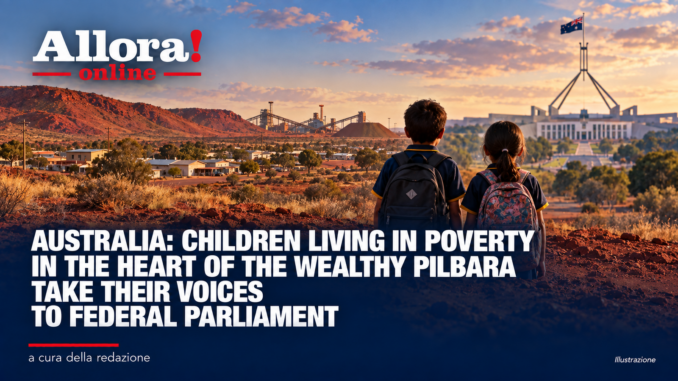
Billions of dollars in mineral exports leave Port Hedland every month, yet just a short distance away children in South Hedland are living with overcrowded or substandard housing, food insecurity, inadequate air conditioning and, in some cases, a lack of safety. The End Child Poverty campaign is now taking their voices directly to Canberra, calling for a nationally legislated strategy to tackle child poverty.
It is one of the starkest contradictions in modern Australia.
The Pilbara, in Western Australia, has long been described as one of the engines of the national economy. Port Hedland handles billions of dollars in trade each month and is one of the world’s largest bulk export ports.
Yet less than 15 kilometres away, in South Hedland, children are experiencing what local organisations describe as profound disadvantage.
The End Child Poverty campaign, led by the Valuing Children Initiative in partnership with the local Youth Involvement Council, has recorded the voices of children in the community and is taking those testimonies to Canberra to be heard by federal ministers and MPs.
“Poor housing, little food and not enough safety”
Tania Murray, chief executive of the Youth Involvement Council, says the contrast between the region’s wealth and the living conditions faced by some young people is confronting.
Some children return home to housing below acceptable standards, she said, with little food, overcrowding and inadequate air conditioning despite the desert climate.
At times, she added, there is also very little sense of safety.
That, Murray argues, is the point at which poverty stops being merely an economic statistic.
Children telling their own stories
The project was designed not simply to collect data, but to allow children to speak for themselves.
Their voices were recorded and are being played to political decision-makers in Canberra.
Sarah Quinton, executive director of the Valuing Children Initiative, said it was important to ask children directly about what they were experiencing.
The Youth Involvement Council works with around 500 children and young people, and staff say many arrive hungry, tired, having not eaten, slept properly or attended school.
Wealth and disadvantage side by side
Socio-economic data also shows a gap between South Hedland and the broader Port Hedland area.
According to the Australian Bureau of Statistics’ SEIFA index, which measures relative socio-economic advantage and disadvantage, South Hedland has a score of 989, compared with 1,011 for the wider Port Hedland area.
The figure does not tell the whole story of childhood poverty, but it reinforces concerns that the enormous wealth generated in the region is not being shared evenly.
A “two-speed economy”
Western Australia’s Commissioner for Children and Young People, Jacqueline McGowan-Jones, has described the situation as a “two-speed economy”.
On one side, vast amounts of wealth leave the port every day.
On the other, some children and families continue to struggle with basic needs.
McGowan-Jones said the issue is well known among elders, community groups and Aboriginal community-controlled organisations across the region.
Calls for a national child poverty strategy
The End Child Poverty campaign is now calling for a nationally legislated strategy to end child poverty.
The proposal would include a clear definition of child poverty and specific indicators designed around children’s experiences.
Quinton argues that many conventional economic measures — such as inflation, mortgage rates and cost-of-living figures — are largely adult-focused.
Understanding child poverty, she says, requires measures that reflect issues such as food, housing, safety, education, sleep and the ability to participate in everyday life.
“We have to stop blaming kids”
McGowan-Jones also supports a national poverty reduction strategy.
Children, she said, cannot be blamed for the circumstances into which they are born.
Failing to provide the right services and support risks sending young people the message that they do not matter.
For campaigners, that is the central argument: child poverty should be treated as a measurable national policy priority, not as a marginal social issue.
Federal government response
The federal Department of Social Services said the government is working to break cycles of disadvantage and improve children’s wellbeing.
A spokesperson acknowledged that families in regional and remote communities such as the Pilbara can face unique barriers and pointed to existing programs designed to improve wellbeing and social connection.
Local advocates, however, say more is needed.
“Come and see it”
Tania Murray has issued a direct invitation to decision-makers in Canberra.
Her message is not simply to read reports or allocate funding, but to visit South Hedland and see the situation firsthand.
Most importantly, she says, politicians should sit down with young people and listen.
That is the core message of the End Child Poverty campaign: in one of the wealthiest regions in Australia, some children are still growing up without enough food, adequate housing or a basic sense of safety.
Now, their own voices are being taken to federal parliament.