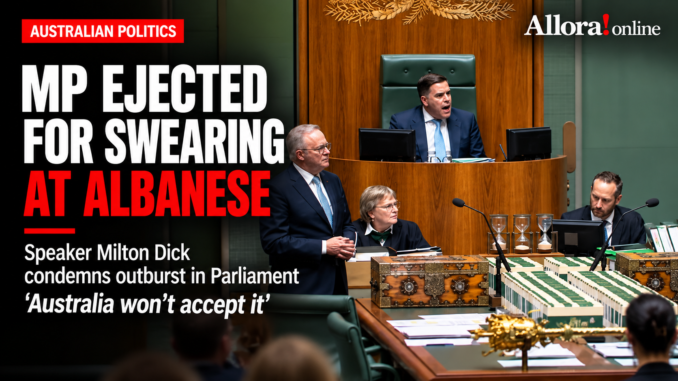
House Speaker Milton Dick delivers a stern rebuke as Nationals MP Llew O’Brien is removed for three hours during a heated exchange over climate change, reigniting concerns about respect and political conduct in Canberra.
Australia’s federal Parliament descended into controversy on Wednesday, 28 October, when Nationals MP Llew O’Brien was ordered out of the House of Representatives after swearing at Prime Minister Anthony Albanese during a heated Question Time exchange.
The incident prompted an unusually forceful intervention from House Speaker Milton Dick, who condemned the language and warned that such behaviour would not be tolerated in Australia’s Parliament.
The confrontation erupted as Albanese responded to questions about the government’s climate change policies and expenditure. One Nation MP Barnaby Joyce had challenged the Prime Minister over the billions of dollars allocated to the climate change department.
As Albanese defended the government’s position, pointing to the growing frequency and intensity of extreme weather events, O’Brien, the Member for Wide Bay in Queensland, reportedly interrupted with the word “bullshit”.
Dick immediately intervened, ordering O’Brien to leave the chamber and imposing a three-hour exclusion.
“Swearing in the parliament is completely unacceptable,” the Speaker declared, before delivering his emphatic warning: “Australia won’t accept it.”
A Parliament Under Pressure to Restore Respect
The incident comes at a particularly sensitive moment for Australian politics, with renewed calls for greater civility following the recent attack on independent MP Helen Haines.
Parliamentarians have been encouraged to sign a civility pledge committing themselves to respectful behaviour, honesty and compassion in political debate.
The episode involving O’Brien has highlighted the difficulties of translating those commitments into everyday parliamentary conduct.
Despite widespread agreement that intimidation and violence have no place in Australian democracy, political leaders remain divided over whether aggressive parliamentary language contributes to a broader culture of hostility.
Opposition Leader Angus Taylor has rejected suggestions that vigorous parliamentary debate should be associated with political violence.
Taylor has defended the Westminster parliamentary tradition, arguing that strong disagreement is fundamental to democratic accountability and must remain distinct from intimidation or physical aggression.
His position reflects a continuing debate over where legitimate political confrontation ends and unacceptable behaviour begins.
The Challenge of Parliamentary Leadership
For Speaker Milton Dick, Wednesday’s confrontation represented another test of his authority and his efforts to maintain order in an increasingly combative House of Representatives.
O’Brien was not the only parliamentarian removed during the session. Nationals MP Darren Chester was also ejected following a separate incident, underscoring the tense atmosphere in the chamber.
Beyond the immediate disciplinary action, the confrontation raises a broader question about the standards Australians should expect from their elected representatives.
Robust debate remains an essential feature of parliamentary democracy. Yet the right to challenge a government, question its decisions and fiercely oppose its policies does not remove the responsibility to respect parliamentary rules.
At a time when Australia’s political institutions are facing renewed scrutiny over conduct and public safety, the Speaker’s intervention has become a reminder that freedom of political expression and standards of behaviour must coexist within the nation’s democratic institutions.