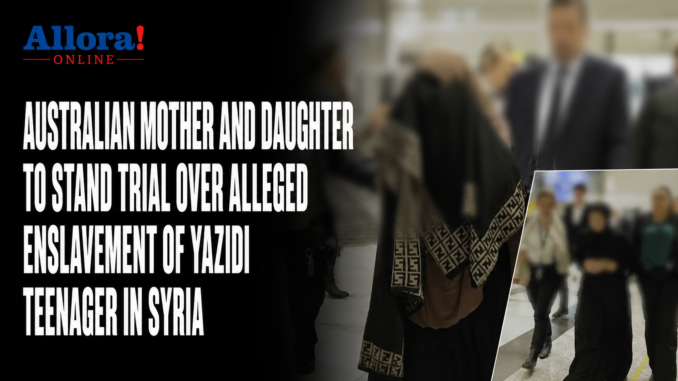
Kawsar Ahmad and Zeinab Ahmad have pleaded not guilty to slavery-related offences allegedly committed while living in territory controlled by Islamic State. Their case will now proceed to the Victorian Supreme Court
An Australian mother and daughter accused of keeping a Yazidi teenager as a slave while living in Syria under Islamic State rule will stand trial in Victoria.
Kawsar Ahmad, 54, and Zeinab Ahmad, 31, appeared before the Melbourne Magistrates’ Court on Friday, where they were committed to face trial in the Victorian Supreme Court.
Both women have pleaded not guilty and intend to contest the allegations.
Kawsar Ahmad faces four crimes-against-humanity charges relating to alleged enslavement, possessing and using a slave, and participating in slave trading.
Zeinab Ahmad faces two charges of enslavement and using a slave.
The allegations have not been proven, and both women are entitled to the presumption of innocence.
Returned to Australia after more than a decade overseas
The two women were charged after returning to Australia on May 7 following more than ten years overseas.
Police allege they left Australia with other family members in 2014 and settled in Syria in January 2015, where they allegedly joined Islamic State.
After the fall of Baghouz, regarded as the group’s final territorial stronghold, in March 2019, the family was detained in the Al Roj camp for displaced people in northern Syria.
Kawsar Ahmad was arrested at Melbourne Airport after returning to Australia and was granted bail last month.
Zeinab Ahmad remains in custody.
Yazidi teenager allegedly purchased for $US10,000
Police allege Kawsar Ahmad’s husband, Mohammed Ahmad, who is also Zeinab Ahmad’s father, purchased a Yazidi teenager for $US10,000 in June 2017.
It is alleged the teenager was brought into the family home and subjected to forced domestic labour, threats and abuse.
Investigators claim Mohammed Ahmad told the girl she had been purchased for sexual exploitation and domestic service.
He remains detained in Iraq and has not been charged in relation to the Australian proceedings.
The alleged victim now lives outside Australia.
Claims of threats and mistreatment
Police allege the Yazidi woman was physically and sexually abused before being sold to another Islamic State fighter in about November 2018.
She reportedly told investigators that Kawsar Ahmad frequently threatened her with violence or with being sold to someone else.
Zeinab Ahmad is alleged to have treated the teenager badly and to have supervised the household when her parents were absent.
According to the allegations, the woman was subsequently sold or transferred a further seven times before Kurdish forces freed her in 2019.
These claims will now be tested at trial.
Rare crimes-against-humanity prosecution
The case is significant because the charges involve alleged slavery committed outside Australia and classified as crimes against humanity.
Prosecutors will be required to establish the conduct of each accused woman, their knowledge of the alleged victim’s status and the extent of their individual involvement.
The defence will have an opportunity to challenge the evidence, including witness testimony, overseas records and the circumstances in which statements were obtained.
The fact that the women lived in Islamic State-controlled territory does not, by itself, prove their involvement in any crime.
The court must determine whether prosecutors can establish each charge beyond reasonable doubt.
Case moves to Victoria’s highest court
The magistrates’ court did not decide whether the women were guilty. Its role was to determine whether there was sufficient evidence for the case to proceed to trial.
The proceedings will now move to the Victorian Supreme Court, where both accused are expected to appear on August 21.
The trial is likely to examine the family’s movements in Syria, the treatment of the alleged victim and the wider system through which Yazidi women and girls were allegedly captured, traded and exploited by Islamic State members.
For the alleged victim, the prosecution represents an attempt to secure accountability years after she was freed.
For Kawsar Ahmad and Zeinab Ahmad, it begins a Supreme Court process in which they will continue to deny the charges and challenge the prosecution’s case.