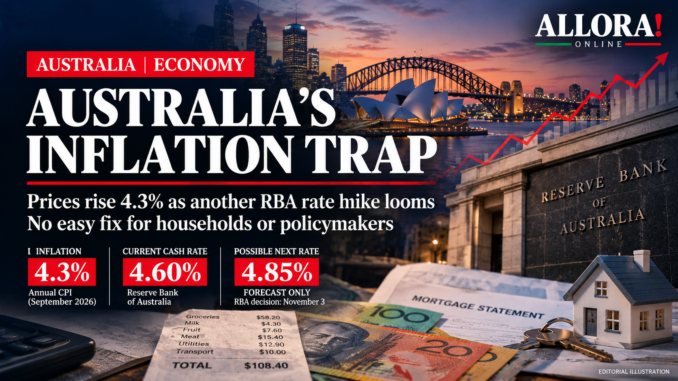
Inflation has climbed to 4.3%, raising expectations that the Reserve Bank will lift interest rates to 4.85% next week. For Anthony Albanese’s government and Treasurer Jim Chalmers, the challenge is becoming increasingly difficult: controlling prices without damaging employment, economic growth or household finances.
Australia is confronting an increasingly uncomfortable economic reality: nearly five years after inflation began putting pressure on household budgets, the country still has no straightforward path back to price stability.
The latest figures from the Australian Bureau of Statistics have intensified concerns about the cost of living and reinforced expectations that the Reserve Bank of Australia (RBA) will raise interest rates again when its Monetary Policy Board meets on November 2 and 3.
Annual consumer price inflation reached 4.3% in September 2026, up from 4.0% in August and above market expectations.
Underlying inflation, which measures broader price pressures, also increased to 3.6%, remaining above the Reserve Bank’s target range of 2–3%.
For millions of Australians already struggling with mortgage repayments, groceries, rent and energy bills, the figures represent another setback.
For the federal government, they create a difficult political and economic dilemma.
And for the Reserve Bank, they raise an increasingly urgent question: how much further must the economy slow before inflation returns to acceptable levels?
Another interest rate rise appears increasingly likely
Financial markets and major Australian banks are now anticipating another increase in the official cash rate.
If the Reserve Bank raises rates by 25 basis points at its November meeting, the cash rate would rise from 4.60% to 4.85%, reaching a level not seen for approximately 18 years.
It would represent the fifth interest rate increase of 2026.
All four major Australian banks have forecast a November rise, although the final decision remains with the RBA.
The potential consequences extend well beyond mortgage holders.
Higher borrowing costs affect business investment, consumer credit, construction activity and the willingness of households to spend.
A prolonged period of expensive credit can also place pressure on employment as businesses become more cautious about hiring and expansion.
The Reserve Bank is therefore attempting to contain inflation without imposing unnecessary damage on the broader economy.
That task is becoming more challenging.
The fading hope of a soft landing
When Australia’s inflation problem intensified in 2022, policymakers pursued what became known as the narrow path to a soft landing.
The objective was to bring inflation down through higher interest rates while avoiding a recession and widespread unemployment.
Rather than attempting to eliminate inflation through an abrupt economic contraction, the Reserve Bank adopted a comparatively gradual approach.
For several years, that strategy appeared capable of producing the desired result.
Employment remained relatively strong, widespread mortgage defaults were avoided, and the economy continued growing despite higher borrowing costs.
But the latest inflation figures have renewed doubts about whether the strategy can succeed without a more prolonged period of economic weakness.
An ABC economic analysis by Tom Crowley argues that the combination of domestic inflationary pressures, international supply disruptions and rising investment demand has made the soft-landing objective increasingly difficult.
That remains an economic assessment, not a confirmed prediction of recession.
Indeed, RBA chief economist Sarah Hunter has said that the indicators currently monitored by the central bank do not suggest Australia is entering an imminent recession.
Nevertheless, even if a downturn is avoided, households could face an extended period of weak growth and financial pressure.
The Middle East conflict and the AI investment boom
Australia’s inflation challenge is being complicated by developments beyond its borders.
The continuing conflict in the Middle East has increased global energy prices, affecting transport, manufacturing and the distribution of goods.
Higher fuel costs can quickly spread through the economy as businesses pass additional expenses to consumers.
At the same time, the global boom in artificial intelligence is generating substantial demand for technology, computing equipment, electricity and infrastructure.
Australia is experiencing growing investment in data centres, cloud computing and AI-related facilities.
These projects offer important long-term economic opportunities, including employment, technology development and increased productive capacity.
However, large investment projects also require labour, energy, construction materials and other resources.
When the economy is already operating close to its capacity in particular sectors, additional demand can contribute to higher costs.
The Reserve Bank has identified both global energy disruptions and AI-related investment as factors influencing its economic outlook.
These pressures help explain why inflation has remained persistent despite the impact of previous interest rate increases.
Productivity: Australia’s deeper economic challenge
The central economic problem is not simply that Australians are spending too much.
It is also that the economy is struggling to expand its productive capacity quickly enough.
When demand for goods and services grows faster than the economy can supply them, prices tend to rise.
Inflation can therefore be reduced through two broad approaches: slowing demand or improving supply.
Higher interest rates operate primarily through the first mechanism.
They make borrowing more expensive, encourage saving and reduce spending.
But this approach places much of the immediate burden on households and businesses with debt.
Increasing productivity offers a more sustainable long-term solution.
Higher productivity allows businesses to produce more goods and services with available resources, helping the economy grow without generating equivalent increases in prices.
Australia’s productivity performance has remained weak, reflecting challenges involving investment, technology, workforce skills and the efficient use of resources.
Governor Michele Bullock has identified weak productivity growth as a fundamental constraint on the economy.
Improving it will require more than a single policy announcement.
Investment in infrastructure, education, technology, training and business efficiency can contribute, but these changes generally take years to deliver measurable results.
In the meantime, monetary policy remains one of the main tools available for reducing inflation.
Albanese and Chalmers face a political dilemma
The economic challenge also places considerable pressure on Prime Minister Anthony Albanese and Treasurer Jim Chalmers.
The government faces demands for additional cost-of-living assistance at precisely the moment policymakers are attempting to reduce pressure on demand.
Chalmers has repeatedly acknowledged the difficulties Australians are experiencing, while defending the government’s approach to public spending.
He argues that international events have contributed significantly to the inflation problem and that fiscal policy must balance support for vulnerable households with broader economic responsibility.
Government spending can increase overall demand, but its effects depend on how much is spent, when it is spent and where the money goes.
Expenditure on essential services or assistance for lower-income families does not necessarily have the same economic consequences as broad, untargeted subsidies.
The Coalition has criticised aspects of the government’s spending, including support for electric vehicles and home battery systems.
Such programmes can serve environmental and energy-policy objectives, but their distributional effects and overall economic costs remain legitimate subjects for scrutiny.
At the same time, reducing government expenditure is not necessarily straightforward.
Cuts to health, education or infrastructure can have consequences for public services and future productivity.
The central question is therefore not simply whether government spending should rise or fall, but which measures provide economic benefits without unnecessarily increasing inflationary pressure.
Could the federal budget help fight inflation?
The Reserve Bank does not control every factor influencing inflation.
Federal fiscal policy can also affect economic demand.
A government can reduce demand through lower expenditure, higher taxation or measures that improve the budget balance.
Unlike interest rate increases, some fiscal measures can be directed towards particular groups or sectors.
However, broad spending cuts or higher taxes can also weaken economic activity and impose costs on households.
Economists therefore disagree about how aggressively fiscal policy should contribute to reducing inflation.
Some favour a stronger reduction in public spending, arguing that it would allow monetary policy to become less restrictive over time.
Others warn that rapid expenditure cuts could damage essential services and deepen an economic slowdown.
The government must weigh these competing risks while responding to public pressure for relief from rising prices.
Chalmers has signalled that additional budget savings will remain part of the government’s approach, while expectations of significant new cost-of-living assistance have been tempered.
Unemployment is rising, but inflation remains stubborn
Australia is already showing signs of economic weakness.
The seasonally adjusted unemployment rate reached 4.7% in September, while employment declined by approximately 39,300 people during the month.
The employment-to-population ratio also fell to 63.6%.
Although the RBA does not currently forecast an imminent recession, a weakening labour market increases the risks associated with further interest rate increases.
For households, the consequences can be particularly serious when slower wage growth or reduced working hours occur alongside higher living expenses.
The Reserve Bank must therefore consider not only the inflation rate, but also how monetary tightening affects employment, consumer spending and business activity.
If inflation remains elevated for longer, the economic adjustment could become more difficult.
But if interest rates are raised too aggressively, the risk of unnecessary damage to the economy also increases.
This is the dilemma confronting policymakers.
The cost of living may remain under pressure into 2027
Even if inflation begins falling again, that does not mean prices will return to where they were several years ago.
A reduction in inflation means that prices are rising more slowly, not necessarily declining.
For Australians who have experienced years of increases in essential expenses, this distinction matters enormously.
Households may continue to face high costs even after the RBA eventually brings inflation back within its target range.
That is why wage growth, productivity improvements and the availability of affordable housing and essential services are so important.
The concern now is that achieving sustainable price stability may require interest rates to remain elevated for longer than previously expected.
Some economists believe further tightening could be needed if inflation fails to respond to existing policy settings.
Others argue that the delayed impact of previous increases should be allowed more time before additional action is taken.
Neither outcome is guaranteed.
November 3: a critical decision for the Australian economy
The Reserve Bank’s next monetary policy announcement is scheduled for Tuesday, November 3, at 2:30 pm Sydney time.
Financial markets will examine both the decision itself and the central bank’s explanation of the economic outlook.
A rate increase would indicate that policymakers believe additional action is necessary to control inflation.
A decision to hold at 4.60% would suggest the Board prefers to assess more evidence about the impact of previous increases.
In either case, Australians will be looking for an indication of when financial conditions might begin to improve.
The wider challenge, however, extends beyond one interest rate decision.
Australia needs to restore price stability while encouraging investment, protecting employment and addressing structural pressures on housing, infrastructure and productivity.
The inflation figures have made one thing increasingly clear: there is no painless solution. Higher interest rates can slow demand, government budgets can influence spending, and productivity improvements can expand supply. But none of these measures can eliminate years of accumulated financial pressure overnight.
For Albanese, Chalmers and Bullock, the task is to find a workable balance.
For millions of Australians, the question is much more immediate: how much longer will households have to absorb the cost before the economy finally begins to offer some relief?