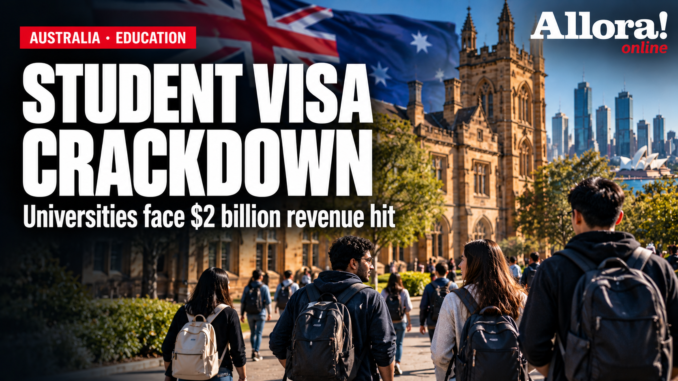
The Albanese government signals a review of international student visa requirements amid concerns that tougher immigration controls are discouraging genuine applicants and threatening one of Australia’s most important export industries.
Australia’s federal government is preparing to reconsider key elements of its international student visa policy as universities face a projected $2 billion revenue shortfall and growing concerns that strict immigration requirements are driving prospective students towards competing destinations.
The Albanese Labor government has acknowledged that measures designed to restore integrity to the migration system may be producing unintended consequences, particularly for applicants from South Asia.
Assistant Minister for International Education Julian Hill is expected to address the issue in Sydney on Friday, 30 October, warning against an excessive tightening of visa rules while maintaining the government’s commitment to controlling student migration.
Universities Face an 18% Decline in New International Students
Australian public universities are projected to experience an approximately 18% decline in new international student commencements in 2026, contributing to an estimated $2 billion reduction in revenue over three years.
While the government argues that tougher visa restrictions are not solely responsible, the financial impact is raising concerns across the higher education sector.
Competition from international education providers in other countries, rising living costs and uncertainty surrounding visa approvals are also influencing students’ decisions.
The challenge for Australia is particularly significant because international education is the country’s fifth-largest export sector and supports approximately 250,000 jobs.
Universities rely on international student revenue not only to deliver education but also to fund research, infrastructure and other academic activities.
Visa Rejection Rates Raise Serious Concerns
The government’s review follows a substantial increase in student visa refusals since the introduction of Ministerial Direction 106 in 2024.
The directive strengthened assessments of whether applicants genuinely intended to study in Australia, including examination of their financial circumstances.
During the last financial year, more than 24.2% of student visa applications were refused.
Rejection rates were particularly high among applicants from South Asia, with more than 51% of applications from Nepal and over 40% from India unsuccessful.
These figures have prompted concerns that students with legitimate academic ambitions may avoid applying to Australian institutions because of the possibility of rejection.
A refused visa application can also create uncertainty for students considering opportunities in other countries.
New Financial Requirements Under Consideration
The Department of Home Affairs and education officials are developing revised financial assessment standards, particularly for students from South Asia.
The government is also preparing a replacement for Ministerial Direction 106, with universities and education agents expected to participate in consultations during November.
Hill is expected to argue that clearer financial requirements could make visa outcomes more predictable, even if the eligibility thresholds are increased.
The proposed approach would focus on ensuring applicants can genuinely meet tuition fees and living expenses before submitting their applications.
Another option being examined is a system similar to New Zealand’s, allowing international students to demonstrate financial capacity by depositing funds sufficient to cover educational and living costs.
However, such an arrangement remains a longer-term possibility rather than an immediate policy change.
Labor Defends Immigration Controls
Despite recognising the pressures affecting universities, the Albanese government has made clear that it does not intend to abandon its broader migration reforms.
Measures introduced in October have already restricted certain onshore student visa applications, tightened rules around changing education providers and limited the circumstances in which international students can bring family members.
The government maintains that these policies are necessary to prevent misuse of student visas and protect the reputation of Australian education.
Hill is also expected to emphasise the distinction between public universities and some private education providers, arguing that public institutions reinvest their financial surpluses into education, research and facilities.
The government’s position reflects an attempt to manage migration numbers without undermining the economic and educational benefits associated with international students.
Finding the Balance Between Migration and Education
Australia now faces a policy challenge that extends beyond university finances.
International students contribute to local businesses, employment and cultural exchanges while helping Australian institutions maintain their international research and teaching capabilities.
At the same time, the government continues to face pressure to manage population growth, housing demand and the integrity of the migration system.
The coming review will therefore test whether Australia can maintain strict immigration controls while providing a clearer and more predictable pathway for genuine students.
The central question is whether Australia can protect the integrity of its visa system without weakening its reputation as a leading international education destination.
With university revenues under pressure and international competition intensifying, the outcome could have lasting implications for Australia’s education sector and its wider economy.