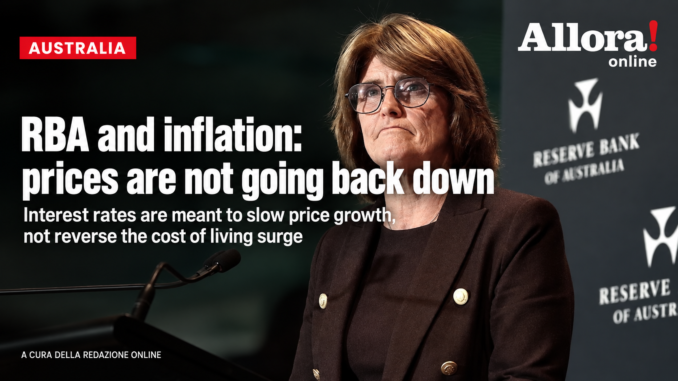
Many Australians are asking why supermarket prices, rents, services and everyday goods are not returning to earlier levels despite higher interest rates. The answer is simple: the Reserve Bank is not trying to reverse prices, but to slow the pace at which they rise.
When the Reserve Bank of Australia raises interest rates, it is not trying to force businesses to cut prices.
That is one of the biggest sources of confusion in the inflation debate.
If a product rises from $10 to $12, getting inflation back under control does not necessarily mean that product will return to $10. It means its price should start rising much more slowly from that point onward.
That is the key difference between the price level and the inflation rate.
PRICES CAN STAY HIGH EVEN WHEN INFLATION FALLS
Inflation measures the speed at which prices are rising.
If inflation falls from 7 per cent to 3 per cent, prices are not falling. They are still increasing, just at a slower pace.
For prices to decline broadly, Australia would need deflation — a general fall in the overall price level.
That is not the Reserve Bank’s objective.
Australian monetary policy instead aims to keep inflation low and stable over time.
In simple terms, the goal is for prices to keep rising, but at a pace that does not destabilise households, businesses or the labour market.
THE PROBLEM CREATED BY RECENT PRICE INCREASES
The difficulty for Australians is that prices have already risen sharply over the past few years.
Reserve Bank governor Michele Bullock has said consumer prices have increased by around 20 to 25 per cent in recent years.
That cumulative increase helps explain why households can still feel intense cost-of-living pressure even when inflation data show that price growth is slowing.
Inflation can ease while the higher price level remains.
A basket of goods that cost $100 several years ago might now cost $120 or $125. Bringing inflation under control does not automatically take that basket back to $100.
It means trying to prevent $125 from quickly becoming $135 or $140.
WHAT THE RBA IS ACTUALLY TRYING TO DO
The Reserve Bank mainly uses interest rates to reduce demand in the economy.
When rates rise, mortgages and loans become more expensive.
Households with debt have less disposable income. Businesses face higher financing costs. Investment and consumer spending tend to slow.
When demand weakens, businesses generally have less ability to keep raising prices aggressively.
That is the mechanism at the heart of monetary policy.
The RBA does not tell supermarkets to cut the price of bread or restaurants to lower the cost of a meal.
It tries to create economic conditions in which repeated price increases become harder to sustain.
THE COST OF FIGHTING INFLATION
The strategy is not painless.
Higher interest rates slow the economy.
They can reduce investment and consumption, put pressure on mortgage holders and weaken employment growth.
If monetary policy becomes restrictive enough, unemployment can also rise.
That is the difficult balance every central bank faces: slow the economy enough to bring inflation under control, but not so much that it triggers a severe recession.
That balance is now at the centre of Australia’s economic debate.
NOT ALL INFLATION COMES FROM AUSTRALIA
There is another complication.
Not every price increase can be controlled by Australian interest rates.
A war that pushes up global oil prices, a drought that damages crops or flooding that disrupts supply chains can all raise prices regardless of what the RBA does.
The same is true of some increases in insurance premiums linked to extreme weather.
The Reserve Bank cannot produce more oil, stop a war or make it rain during a drought.
What it can do is try to prevent those temporary shocks from spreading into a broader cycle of price increases across the economy.
WHY HOUSEHOLDS STILL FEEL POORER
This is the central issue.
The cost of living is not determined only by the annual inflation rate. It also depends on how far prices have risen compared with household incomes.
If prices rise rapidly for several years, wages have to catch up.
That is why many households do not immediately feel better when inflation starts to fall.
Prices remain high.
Mortgage repayments may be higher.
Rents may have increased.
Insurance, energy, groceries and services may already be permanently more expensive than they were before.
LOWER INFLATION DOES NOT MEAN LOWER PRICES
That is probably the most important distinction to understand.
When people hear that “inflation is falling”, it does not necessarily mean the weekly grocery bill will become cheaper.
It means the bill should rise more slowly.
It sounds like a technical distinction, but it is fundamental to understanding why monetary policy can feel so disconnected from everyday experience.
The Reserve Bank is not trying to turn back the clock on prices.
It is trying to stop the clock from running too fast.
And after the sharp increase in the cost of living in recent years, that remains difficult for many Australians to accept: inflation can be “under control” even while almost everything still costs much more than it used to.