
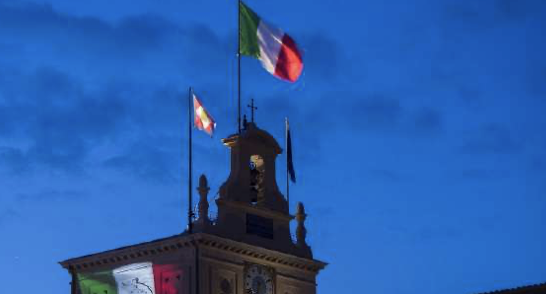
“The Tricolour represents our history.” With these words, Prime Minister Giorgia Meloni summed up the meaning of Tricolour Day, marked on January 7 to celebrate the 229th anniversary of the birth of the Italian flag, a symbol of national unity and of the founding values of the Republic.
In a message posted on social media, Meloni recalled the “deeds of those who, long before us, fought with courage for the values that underpin the Constitution,” stressing that the flag is the direct expression of that legacy and urging Italians to “honour our Fatherland and the national unity achieved through sacrifice and loyalty.”
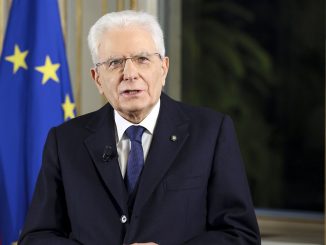
It was President of the Republic Sergio Mattarella, however, who most fully retraced the historical meaning of the Tricolour.
In his message, the Head of State recalled the flag’s birth in 1797 in the Cispadane Republic, under the influence of revolutionary ideals, its role in the Risorgimento, and its official adoption in 1861 as the flag of the Kingdom of Italy.
Later chosen by the Constituent Assembly as the emblem of the new Republic, the Tricolour “today embodies the high values set out in the Constitution: unity, freedom, democracy and social cohesion,” Mattarella said.
He highlighted that the flag identifies Italy “in every place and in every sphere,” from peacekeeping missions and diplomatic posts to sporting competitions, reiterating that “our shared history and the foundations of our civilisation are reflected in it.”
From Parliament came similar messages.
Speaker of the Chamber of Deputies Lorenzo Fontana said the Tricolour “marks the history and accompanies the present of the country,” linking the anniversary to the approaching 80th anniversary of the Italian Republic, in continuity with the legacy of the framers of the Constitution.
Galeazzo Bignami, leader of Brothers of Italy in the Chamber, said the flag is not “three simple colours” but the story of the nation, urging Italians to “remember where we come from in order to honour our country.”
Senate President Ignazio La Russa said that on the 229th anniversary of the Tricolour “we pay tribute to the symbol that represents our Fatherland, our history, and the unity and identity of our nation.”
Over the years, he added, many have died “for this flag and under this flag,” making the ultimate sacrifice to defend Italy or to help other peoples in difficulty — “a great act of love that must be remembered today, just as it is right today to be proud to be Italian and to hold our beloved Tricolour high.”
From the opposition also came a call to constitutional values.
Matteo Richetti, leader of Action in the Chamber, said celebrating the Tricolour means remembering “the foundations of democracy, peace and cohesion on which our country is built,” values that must be defended and passed on to new generations.
On the economic and productive front, Minister for Made in Italy Adolfo Urso described the Tricolour as a “symbol of national unity and of our shared memory,” but also as the image of “a credible, cohesive Italy, capable of translating its values into that productive quality which Made in Italy continues to represent around the world.”
Be the first to comment