M1 and Kossuth Radio have suspended news broadcasts as Prime Minister Péter Magyar’s new government begins a sweeping reform of Hungary’s public media. The move marks a symbolic break with the Orbán era — but the real test will be whether public broadcasting becomes independent, pluralist and credible, rather than merely changing political hands.
A screen message that closed an era
In Hungary, it was not just a television bulletin that went off air. It was an entire political era that appeared to end on screen.
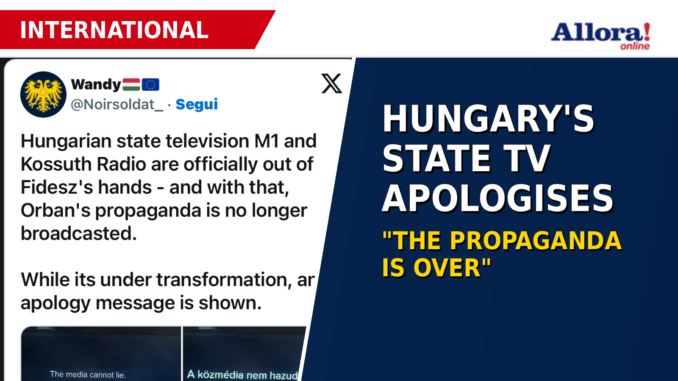
Hungarian state television channel M1 temporarily suspended its news broadcast and displayed a message that immediately became one of the most symbolic moments of the post-Orbán transition: public media, it said, “cannot lie”, followed by an apology for having done so for years. Reuters reported that M1’s news service was halted as part of a broader overhaul of state media promised by newly elected Prime Minister Péter Magyar.
State-run Kossuth Radio also suspended its news service, underlining the scale of the operation. This was not a technical interruption. It was a political and institutional reset.
Magyar begins the media reform
The decision comes as the new government led by Péter Magyar and his Tisza party moves to reform Hungary’s public media system after the defeat of Viktor Orbán and Fidesz in April.
Magyar had campaigned on a promise to dismantle what he described as a state propaganda machine and restore public media as an independent and credible service. Reuters reported in June that Tisza had submitted legislation to overhaul public media, a central campaign pledge after critics said state broadcasting had become a government mouthpiece under Orbán.
That pledge has now moved from campaign language to institutional action.
The end of the Orbán media model
For years, Hungary’s public media had been accused by opposition parties, civil society groups and international observers of serving the political interests of Orbán’s government.
Under Orbán, Hungary promoted what he called an “illiberal democracy”, while critics argued that the state had weakened checks and balances, captured institutions and built a media environment heavily tilted toward the ruling party. The Guardian reported that under Orbán, a large share of the Hungarian media landscape became loyal to Fidesz, helping create a distorted public information space.
The suspension of M1’s news service is therefore more than an internal broadcasting decision. It is a direct challenge to the information system that helped define sixteen years of Orbán’s rule.
Orbán denounces “Tisza tyranny”
Orbán has reacted sharply.
The former prime minister described the move as an act of political force by the new government and reportedly urged viewers to turn to Hír TV, a private channel close to Fidesz. Reuters reported that Orbán criticised the overhaul as despotic and directed his supporters toward right-wing private media.
His argument is simple: what Magyar calls reform, Orbán calls political capture.
That is now the central test for the new government. If the aim is truly to restore public service journalism, the reform must be protected from becoming a mirror image of the system it is replacing.
A historic but dangerous moment
The symbolism of the apology is powerful.
A public broadcaster acknowledging that it misled citizens for years is almost unprecedented in modern European politics. It sends a message not only to Hungary, but to the whole continent: media capture is not an abstract democratic problem. It shapes elections, public debate, national identity and trust in institutions.
But symbolism is not enough.
The real challenge begins now. A credible public media reform must guarantee editorial autonomy, transparent governance, fair appointments, independent oversight and protection from political interference.
Otherwise, the old propaganda machine may simply be repainted in new colours.
A new media law and the question of trust
Magyar’s government has already moved to legislate.
Reuters reported that the proposed reform aims to overhaul the structure of Hungary’s public media after years of domestic and international criticism. Balkan Insight reported that the draft law is designed to restore journalistic independence, editorial freedom and public access to reliable information.
These are the right words. But in Hungary, after years of institutional polarisation, words will not be enough.
Trust must be rebuilt slowly, through daily editorial choices, access for all political voices, professional reporting standards and public accountability.
Europe is watching
The Hungarian case matters far beyond Budapest.
For the European Union, Hungary under Orbán had long represented one of the most difficult rule-of-law challenges inside the bloc. Press freedom was one of the most visible areas of concern. Reuters noted that Hungary fell significantly in the Reporters Without Borders press freedom index during the Orbán years.
If Magyar succeeds in rebuilding independent public media, Hungary could become an example of democratic repair after years of institutional capture.
If he fails, the country risks replacing one partisan media system with another.
Public media cannot belong to parties
The central principle is clear: public media must belong to citizens, not governments.
A public broadcaster is not supposed to be the voice of the prime minister. It is not supposed to campaign for the ruling party. It is not supposed to erase the opposition or turn journalism into political theatre.
Its role is to inform, question, investigate and serve the public interest.
That is why the Hungarian reform must be judged not by its first dramatic gesture, but by what follows: who is appointed, who supervises, who gets airtime, how dissent is handled, and whether journalists are free to work without fear.
The political bill always arrives
The message on M1 was devastating because it contained an admission many Hungarians had long believed: public media had failed its duty.
When a broadcaster created to serve the people becomes a tool of political power, democracy is weakened from within. Citizens are not only misinformed. They are denied the basic conditions needed to make free political choices.
That is why this moment matters.
Hungary’s state television has not only suspended its news service. It has publicly acknowledged the collapse of a public trust.
Now the task is harder than switching off the signal. The task is to build a system that no future government can turn back into propaganda.
The lesson from Budapest
The Hungarian case sends a warning to every democracy.
Press freedom is not a decorative feature of democratic life. It is one of its foundations. When public media lies, it does not merely damage journalism. It damages the state.
And when a public broadcaster finally apologises for years of propaganda, it proves one thing: political control over information can last a long time, but the bill eventually comes due.
The propaganda may be over. The reconstruction of truth has only just begun.