
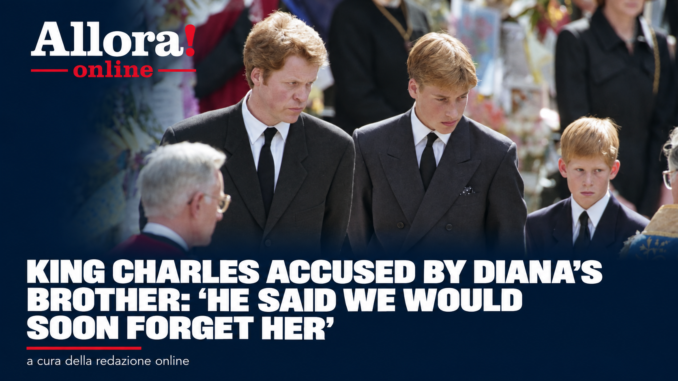
Charles Spencer recounts an explosive phone call allegedly made after the Princess of Wales’s death. Buckingham Palace has issued a rare response, suggesting grief may have affected his memory and judgement.
By the Online Editorial Team
An explosive allegation involving King Charles III has reopened one of the most painful chapters in the recent history of the British monarchy.
Charles Spencer, the 9th Earl Spencer and brother of Princess Diana, claims the King said Diana would soon be forgotten during an angry telephone conversation following her death in 1997.
The episode is detailed in Spencer’s forthcoming memoir, Swan Song: Diana, My Sister, which examines his sister’s life, her troubled marriage to the then Prince Charles and the dramatic events surrounding her funeral.
The account represents Spencer’s personal recollection and there is no known recording of the conversation. Buckingham Palace has nevertheless taken the unusual step of responding publicly to the allegation.
The alleged phone call after Diana’s death
Spencer claims Charles released what he interpreted as “pent-up contempt” for Diana and expressed anger at the overwhelming international reaction to her death.
“Rest assured, we’ll forget her soon enough,” Charles allegedly told him.
Spencer writes that he was stunned by the remark and replied, “I can’t believe you just said that,” before ending the call.
The allegation is particularly serious because the conversation reportedly occurred during the traumatic days following Diana’s death, when millions of people around the world mourned the princess.
Vast crowds gathered outside Kensington Palace and Buckingham Palace, leaving flowers, photographs and personal messages in an unprecedented public display of grief.
Buckingham Palace issues rare response
Buckingham Palace, which ordinarily refuses to comment on books about the Royal Family, issued a statement shortly after extracts from Spencer’s memoir emerged.
“While we do not comment on books as a matter of principle, His Majesty is mindful that the pain of fraternal grief can cloud reason, affect judgment and colour memory in ways others do not recognise, even many years after such a loss,” a palace spokesperson said.
The statement does not directly deny that the telephone conversation took place. It does, however, challenge Spencer’s recollection and interpretation of what was said.
The unusual response demonstrates how sensitive the allegations are for the Palace. Almost three decades after Diana’s death, her relationship with Charles remains one of the most controversial and painful chapters in the history of the modern monarchy.
Diana’s marriage and divorce
Spencer’s memoir also revisits Diana’s marriage to Charles, which began with a spectacular ceremony at St Paul’s Cathedral in 1981.
The wedding was presented as a royal fairytale and watched by hundreds of millions of people around the world. Behind the public image, however, the relationship progressively deteriorated.
Personal differences, intense media pressure and extramarital affairs contributed to the couple’s separation and eventual divorce in 1996.
Diana died the following year, aged 36, after the car in which she was travelling crashed in Paris’s Pont de l’Alma tunnel. Her partner, Dodi Fayed, and driver Henri Paul were also killed.
Her death triggered an extraordinary wave of public mourning and placed the monarchy under immense pressure. The Royal Family was initially criticised for appearing distant and failing to understand the scale of the public’s grief.
The dispute over the funeral procession
Spencer also recounts disagreements over the arrangements for Diana’s funeral at Westminster Abbey.
According to his account, an aide to Queen Elizabeth II informed him that Princes William and Harry, then aged 15 and 12, would not walk in the funeral procession.
“That’s not going to happen,” Spencer says he told the aide.
William and Harry ultimately walked behind their mother’s coffin alongside their father Charles, grandfather Prince Philip and uncle Charles Spencer.
The image became one of the most painful and enduring moments of Diana’s funeral. In later years, Harry repeatedly spoke about the trauma of having to make that public walk while millions of people watched.
During the funeral, Spencer delivered a powerful address in which he promised to protect William and Harry and indirectly criticised both the media and the royal environment that had surrounded his sister.
A wound that has never fully healed
The new accusations could create another difficult controversy for Charles III. Diana continues to hold a powerful place in the public imagination, and every new account of the final years of her life reignites debate about personal and institutional responsibility.
Spencer’s memoir is presented as a deeply personal family testimony, but it arrives at a sensitive time for the monarchy, which is already dealing with tensions between William and Harry and the Duke of Sussex’s complicated relationship with the Royal Family.
Nearly three decades later, however, the prediction attributed to Charles appears to have been disproved by history. Diana has not been forgotten. Her life, death and troubled relationship with the monarchy continue to occupy a central place in British and international memory.

Be the first to comment