
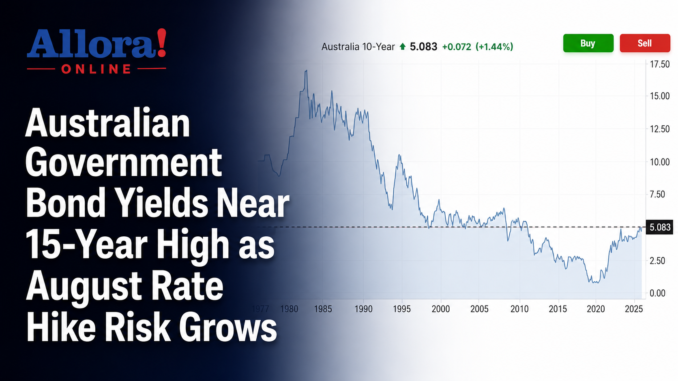
The 10-year bond yield has climbed above 5% as oil returns to more than US$100 a barrel. Markets fear another inflation surge and are increasingly preparing for further action from the Reserve Bank
A sharp sell-off in Australian government debt has pushed the yield on the 10-year bond to around 5.08%, close to its highest level in 15 years.
The rise reflects growing concern about another inflation shock, driven by oil prices above US$100 a barrel, escalating geopolitical tensions in the Middle East and new tariffs introduced by the Trump administration.
The shift is rapidly changing expectations for Australian monetary policy. After months of debate about possible future rate cuts, investors and economists are now considering whether the Reserve Bank of Australia could increase interest rates again as early as August.
What Is Happening to Government Bonds?
When investors sell bonds, their market price falls and their yield rises.
Australia’s 10-year government bond yield climbed to about 5.08%, close to the intraday peak of 5.11% recorded in May. Before this year, comparable levels had not been seen since 2011.
The yield on the three-year bond also rose to around 4.69%.
The bond market is therefore sending a clear signal: investors expect official interest rates to remain higher for longer and believe the RBA may be forced to act again to contain inflation.
Oil Returns Above US$100 a Barrel
The main source of concern is the renewed increase in global energy prices.
Brent crude briefly rose above US$101 a barrel before settling slightly above US$100.
The conflict involving the United States and Iran, threats to shipping through the Strait of Hormuz and attacks affecting Red Sea routes have increased fears about global oil supplies.
A significant share of Middle Eastern oil may need to be transported through much longer routes, increasing fuel, insurance and shipping costs.
Those increases do not remain confined to the energy industry. They can quickly flow through to transport, food, imported goods and industrial production.
Inflation Could Accelerate Again
The Reserve Bank uses interest rates to reduce demand across the economy and return inflation to its target range.
The difficulty is that higher oil prices represent an external supply shock. Raising interest rates cannot produce more oil or reopen blocked shipping routes.
It can, however, help prevent higher energy costs from spreading into broader and more persistent increases in prices and wages.
Westpac expects the June monthly Consumer Price Index to rise by 0.4%, lifting annual inflation from 4% to 4.2%.
Quarterly trimmed-mean inflation is forecast to increase by 0.9%. A stronger reading could place additional pressure on the RBA ahead of its August meeting.
Markets Prepare for Another Increase
Expectations of an August rate rise strengthened after employment data showed that about 76,000 jobs were added in June.
A resilient labour market, combined with oil above US$100 and new international trade barriers, gives the Reserve Bank less room to leave monetary policy unchanged.
One market estimate placed the likelihood of an August increase at about 36%, while at least one further rise before the end of the year was viewed as highly probable.
The official cash rate could therefore reach 4.6%, its highest level since October 2011.
Renewed Pressure on Mortgages and Household Budgets
Another rate increase would have immediate consequences for households with variable-rate mortgages.
Banks could pass the RBA’s decision on to borrowers quickly, increasing monthly repayments and placing further pressure on family budgets.
Even without an official rate rise, higher bond yields can make it more expensive for banks to raise money in wholesale markets.
Those costs may eventually be passed on through:
- new home loans;
- business lending;
- commercial finance;
- consumer credit.
Households could therefore face higher mortgage repayments at the same time as rising fuel, food and imported goods prices.
Higher Borrowing Costs for Governments
Independent economist Saul Eslake said the movement in Australian yields reflected similar increases in the United States and other major bond markets.
Investors are concerned not only about inflation but also about government debt and the absence of meaningful fiscal discipline across many advanced economies.
Higher yields mean greater interest expenses for both the federal government and the states.
The increased costs apply when governments finance new deficits and when they replace maturing debt issued in previous years.
A larger share of public revenue may consequently be required for interest payments, leaving fewer resources available for health, education, infrastructure and essential services.
Australian Share Market Loses Ground
The pressure has also spread to equities.
The ASX 200 fell by about 0.7%, while the technology sector dropped roughly 2.5%.
Companies including Xero, WiseTech Global and Codan recorded losses of more than 4%, while NextDC and TechnologyOne also declined substantially.
Higher bond yields are particularly damaging for technology companies and other businesses whose expected profits are concentrated in future years.
Investors can obtain more attractive returns from government debt, which is generally considered less risky.
Energy companies, utilities and banks helped limit the broader market decline.
Wall Street Hit by Oil and AI Spending Doubts
The financial pressure extends well beyond Australia.
On Wall Street, the Dow Jones lost almost 1%, the S&P 500 fell about 1.2% and the Nasdaq dropped more than 2%.
Alongside rising oil prices, investors are questioning whether enormous spending on artificial intelligence will produce adequate returns.
Higher borrowing costs make it more difficult to finance data centres, digital infrastructure and other capital-intensive technology projects.
Tesla shares fell about 14%, while Google and Alphabet declined by approximately 7%.
US Tariffs Add Another Inflation Risk
The new 12.5% American tariff on Australian exports has further complicated the outlook.
The Business Council of Australia described the decision as unjustified, arguing that it will make Australian companies less competitive in the US market.
Wine and sheep meat exporters are among the industries expected to be particularly exposed.
For wine producers, the tariff could have its greatest effect on bulk exports and products competing in price-sensitive segments of the US market.
For the meat industry, weaker American demand could particularly affect high-value cuts that are difficult to redirect to alternative markets.
ACCC Watches Supermarkets and Refineries
Against the backdrop of higher prices, the Australian Competition and Consumer Commission has announced closer scrutiny of Coles and Woolworths.
ACCC chair Gina Cass-Gottlieb noted that the two companies rank among the most profitable supermarket groups in the world.
New regulations that took effect on July 1 make it illegal for very large supermarkets to charge prices considered excessive compared with supply costs and a reasonable profit margin.
The regulator plans to select key products for detailed monitoring, guided by consumer complaints, unusually high prices and differences in margins.
The ACCC is also examining the margins being earned by Australia’s two remaining oil refineries, operated by Ampol and Viva Energy, to determine whether they are taking advantage of current market disruption.
A Difficult New Economic Environment
Australia is facing a particularly challenging combination of risks: oil above US$100, tariffs on exports, persistent inflation, strong employment and government bond yields at their highest levels since 2011.
The Reserve Bank may now be forced to choose between two dangers.
Leaving rates unchanged could allow inflation to strengthen further. Raising them again could intensify pressure on mortgages, consumption, businesses and economic growth.
The next inflation figures will therefore be critical.
Should price growth exceed expectations, an August increase could quickly move from a possibility to the central scenario confronting Australian households and financial markets.



Be the first to comment