
Di Redazione
The period between 1945 and 1948 represents one of the most significant turning points in Italian history. Following the collapse of Fascism and the devastation of World War II, Italy faced not only physical destruction and economic hardship but also a profound crisis of political legitimacy.
The creation of the Italian Republic was therefore far more than a constitutional reform. It was the culmination of war, resistance, political reconstruction and a collective effort to redefine the nation’s identity after more than two decades of dictatorship.
The Fall of Fascism and the End of the War
Italy’s transformation began during the final stages of World War II. After the fall of Benito Mussolini in July 1943 and the signing of the Armistice of Cassibile in September of the same year, the country entered a period of division and conflict.
German forces occupied much of central and northern Italy, while the south gradually came under Allied control. Rescued by German troops, Mussolini established the Italian Social Republic in northern Italy, a Nazi-backed puppet state.
At the same time, resistance movements composed of communists, socialists, Catholics, liberals and other anti-fascist groups fought against both Fascist and German forces.
The liberation of northern Italy in April 1945 marked the definitive collapse of Fascism. Mussolini was captured and executed shortly afterwards, and by early May 1945 the war in Italy had effectively ended.
A Nation Rebuilding Itself
Peace did not immediately bring stability.
Italy emerged from the war with devastated infrastructure, a collapsed industrial sector, widespread unemployment, inflation and severe food shortages. The country also faced a deep institutional crisis.
The monarchy had become closely associated with the Fascist regime. King Victor Emmanuel III had appointed Mussolini Prime Minister in 1922 and failed to remove him during his dictatorship. His decision to flee Rome in 1943 further weakened public confidence in the Crown.
In an attempt to preserve the monarchy, Victor Emmanuel III transferred his powers to his son, Umberto, in 1944. However, the move did little to restore trust among Italians.
The Historic Referendum of 2 June 1946
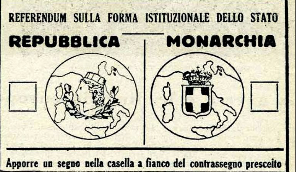
The central question facing post-war Italy was whether the country should remain a monarchy or become a republic.
This issue was resolved through a national referendum held on 2 June 1946.
The vote was historic for several reasons. It was the first national election in which Italian women were allowed to participate, marking a major step toward universal suffrage and democratic inclusion.
The referendum produced a narrow but decisive victory for the republic, which received approximately 54 percent of the vote, while the monarchy obtained around 46 percent.
Regional differences were evident. Support for the republic was strongest in northern and central Italy, while the monarchy maintained greater support in several southern regions.
Despite disputes regarding the results, the outcome was officially confirmed.
On 13 June 1946, King Umberto II left Italy for exile, bringing an end to the House of Savoy’s reign and opening a new chapter in Italian history.
Building the Italian Republic
On the same day as the referendum, Italians elected a Constituent Assembly tasked with drafting a new democratic constitution.
The Christian Democrats emerged as the largest political force, followed by the Socialists and the Communists.
The Assembly convened on 25 June 1946 and appointed Enrico De Nicola as provisional Head of State.
Its mission was to create a constitutional framework capable of preventing the return of dictatorship while accommodating Italy’s diverse political traditions.
The debates reflected the ideological pluralism of post-war Italy, bringing together Catholic democratic principles, socialist ideals, liberal traditions and republican values.
The Constitution and the Birth of Modern Italy
The Italian Constitution came into force on 1 January 1948.
It established a parliamentary democracy founded on fundamental rights, the rule of law, separation of powers and democratic representation.
The Constitution sought to ensure that no future government could concentrate power in the way Fascism had done. It introduced a system of checks and balances and protected civil liberties, political freedoms and social rights.
The first general elections under the new constitutional order were held on 18 April 1948, marking another crucial milestone in the consolidation of Italian democracy.
A Legacy That Endures
Between 1945 and 1948, Italy underwent a profound transformation.
The country moved from dictatorship and monarchy to democracy and republican government. Despite enormous economic, social and political challenges, the foundations were laid for the modern Italian state.
Eighty years later, the Republic remains one of the most important achievements in Italy’s contemporary history, symbolising freedom, democracy and the determination of a nation to rebuild itself after war and authoritarianism.

Be the first to comment