
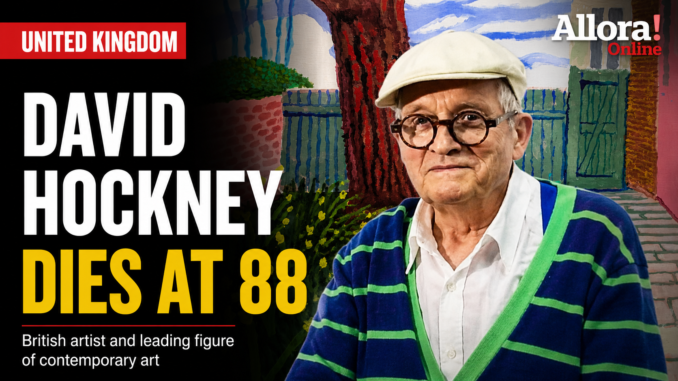
David Hockney, one of the most influential and celebrated figures in contemporary art, has died at the age of 88.
The announcement was made by his longtime agent, Erica Bolton, who confirmed that the British artist passed away peacefully at his home in London.
“One of the most important figures of contemporary art in the 20th and 21st centuries has died peacefully at his home,” Bolton said in a statement.
Hockney leaves behind his longtime partner, Jean-Pierre Gonçalves de Lima, as well as two brothers, numerous nephews and great-nephews.
Born on July 9, 1937, in Bradford, Yorkshire, Hockney emerged as one of the leading voices of British art during the 1960s. Educated at Bradford College of Art and later at London’s Royal College of Art, he quickly gained recognition for his innovative style and bold use of colour.
Throughout a career spanning more than seven decades, Hockney continually reinvented himself, working across painting, drawing, printmaking, photography and digital media. His distinctive visual language, characterised by vivid colours and unique explorations of perspective, made him one of the most recognisable artists of his generation.
A central figure of the Pop Art movement, Hockney achieved international acclaim with works inspired by everyday life, portraits, landscapes and the iconic swimming pools of California, which became some of the most celebrated images in modern art.
His rise to prominence began in the early 1960s. In 1961 he won a major award for engraving in London and a painting prize in Liverpool. Two years later he received the top graphics prize at the Paris Biennale and staged a successful solo exhibition at London’s Kasmin Gallery, helping establish his international reputation.
Even in his later years, Hockney remained remarkably productive, embracing new technologies and continuing to experiment with digital drawing and multimedia art. His work was exhibited in major museums and galleries around the world, attracting millions of visitors and influencing generations of artists.
Tributes are expected to pour in from across the global art community, where Hockney is widely regarded as one of the defining artistic voices of the modern era.
His death marks the end of an extraordinary chapter in British and international art history, but his legacy will continue through a body of work that transformed the way colour, perspective and everyday life are represented in contemporary art.