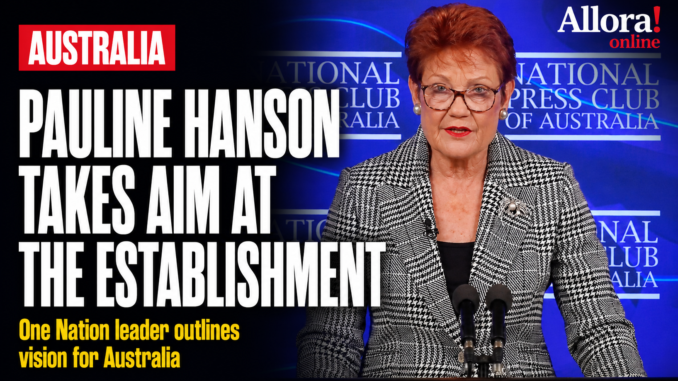
CANBERRA – Pauline Hanson used her first-ever National Press Club address to deliver a sweeping critique of Australia’s political establishment, arguing that decades of failed policies on immigration, energy, housing and national identity have left millions of Australians feeling ignored, poorer and increasingly disconnected from the country they once recognised.
Three decades after entering federal politics, the One Nation leader stood before journalists in Canberra and presented what many observers see as her most comprehensive vision yet for Australia’s future.
The speech comes at a time when One Nation is experiencing unprecedented momentum. Recent opinion polls have shown the party attracting support levels that would have been unimaginable only a few years ago, reflecting growing voter frustration with both Labor and the Coalition.
Speaking for nearly an hour, Hanson positioned herself as the voice of Australians who feel abandoned by mainstream politics.
“The public are sick and tired of being ignored,” Hanson said.
“Politicians today are good at talking but not listening. They will do anything to get your vote, but when that has been achieved, the voter is ignored.”
Immigration at the Centre of the Debate
Immigration dominated much of Hanson’s address.
The One Nation leader argued that record migration levels have placed enormous pressure on housing, infrastructure and social cohesion. She cited figures showing that net overseas migration exceeded one million people during the first three years of the Albanese Government, claiming the numbers are unsustainable at a time when many Australians cannot find affordable housing.
Hanson criticised Australia’s multicultural model and renewed her long-standing call for stronger cultural integration.
“We are a multiracial society, but we must be monocultural,” she told the audience.
“Australians must live under the one cultural umbrella.”
She argued that Australia risks losing its identity if migration continues at current levels and warned against what she described as the importation of overseas conflicts and divisions.
During the question-and-answer session, Hanson reinforced her concerns about radical Islam, saying Australia must learn from challenges experienced in parts of Europe and maintain strong controls over immigration policies.
Her comments are certain to generate controversy, but they also reflect issues that continue to resonate with a significant segment of the electorate.
Housing Crisis and Cost of Living
Another major theme of Hanson’s speech was the growing housing crisis.
She accused successive governments of failing to address the imbalance between housing supply and population growth, arguing that high migration has intensified shortages and pushed rents beyond the reach of many families.
The One Nation leader pointed to rising homelessness, increasing waiting lists for social housing and growing rental stress across major cities.
She linked these problems directly to broader cost-of-living pressures affecting households nationwide.
Quoting figures from welfare organisations, Hanson painted a bleak picture of Australians struggling to afford food, electricity and basic necessities.
She referenced reports showing some Australians skipping meals, relying on food charities and even eating expired food because of financial hardship.
“What kind of Australia have we become?” she asked.
“These figures are appalling and totally un-Australian for a rich country such as ours.”
Energy Policy and Nuclear Power
Energy emerged as one of Hanson’s strongest areas of attack against the Albanese Government.
She blamed rising power prices on what she described as failed renewable energy policies and the pursuit of net-zero emissions targets.
According to Hanson, Australians are paying the price for ideological decision-making that has undermined energy security and increased costs for households and businesses alike.
“The cost of energy feeds into everything we use, everything we eat, everything we manufacture,” she said.
“So food is dearer, housing is dearer, rent is dearer. There is your cost-of-living crisis.”
One Nation is proposing a significant expansion of Australia’s energy mix, including investment in nuclear power, continued use of coal and gas, and a reduction in government subsidies for renewable energy projects.
Hanson criticised what she described as billions of dollars in taxpayer-funded support for renewable projects, arguing that genuinely viable technologies should be able to survive without government assistance.
During the press conference, she confirmed that One Nation would support the construction of a large-scale nuclear reactor on Australia’s east coast while maintaining existing coal-fired generation to ensure energy reliability.
Challenging the Political Class
Perhaps the most striking aspect of Hanson’s appearance was her direct challenge to Australia’s political establishment.
She repeatedly argued that both major parties have failed ordinary Australians and accused governments of contributing to a national debt approaching one trillion dollars.
Hanson contrasted her experience as a former small business owner with what she described as career politicians who have spent most of their lives working within government structures.
“The difference between Albanese, Chalmers and me is that I actually ran a small business,” she said.
She promised to reduce government spending, cut bureaucracy and reform public administration if One Nation were ever in a position to influence government policy.
Media, Free Speech and Public Broadcasters
Hanson also took aim at sections of the media, arguing that One Nation has faced disproportionate scrutiny throughout its history.
While acknowledging that greater electoral support brings greater responsibility, she accused parts of the media of attempting to delegitimise her party.
“It doesn’t give you the licence to continue to repeat the lie that we are a racist party,” she said.
“The Australian people can make up their own mind, and they are.”
One of the most headline-grabbing proposals involved public broadcasting.
Hanson stated that SBS would be abolished under a One Nation government, while the ABC would undergo major restructuring.
She argued that the media landscape has changed dramatically and questioned whether taxpayers should continue funding services that compete with commercial outlets.
Artificial Intelligence and the Future Economy
Looking beyond immediate political battles, Hanson also devoted part of her speech to artificial intelligence, describing it as the most significant technological transformation since the Industrial Revolution.
Unlike many politicians who focus solely on AI’s economic potential, Hanson warned of its possible impact on employment, privacy and democratic participation.
She called for stronger safeguards to ensure that AI development serves the public interest while protecting Australian workers from economic disruption.
“The Albanese Government’s response to AI is largely to leave it in the hands of corporations,” she said.
“Public trust is essential for widespread adoption.”
A Party Seeking Government Credibility
Throughout both the speech and the subsequent press conference, Hanson appeared determined to present One Nation as more than simply a protest movement.
She repeatedly emphasised that the party is strengthening its internal structures, improving candidate vetting processes and preparing for increased political responsibility.
“There will be big changes if One Nation is given the chance,” she declared.
Whether Australians are prepared to entrust One Nation with greater political influence remains uncertain.
What is clear, however, is that Pauline Hanson remains one of the most consequential and controversial figures in Australian politics. Thirty years after she first entered Parliament, she continues to shape national debates on immigration, identity, energy and economic policy.
And if current polling trends continue, Australia’s political establishment may no longer be able to dismiss One Nation as a fringe movement. The party’s rise is becoming one of the defining stories of contemporary Australian politics.