
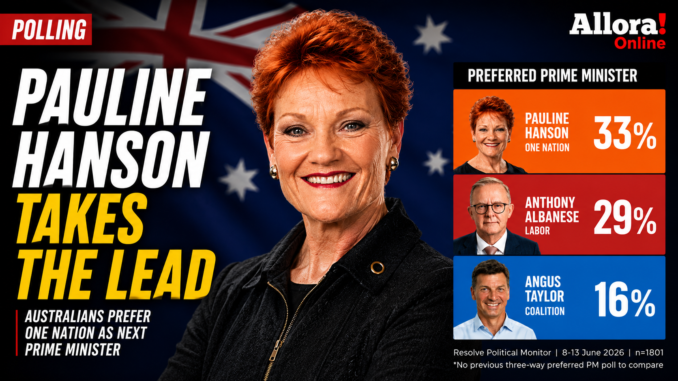
The populist leader overtakes Anthony Albanese as Australians’ preferred prime minister, highlighting growing dissatisfaction with the country’s traditional political parties.
By Emanuele Esposito
For years, she was regarded as a political outsider. Today, Pauline Hanson and her One Nation party are at the centre of Australia’s political debate.
Recent polling has shaken the country’s political landscape and tells a story that would have seemed unthinkable just a few months ago: One Nation has emerged as Australia’s most popular political force, while Pauline Hanson has overtaken Prime Minister Anthony Albanese as the nation’s preferred leader.
According to the latest Resolve Political Monitor, Hanson is preferred by 33 per cent of voters compared with Albanese’s 29 per cent. At the same time, One Nation has surged to 29 per cent in primary voting intentions, placing it ahead of both Labor and the Liberal-National Coalition.
Other polling organisations have confirmed the trend. A recent Roy Morgan survey placed One Nation at 29.5 per cent, the highest level of support recorded by the party since its foundation in 1997.
THE POLITICAL COMEBACK OF PAULINE HANSON
To understand the significance of these numbers, it is necessary to look back nearly three decades.
When Pauline Hanson first entered federal parliament in 1996, many political observers viewed her as a temporary phenomenon. Her views on immigration, national identity and globalisation generated controversy and fierce debate.
Yet Hanson survived political setbacks, changes of government, economic crises and shifting social attitudes.
Today, at the age of 72, she finds herself at the centre of one of the most remarkable political comebacks in modern Australian history.
WHY AUSTRALIANS ARE TURNING TO ONE NATION
The party’s rise reflects a combination of economic and social concerns.
The cost-of-living crisis, housing affordability pressures, inflation, stagnant wages and growing frustration with traditional political parties are pushing many voters toward alternative political movements.
Particularly notable is One Nation’s growing support among middle-aged Australians, many of whom feel squeezed by mortgage repayments, rising rents, energy costs and broader financial uncertainty.
For many voters, Hanson represents an authentic voice who speaks directly and without the carefully scripted language often associated with major political parties.
PART OF A GLOBAL POLITICAL TREND
One Nation’s rise is not occurring in isolation.
In the United States, Donald Trump built his political success on similar themes. Across Europe, nationalist and sovereignty-focused movements have gained significant electoral support.
In Australia, a growing segment of the electorate is demanding stronger action on immigration, national identity, cost-of-living pressures, security and the protection of domestic interests.
These are issues Hanson has championed for decades and which are now resonating with a much broader audience.
CAN HANSON REALLY BECOME PRIME MINISTER?
That is the question increasingly being asked across Australia.
While the polling numbers are extraordinary, Australia’s parliamentary system makes it difficult for a party with limited representation in the House of Representatives to form government on its own.
Nevertheless, the political significance of the latest surveys is undeniable.
One Nation is no longer simply a protest movement.
It is becoming a major force in Australian politics.
As Labor and the Coalition struggle to contain the loss of support, Pauline Hanson finds herself in the strongest political position of her long career.
What once seemed impossible now appears to be one of the most remarkable political stories unfolding in contemporary Australia.
Be the first to comment