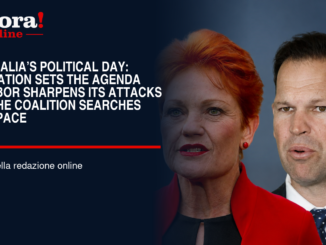
The One Nation leader uses Britain’s political crisis to attack the Australian prime minister, pointing to the $4.8 million raised through the “Fire the Liar” campaign and criticising the government over migration, debt and public spending
Pauline Hanson has called on Anthony Albanese to follow the example of British Prime Minister Keir Starmer and step down as leader of Australia.
The One Nation leader launched the attack while speaking to journalists in Canberra, only hours after Starmer announced that he would resign as prime minister of the United Kingdom.
According to Hanson, Albanese has also lost the support of the public and should allow a change of leadership.
“I’d love it, and so would the Australian people, because it’s proven,” she said when asked whether the prime minister should resign.
Hanson pointed to the success of One Nation’s “Fire the Liar” fundraising campaign as evidence of public dissatisfaction with Albanese.
“I started the Fire the Liar campaign with $4.8 million in funding from donations by Australian people. It’s clear that people don’t want Anthony Albanese as prime minister of this country any longer,” she said.
The “Fire the Liar” campaign
One Nation launched the fundraising drive to finance a major advertising campaign against the Labor government.
The money is expected to be spent on television and radio advertisements, billboards, digital campaigning and activities in electorates held by Labor MPs.
The campaign directly targets Albanese, accusing him of breaking promises on migration, the cost of living, taxation and economic management.
The response from supporters exceeded the party’s initial expectations, allowing Hanson to present the fundraising total as a sign of growing anger towards the government.
However, the success of the campaign does not by itself prove that a majority of Australians want the prime minister to resign.
The donations come from politically motivated supporters, and their wider electoral significance can only be assessed through polling and, ultimately, at the ballot box.
The comparison with Britain
Hanson linked Britain’s political crisis primarily to migration, claiming the United Kingdom was facing a “mass migration” problem that had contributed to Starmer’s downfall.
“People don’t feel they’re British anymore, they can’t fly the flag, and I see the same thing happening here in Australia,” she said.
The One Nation leader argued that Albanese should study what had happened in Britain and draw a political lesson from it.
Starmer’s resignation followed months of pressure inside the Labour Party, falling government approval ratings and a series of poor electoral results.
The British situation therefore has different political and constitutional features from Australia, where Albanese still retains the support of his party and the parliamentary majority required to govern.
Hanson nevertheless used the British case to highlight what she sees as the dangers of high migration, weakening national identity and a growing divide between governments and voters.
Attack on the Australian economy
The senator also sharply criticised Labor’s handling of the economy.
“Our economy is in the toilet, actually. I think it’s a mess,” Hanson said.
She pointed to public debt, which is expected to exceed one trillion dollars, and accused the government of losing control of spending.
“We’ve got trillion-dollar debt, government spending is out of control, so it needs to be changed,” she said.
Australia has recorded a significant increase in federal debt, while households and businesses continue to face high housing costs, inflationary pressures and elevated interest rates.
However, describing the economy as being “in the toilet” remains a political judgement.
The government argues that it has introduced measures to reduce cost-of-living pressures, support employment and improve the debt outlook compared with earlier forecasts.
One Nation says those measures are inadequate and claims Labor’s spending is continuing to fuel inflation.
Albanese remains firmly in office
In Australia, the prime minister is not directly elected by voters but remains in office while retaining the leadership of the governing party and the confidence of the House of Representatives.
There is currently no internal challenge to Albanese’s leadership comparable to the crisis that brought down Starmer in Britain.
Hanson’s demand is therefore a political attack rather than the beginning of any formal process capable of forcing the prime minister from office.
One Nation is nonetheless attempting to turn its fundraising success and rising profile into a broader national campaign against Labor and the major parties.
Hanson’s message is clear: in her view, the British experience shows that even a leader elected with a large majority can be forced to step aside after losing public and party confidence.
Albanese, for now, remains in control of the government and has rejected pressure from One Nation, presenting Labor as the stable alternative to what it describes as Hanson’s divisive and populist politics.
The political battle is likely to continue in the months ahead, with migration, public debt, the cost of living and national identity expected to remain at the centre of the debate.