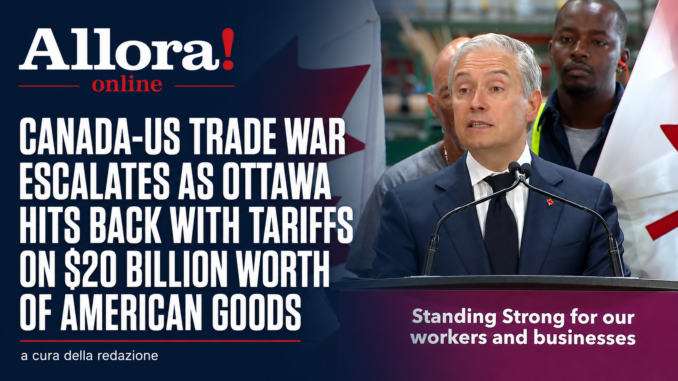
Canada has announced retaliatory tariffs on more than 700 US-made products worth about $20 billion after the Trump administration imposed 50% tariffs on a wide range of Canadian goods. Ottawa says the new measures, which will take effect on September 8, are designed to match Washington “dollar for dollar, rate for rate.”
The trade relationship between two of the world’s most closely integrated economies has entered a new and far more confrontational phase.
Canada’s response follows the collapse of trade negotiations and the Trump administration’s decision to impose 50% tariffs on Canadian imports. Prime Minister Mark Carney has accused Washington of trying to subordinate Canada economically and of advancing demands that could damage major Canadian industries. President Donald Trump, meanwhile, has told Canadian leaders to “fall in line.”
More than 700 US products targeted
Canada’s counter-tariffs will apply to a wide range of American goods, including steel and aluminium products, dairy, seafood, household appliances, farm equipment, cosmetics, clothing, smartphones and video game consoles.
Rates will vary between 15%, 25% and 50%, depending on the tariff imposed by the United States on the equivalent Canadian product.
Ottawa says the purpose is not primarily to raise revenue, but to protect Canadian businesses and reduce reliance on US imports.
“We did not choose this conflict”
Finance Minister François-Philippe Champagne said Canada had no choice but to respond once economic integration began being used as a political weapon.
He said Canada would not accept restrictions on its ability to choose its own trading partners and described the country’s economic sovereignty as “non-negotiable.”
$7.5 billion support package
The Canadian government has acknowledged that retaliatory tariffs will also raise costs for some domestic businesses and consumers.
Ottawa has therefore announced a C$7.5 billion support package for workers and companies affected by the dispute.
The government says it has already provided more than C$30 billion in tariff-related support since 2025 as it attempts to cushion the economic impact.
Jobs Minister Patty Hajdu warned that uncertainty itself can damage the economy, causing families and businesses to delay investments, home purchases, expansion plans and other major decisions.
Autos, manufacturing and energy face major risks
Canada and the United States have deeply integrated supply chains in automotive manufacturing, agriculture, energy and heavy industry.
That means a prolonged tariff war could inflict damage on both sides of the border.
Canada is a major customer for US-made vehicles, while American factories depend heavily on Canadian components, raw materials and energy supplies.
The dispute is already creating political pressure in US border states, where some Republican lawmakers have publicly criticised the escalation.
French language protections enter the dispute
The trade confrontation has also taken on a cultural dimension.
Carney says US negotiators raised Canada’s rules promoting French-language content on streaming platforms and bilingual labelling as trade irritants.
The Prime Minister rejected the idea that such protections could be bargained away, saying French language and Quebec culture are fundamental rights rather than trade concessions.
Trump has denied trying to interfere with Canadians’ right to speak French and accused Carney of inventing the dispute for political advantage.
A historic relationship under strain
For decades, Canada and the United States built one of the world’s closest economic partnerships, with goods and components often crossing the border multiple times before becoming finished products.
Turning that relationship into a tariff war therefore risks hurting not only the other country, but also domestic businesses, workers and consumers.
Ottawa has decided diplomacy alone is no longer enough. Washington continues to use tariffs as leverage. The danger now is that what began as a trade dispute could become a much deeper economic and political rupture.