
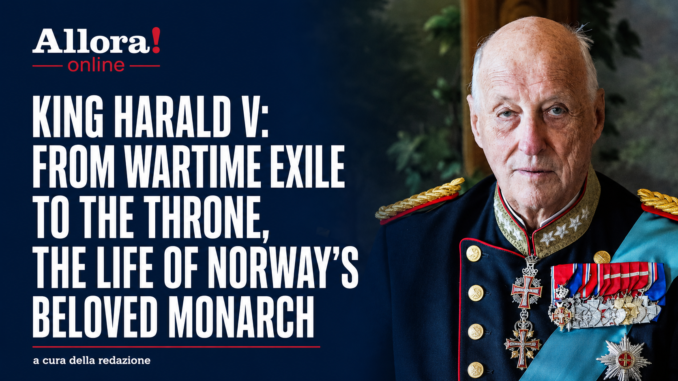
King Harald V of Norway has died at the age of 89, bringing to an end a reign that lasted more than 35 years and a life closely intertwined with the modern history of his country. Born before the Second World War, forced into exile as a child, an Olympic sailor, a Crown Prince who fought to marry the woman he loved and later a monarch who helped modernise Norway’s royal institution, Harald became one of the country’s most recognisable symbols of continuity and national unity.
Harald was born on February 21, 1937, at Skaugum in Asker, the son of Crown Prince Olav and Crown Princess Märtha.
His birth carried particular constitutional significance. He was the first Norwegian-born prince in 567 years and, under the succession rules then in force, his arrival secured the continuation of the royal line.
A childhood shaped by war
Harald’s early childhood was abruptly interrupted on April 9, 1940, when Nazi Germany invaded Norway.
As the royal family and government fled Oslo, Crown Princess Märtha escaped with Harald and his sisters, Ragnhild and Astrid, first to Sweden and later to the United States at the invitation of President Franklin D. Roosevelt.
The young prince spent much of the war in America before returning to Norway in June 1945, after Germany’s defeat.
He was eight years old when he came home.
That experience of exile became part of the story of a royal family whose identity was deeply connected to Norway’s resistance and independence.
Education, military service and Oxford
Harald attended ordinary schools in Oslo before completing military training at the Norwegian Military Academy in 1959.
He later studied social science, history and economics at Balliol College, Oxford, from 1960 to 1962.
When his grandfather King Haakon VII died in 1957, Harald became Crown Prince and gradually assumed a larger role alongside his father, King Olav V.
The Crown Prince who married for love
One of the defining episodes of Harald’s life came before he became king.
He had fallen in love with Sonja Haraldsen, a commoner from Oslo, at a time when a future king was still widely expected to marry into European royalty or nobility.
Their relationship lasted for nine years before King Olav finally gave his approval.
The decision was controversial enough that some predicted it could damage the monarchy.
Instead, Harald and Sonja married at Oslo Cathedral on August 29, 1968, and the marriage became one of the most enduring partnerships in European royal life.
They had two children: Princess Märtha Louise, born in 1971, and Haakon, born in 1973.
Becoming King
Harald became king on January 17, 1991, following the death of his father, King Olav V.
Four days later, he swore his oath to uphold Norway’s Constitution before the Storting.
Like his father and grandfather, he adopted the royal motto:
“Alt for Norge” — “We give our all for Norway.”
His constitutional powers were limited by Norway’s parliamentary democracy, but his symbolic role was considerable.
He opened parliament, formally presided over the Council of State, received ambassadors, represented Norway abroad and became a familiar presence during both national celebrations and moments of tragedy.
A King during Norway’s darkest moments
Perhaps one of Harald’s most important roles came after the July 22, 2011 terrorist attacks, when 77 people were killed in Oslo and on the island of Utøya.
The Royal Court later described his role during national tragedies as one of expressing the collective grief of the country.
His appearances and words following the attacks helped reinforce the monarchy’s position not simply as an institution of ceremony, but as a national point of reference during moments of profound shock.
A modern monarch
Harald inherited a monarchy rooted in tradition but ruled over a society undergoing rapid social change.
Over the decades, he helped adapt the institution to a more modern Norway.
His reign coincided with changing attitudes towards family, identity, immigration, equality and social inclusion.
Reuters described him as a reform-minded head of state who gradually stepped out of the shadow of his extremely popular father and developed his own relationship with the Norwegian public.
The sportsman King
Away from official duties, Harald had a lifelong passion for sport and nature.
He represented Norway in sailing at several Olympic Games and carried the Norwegian flag at the opening ceremony of the 1964 Tokyo Olympics.
His competitive career continued for decades.
In 1987, Harald and his crew became world champions aboard Fram X, and in 2005 they won a European title aboard Fram XV. He continued competing in regattas until announcing the end of his competitive sailing career in 2022.
He was also closely involved with environmental causes and helped establish the Norwegian branch of the World Wide Fund for Nature, serving as its president for 20 years.
Health struggles in later life
In his final years, Harald faced increasingly serious health problems but repeatedly resisted suggestions that he might abdicate.
Even as several European monarchs stepped aside, he maintained that his role was a lifelong responsibility.
In August 2026, he was hospitalised and his condition deteriorated after a serious bacterial blood infection. The Royal Court later announced his death at the age of 89.
The end of an era
Harald’s life stretched from the Second World War to the age of artificial intelligence.
He experienced exile as a child, watched Norway emerge as one of Europe’s wealthiest and most stable democracies, represented his country on the Olympic stage and spent more than three decades as its king.
His story was also unexpectedly personal for a monarch: the prince who insisted on marrying a commoner, the sailor who continued racing into old age, and the king who tried to keep an ancient institution connected to a modern society.
With his death, his son Haakon succeeds to the throne.
Norway now enters a new royal era.
But Harald’s place in its history is already established.
He was born into a monarchy still marked by war and exile, and leaves behind one that survived by learning how to change with the country it represented.
META DESCRIPTION
King Harald V of Norway has died aged 89. From wartime exile and Olympic sailing to his marriage to Queen Sonja and more than 35 years on the throne, this is the story of his life.