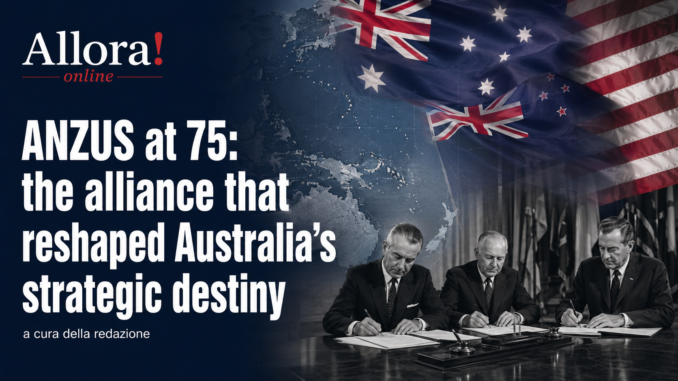
On September 1, 1951, Australia, New Zealand and the United States signed the ANZUS Treaty in San Francisco. Seventy-five years later, the agreement remains one of the foundations of Australian foreign and defence policy — and one of the most consequential strategic choices Canberra has ever made.
On September 1, 1951, Australia, New Zealand and the United States signed an agreement that would profoundly reshape the strategic architecture of the Pacific.
The treaty became known simply as ANZUS, from the names of its three signatories: Australia, New Zealand and the United States.
But behind those few letters was something much larger.
For Australia, the agreement represented a decisive strategic shift: national security would no longer depend primarily on the traditional relationship with Britain. Canberra was establishing a direct and structured security partnership with Washington.
A world transformed by war
The treaty was signed only six years after the end of the Second World War.
Australia still carried vivid memories of the Japanese advance through the Pacific, the fall of Singapore and the bombing of Darwin.
At the same time, a new global confrontation was emerging.
The Soviet Union had become a nuclear power, the People’s Republic of China had been established in 1949 and the Korean War, which began in 1950, demonstrated that Asia would become one of the central theatres of the Cold War.
For Australian policymakers, the strategic conclusion was increasingly clear: Britain could no longer provide the security guarantees Australia had traditionally relied upon.
A closer relationship with the United States was becoming essential.
Percy Spender and the push for an American guarantee
One of the key architects of ANZUS was Australian diplomat and politician Percy Spender, who strongly pressed Washington to accept a formal Pacific security arrangement.
Japan was central to the negotiations.
The United States wanted to normalise relations with Tokyo and bring Japan back into the international community. Australia and New Zealand, still deeply affected by the war, wanted stronger security guarantees before accepting that process.
ANZUS emerged in part from that strategic compromise.
What the treaty actually says
The agreement established that an armed attack in the Pacific against one of the parties would be regarded as a threat to the peace and security of the others.
But there is an important distinction.
ANZUS does not create an automatic requirement for every member to immediately enter a war.
Each country is expected to respond in accordance with its own constitutional processes.
That distinction remains crucial when discussing what the alliance would mean in a future regional crisis.
The treaty formally entered into force on April 29, 1952.
From that moment, the alliance with the United States became a permanent feature of Australian foreign policy.
From Korea and Vietnam to the Cold War
Over the following decades, the broader Australia-US strategic relationship developed through the Korean War, the Vietnam War and the long confrontation between the Western alliance and the Soviet bloc.
The original three-way structure of ANZUS, however, was eventually disrupted.
In the 1980s, New Zealand’s anti-nuclear policy created a major dispute with Washington, particularly over visits by US nuclear-powered or potentially nuclear-armed vessels.
The United States subsequently suspended its treaty obligations toward New Zealand.
ANZUS remained in existence, but its practical centre of gravity increasingly shifted toward the bilateral Australia-US alliance.
September 11 changes ANZUS history
For almost half a century, ANZUS had never been formally invoked by Australia.
That changed after the September 11, 2001 terrorist attacks against the United States.
The government of Prime Minister John Howard formally invoked the treaty, declaring that the attacks fell within the scope of ANZUS.
It was a moment of enormous symbolic significance.
Fifty years after the treaty had been signed, Australia was affirming that its strategic commitment to the United States was not merely historical or ceremonial.
Intelligence, defence and military cooperation
In the years since, cooperation between Australia and the United States has grown substantially.
Defence planning, intelligence sharing, military technology, joint exercises and the rotational presence of US forces in Australia have all become central elements of the relationship.
ANZUS is also no longer the only framework shaping Australian strategy.
New structures have emerged around it.
The Quad, bringing together Australia, the United States, India and Japan, reflects the growing strategic importance of the Indo-Pacific.
Then came AUKUS, the security partnership between Australia, the United Kingdom and the United States.
Under AUKUS, Australia plans to acquire conventionally armed, nuclear-powered submarines and deepen cooperation in advanced defence technologies.
It represents perhaps the clearest modern extension of the strategic decision Australia made in 1951.
From the Soviet Union to China
The strategic environment, however, has changed dramatically.
In 1951, the dominant concerns were the Soviet Union, communist expansion and uncertainty over the future of Asia after the Second World War.
Today, much of the strategic debate is centred on China’s rise and the balance of power in the Indo-Pacific.
That gives the 75th anniversary of ANZUS particular significance.
The question is no longer simply whether the US alliance helped protect Australia during the Cold War.
The question is how closely Australia should continue to bind its strategic future to Washington in a far more complex and unpredictable international environment.
Security or strategic dependence?
Supporters of the alliance argue that Australia would have far less military, technological and intelligence capacity without the United States.
From intelligence sharing to advanced weapons systems and deterrence, Washington provides capabilities Australia could not easily reproduce alone.
Critics and strategic sceptics raise a different concern.
They argue that Canberra should maintain greater strategic autonomy, particularly when Australian and American interests may not always be identical.
That debate is likely to intensify as competition in the Indo-Pacific grows.
Seventy-five years later, the choice still matters
One historical fact, however, is difficult to dispute.
On September 1, 1951, Australia made one of the most important geopolitical decisions in its modern history.
It chose the United States as its principal strategic partner in the Pacific.
Seventy-five years later, as the centre of global political and economic power shifts increasingly toward the Indo-Pacific, that decision continues to shape Canberra’s defence planning, diplomacy and international identity.
ANZUS is therefore not simply a treaty from Australia’s past.
It remains a fundamental part of the country’s strategic present.
And, barring a profound change in the regional order, it is likely to remain central to Australia’s future as well.