
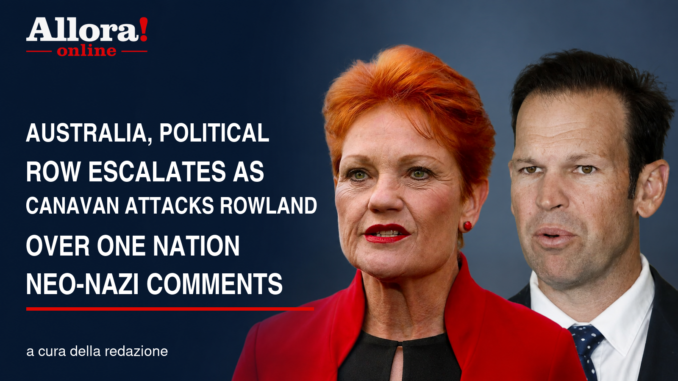
Tensions in Australian politics have intensified following One Nation’s breakthrough victory in the Secret Harbour by-election. Nationals leader Matt Canavan has accused Attorney-General Michelle Rowland of crossing the line with comments linking One Nation to extremist and neo-Nazi figures. Canavan says the government should lower the temperature of the debate, while Labor insists its concerns about the party are legitimate.
The political fight surrounding One Nation is widening.
After Prime Minister Anthony Albanese described Pauline Hanson’s party as “dangerous” and “divisive”, Attorney-General Michelle Rowland went further, accusing One Nation of giving a platform to extremist figures and referring to claims that the party had been infiltrated by extremists and neo-Nazis.
Those remarks triggered a sharp response from Matt Canavan.
Canavan: “Absolutely disgraceful”
The Nationals leader described Rowland’s comments as “absolutely disgraceful” and argued that, given her role as the nation’s first law officer, she should be more careful with her language.
Canavan said Rowland needed to “look at herself” and called on the Prime Minister to condemn the remarks.
He also linked the controversy to Pauline Hanson’s security concerns, noting that she has reported an increase in threats and has sought additional protection.
Canavan’s argument is that robust political criticism is legitimate, but rhetoric that could be interpreted as legitimising hostility or violence crosses a different line.
Albanese had already targeted One Nation
The controversy began after One Nation’s victory in the Secret Harbour by-election in Western Australia.
Albanese described the party as “dangerous” and said Labor had a duty to defeat it politically.
Hanson responded by accusing the Prime Minister of escalating political tensions and argued that calling her party a “threat to our country” could encourage hostility towards One Nation supporters.
Canavan said Albanese had also “misstepped” in the way he responded to Labor’s loss in what had previously been a strong seat.
Rowland stands by her position
Rowland has defended her comments.
Speaking to the ABC, she argued that Hanson should reflect on the standards accepted within her own party and on the people One Nation has chosen to engage with.
She referred to individuals with criminal records and extremist associations, arguing that these links are legitimate matters for public scrutiny.
The distinction remains important, however: criticism of individuals associated with a party is not the same as establishing that the party itself is an extremist or neo-Nazi organisation.
Debate shifts to political language
The dispute is increasingly becoming a wider argument about the tone of Australian politics.
Canavan said politicians should expect scrutiny, criticism and intense debate, but warned there must be a clear line between political attack and rhetoric that may inflame already heightened tensions.
Hanson has made a similar argument, saying Labor’s language risks fuelling hostility against her and her supporters.
One Nation continues to rise
The timing of the dispute is significant because One Nation continues to gain support.
According to the latest News24.com.au Pulse / YouGov poll cited by the outlet, Labor is on 29 per cent of the primary vote, One Nation on 26 per cent and the Coalition on 21 per cent.
If reflected in broader polling, those numbers would represent a major shift in Australian politics.
That means the fight over Hanson is no longer just about rhetoric.
It is also about how Labor, the Coalition and the Nationals respond to a more volatile electorate and to a party that is increasingly challenging the traditional two-bloc system.



Be the first to comment