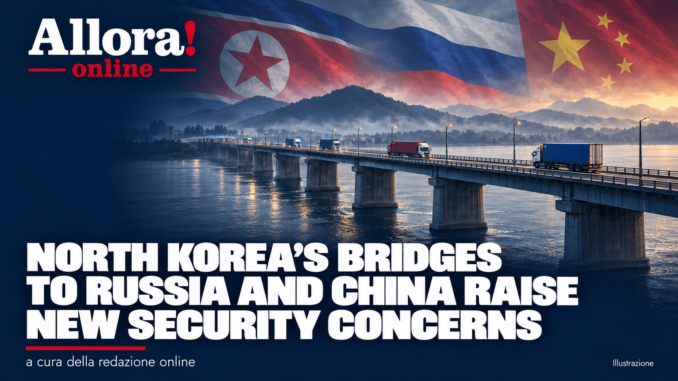
A new road link with Russia and a long-delayed crossing into China could expand trade and strengthen Pyongyang’s partnerships, while raising questions about military cooperation and regional stability.
By the online editorial team
North Korea is strengthening its connections with its two most important partners, opening its first dedicated road bridge with Russia while preparing a major new crossing into China for regular traffic.
The projects could give Pyongyang greater access to goods, investment and political support after years of severe border restrictions. Analysts also warn that improved transport links could facilitate military cooperation, with consequences extending from the war in Ukraine to security in East Asia.
The Russian crossing opened on September 7 over the Tumen River. The one-kilometre, two-lane bridge can accommodate up to 300 vehicles a day, according to Russian officials, and connects with Russia’s wider road network.
Cargo trucks have already begun using the route. Previously, road vehicles could cross the border only through special arrangements involving the nearby railway bridge.
Russian Prime Minister Mikhail Mishustin presented the opening as a milestone in economic, scientific and cultural cooperation. For La Trobe University international relations professor Nick Bisley, the infrastructure also demonstrates growing confidence in the relationship between Moscow and Pyongyang.
That partnership has deepened during Russia’s war against Ukraine, with North Korea supplying weapons and troops. A permanent road connection gives the two countries another transport option alongside maritime and rail routes.
University of Sydney international relations professor Justin Hastings said the bridge could make it easier to move certain weapons by truck where that method is practical. It could also improve commercial trade, although Russia’s economic offering remains more limited than China’s.
Bisley argues that the potential benefits flowing back to North Korea deserve particular attention. Access to Russian expertise could help Pyongyang develop more sophisticated military capabilities, including improvements to its missile arsenal.
“I actually think it’s a bigger concern for Asia than it is for Ukraine,” he said, highlighting the possible effect of Russian support on the regional balance of power.
The Chinese crossing has a different immediate emphasis. The New Yalu River Bridge links Dandong with Sinuiju and is intended to expand the capacity of a vital trading route.
Construction began in 2011 and the bridge itself was completed in 2014, but delays to connecting infrastructure on the North Korean side prevented its official opening.
Satellite analysis published on September 28 indicates that the customs facilities now appear complete. Vehicles and containers have been observed around the crossing, suggesting preparations for operation, but substantial trade activity has not yet been identified. The existing Sino-Korean Friendship Bridge remains in use.
China is North Korea’s largest trading partner. A crossing with larger customs yards and cargo facilities could support increased commerce and ease pressure on the older route.
Yet the relationship remains complicated. Bisley said Beijing views North Korea as both a strategic asset and a difficult partner, whose behaviour does not always align with Chinese interests.
For Pyongyang, closer ties with Russia provide another source of support. Hastings sees echoes of the Cold War, when North Korea sought advantages from its relationships with both China and the Soviet Union.
The bridges therefore point to a selective reopening centred on trusted partners. Their strategic significance will depend on the goods, people and technology moving across them — and on whether stronger economic connections also accelerate military cooperation.