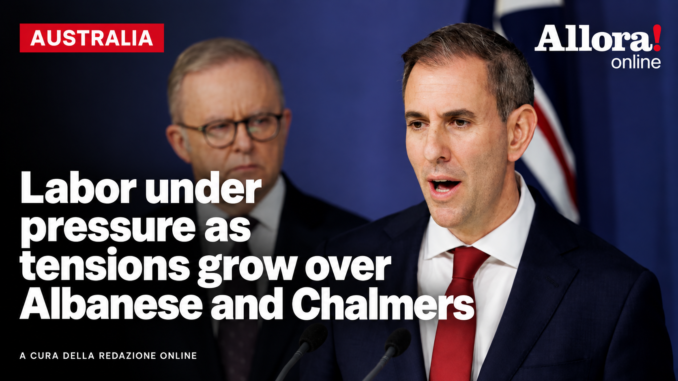
Labor MPs are reportedly becoming increasingly concerned about the cost-of-living crisis and the party’s weakening support, with Treasurer Jim Chalmers coming under pressure as One Nation gains ground.
Prime Minister Anthony Albanese is facing growing political pressure within Labor as concerns mount over the cost of living, inflation, interest rates and the rise of One Nation.
According to reports citing Labor sources, some federal backbenchers fear they could lose their seats at the next election unless the government changes direction and improves its response to the economic pressures facing Australian households.
Treasurer Jim Chalmers has also become a focus of internal criticism, with some within Labor reportedly questioning both the government’s economic management and the way its policies are being communicated to voters.
There is currently no formal leadership challenge against Albanese and no confirmed move to remove Chalmers as Treasurer. The reports instead point to growing internal anxiety as economic issues become increasingly important to voters.
COST OF LIVING BECOMES THE CENTRAL POLITICAL PROBLEM
The cost-of-living crisis remains one of the government’s most difficult challenges.
Australian families and small businesses continue to face high prices, expensive mortgages and renewed pressure from interest rates.
The Reserve Bank’s recent decision to lift rates again has increased political pressure on the federal government, while inflation remains a major concern.
Labor has defended its economic record and argues that its policies are designed to provide household relief without putting additional upward pressure on inflation.
However, some Labor MPs reportedly fear that voters are not feeling enough improvement in their everyday finances.
CHALMERS UNDER PRESSURE
The debate surrounding Jim Chalmers goes beyond individual economic decisions.
Reports suggest some Labor MPs are concerned about the government’s broader economic message and its ability to explain inflation, public spending and interest rates to voters.
Albanese is reportedly aware of the political risks created by the cost-of-living crisis.
Removing the Treasurer, however, would be a major political decision and could be interpreted as an admission that the government’s economic strategy had failed.
It could also trigger further instability inside Labor.
That makes any change particularly difficult for the Prime Minister.
ONE NATION’S RISE ADDS TO LABOR’S PROBLEMS
Another major concern is the growing support for One Nation.
Pauline Hanson’s party has increasingly focused on migration, housing affordability, pressure on public services and household finances.
These issues are resonating with sections of the electorate that have traditionally supported the major parties.
Labor is particularly concerned about working-class seats, regional communities and outer-suburban electorates where economic pressure is being felt most strongly.
One Nation’s growth has therefore become more than a national polling issue. It is increasingly influencing political calculations inside both federal and state Labor.
NSW LABOR ALSO WATCHING CLOSELY
The federal political situation is also creating concerns in New South Wales.
NSW Premier Chris Minns faces a state election in March 2027 and has already described One Nation as a “genuine threat” to Labor.
Minns has also recently called for governments to exercise greater spending restraint while inflation remains elevated.
He has separately placed pressure on Canberra over migration, stressing that population settings remain primarily a federal responsibility.
Within NSW Labor, there is concern that political problems associated with the Albanese government could damage Minns and the state government ahead of the election.
The NSW Right faction, to which Minns belongs, is reportedly particularly sensitive to that risk.
ALBANESE FACES A DIFFICULT POLITICAL BALANCE
For Anthony Albanese, the challenge is now both economic and political.
The government needs to convince Australians that it can ease cost-of-living pressures while maintaining unity inside the Labor Party.
Replacing the Treasurer could create instability and raise questions about the government’s economic record.
Keeping Chalmers in the position means Albanese and the Treasurer continue to share responsibility for the government’s economic strategy.
For the moment, the situation appears to be one of growing internal pressure rather than an organised leadership challenge.
MIGRATION AND HOUSING ADD TO THE PRESSURE
Migration is another issue creating political difficulties for Labor.
The Coalition and One Nation have proposed major reductions in migration, while the federal government is seeking to gradually bring net overseas migration down.
The debate is closely linked to housing.
High rents, limited housing supply and rapid population growth have led many Australians to question whether infrastructure and housing construction are keeping pace with population increases.
One Nation has made this connection a central part of its political message.
For Labor, that means the government must address both economic pressures and growing public concern about migration and housing.
A CRITICAL PERIOD FOR LABOR
Anthony Albanese remains Prime Minister and Labor leader, while Jim Chalmers remains Treasurer.
But the reports of internal concern show how quickly the political environment is changing.
The central question for Labor is no longer simply whether economic indicators improve, but whether voters begin to feel that improvement in their household budgets.
With One Nation gaining support, the Coalition increasing pressure on migration and cost-of-living issues, and the NSW election approaching, economic management, leadership and electoral support are becoming increasingly difficult for Labor to separate.